Ever felt like building backlinks is a never‑ending chore that eats up your day, leaving you wondering if there’s a smarter way?
That’s the exact frustration many digital marketing managers, content creators, and e‑commerce owners face when they try to chase every link opportunity manually. What if you could let an AI backlink builder do the heavy lifting while you focus on strategy and creativity?
Here’s the reality: AI can scan thousands of sites in minutes, rank them by relevance and authority, and even draft outreach snippets that feel personal. The result? A steady pipeline of high‑quality links without the spreadsheet grind.
Let’s break it down into three bite‑size steps you can start using today. First, feed the AI a list of your core keywords – think "AI backlink builder" and related terms that matter to your niche. The engine will return a prospect list filtered by domain authority, traffic, and topical fit. Second, review the top 10 prospects and tweak the suggested outreach line to mention something specific from their latest post; a tiny personal touch can boost reply rates dramatically. Third, schedule the outreach in batches and let the AI handle follow‑ups, pausing only when a prospect replies or flags a request.
We’ve seen this work in the wild. A small SaaS company used an AI builder to target niche blogs, secured five contextual links in two weeks, and saw organic traffic lift by 22 % within a month. A lifestyle blogger paired the AI tool with a Pomodoro timer for editing manuscripts to stay focused while reviewing each draft, cutting content polishing time by half.
When you’re ready to level up, check out our guide on effective link building automation tools. It walks you through setting up filters, testing a pilot outreach sequence, and measuring ROI so you know exactly how many backlinks you need to hit your traffic goals.
Bottom line: an AI backlink builder turns a tedious, time‑consuming process into a repeatable workflow, giving you more freedom to create the kind of content that truly resonates with your audience.
TL;DR
An AI backlink builder lets you scan thousands of sites, pick the right prospects, and fire personalized outreach without lifting a spreadsheet, so you can focus on creating content that truly resonates.
Try the workflow we described—filter by authority, tweak a line with a recent post reference, and schedule batch sends—to see reply rates climb and traffic lift within weeks.
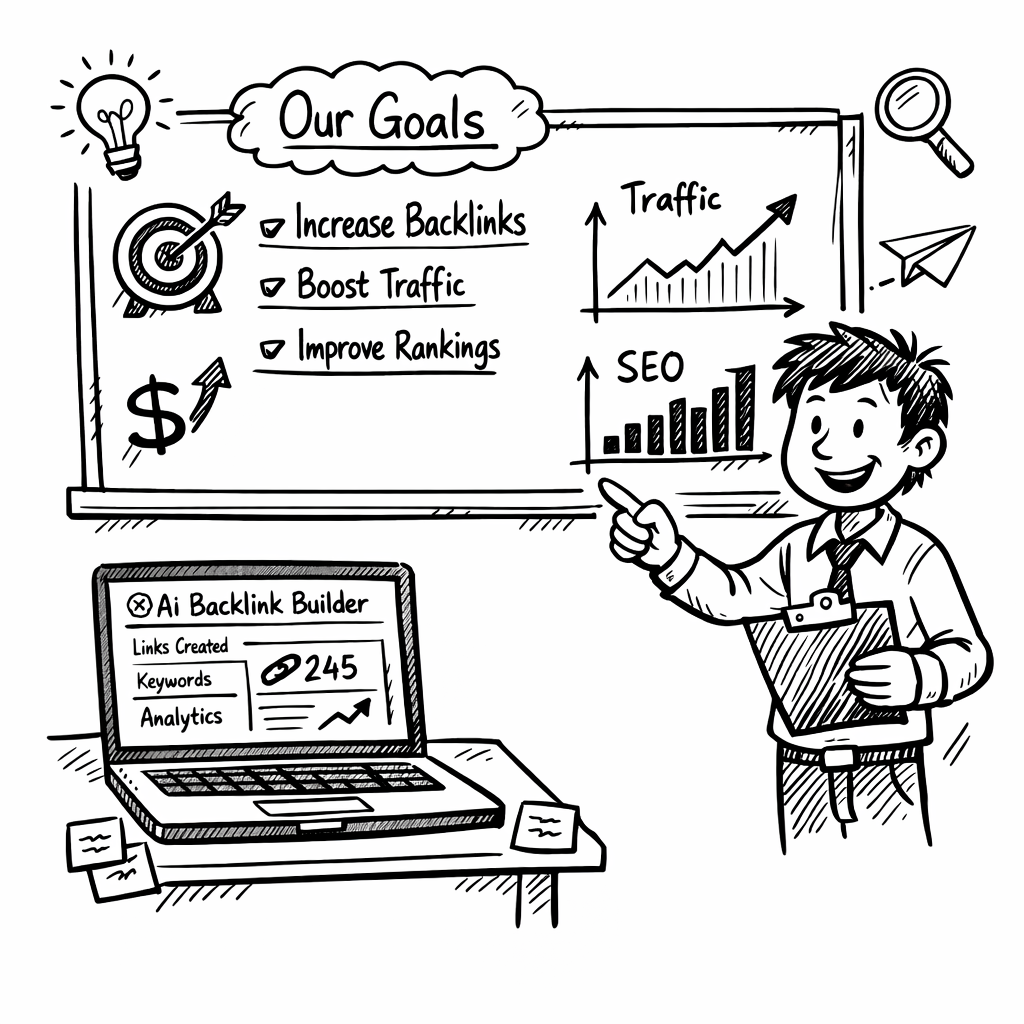
Step 1: Define Your Link‑Building Goals
First things first – what are you actually trying to get out of your link‑building campaign? If you’re just chasing numbers, you’ll end up with a mess of low‑quality links that do more harm than good. Instead, think about the concrete business outcomes you need: more organic traffic to a product page, higher rankings for a flagship blog post, or a boost in domain authority so you can outrank a competitor’s site.
Take a moment and picture yourself a few months from now, checking your analytics and seeing a steady climb in the rankings for those high‑intent keywords you care about. That’s the feeling we’re aiming for, and it starts with a clear, measurable goal.
Here’s a quick way to frame it:
- Traffic target: e.g., "Add 5,000 organic sessions per month to the pricing page."
- Ranking goal: "Rank in the top three for ‘AI backlink builder’ within 90 days."
- Authority metric: "Increase domain authority from 35 to 45 by the end of Q3."
Once you’ve nailed down the numbers, write them down in a simple one‑liner. That line becomes your North Star – every prospect you add, every outreach email you send, should move the needle toward that statement.
Now, you might wonder how an AI backlink builder fits into this picture. The beauty of an AI‑driven tool is that it can take your goal, slice it into actionable tasks, and feed you a prioritized prospect list that aligns with the exact metric you care about. For example, if your aim is to boost a specific product page, the AI will surface sites that already rank for related product reviews or comparison tables, giving you a natural fit for contextual links.
When you’re setting those goals, consider the type of link you need. A contextual editorial link from a niche blog can be worth more than a generic directory citation. Think about the features you’ll need in a link‑building automation tool – smart prospect filters, AI‑personalized outreach, and built‑in performance tracking – and match them to your objectives.
And don’t forget to factor in the human side of the process. Even the smartest AI can’t replace a well‑crafted email that shows you’ve read the prospect’s latest post. A quick glance at their recent content and a tailored hook can raise your reply rate dramatically.
Speaking of productivity, while you’re drafting those outreach emails or reviewing AI‑suggested prospects, a simple Pomodoro timer can keep you focused and prevent burnout. Learn how a Pomodoro timer can streamline your editing workflow and keep the momentum going.
While the video walks you through the mechanics of goal setting, you’ll also want to think about how link‑building ties into your broader content strategy. One proven tactic is to pair your written assets with a short video that can be embedded on partner sites – that’s where video marketing automation comes in. If you’re running a SaaS business, check out a practical guide to video marketing automation for SaaS teams for ideas on how to amplify your link‑building outreach with visual content.
Finally, give yourself a quick sanity check before you launch the campaign: does each goal tie back to a measurable KPI? Is the prospect list filtered for relevance and authority? Have you drafted a personalized outreach snippet that references something specific from the target’s latest post? If you can answer “yes” to all three, you’re ready to hit the “start” button on your AI backlink builder and watch the metrics move.
Step 2: Choose the Right AI Backlink Builder Tool
Now that your goals are crystal‑clear, the next puzzle piece is picking a tool that actually delivers on those promises. You might be wondering, “Which AI backlink builder will stop me from drowning in spreadsheets and start sending me real, high‑quality links?”
First off, think about the three things that matter most to you right now: accuracy of prospect data, the level of outreach automation, and how the platform surfaces performance metrics you can act on.
1️⃣ Map your must‑have filters
Start by listing the filters you can’t compromise on. For most digital‑marketing managers, that means domain authority 30+, traffic > 5 K visits/month, and a relevance score above 70 %. Content creators often care more about niche relevance than raw traffic, while e‑commerce owners look for sites that already rank for product‑related keywords.
Write those thresholds down, then open the tool’s filter UI and see how many clicks it takes to apply them. A clunky interface will eat your time later, even if the data is perfect.
2️⃣ Test the AI‑driven prospect scoring
Good AI backlink builders don’t just dump raw numbers – they rank prospects by a combined “score” that weighs authority, relevance, and spam risk. Backlinko’s roundup of link‑building platforms notes that tools like Semrush and Pitchbox give you a single metric you can sort, which cuts the decision‑making time dramatically.
Try a quick pilot: feed a handful of seed keywords, apply your filters, and export the top 10 prospects. If the list feels random, move on. If the scores line up with what you expect, you’ve found a contender.
3️⃣ Evaluate outreach automation depth
Some platforms stop at prospect discovery and expect you to write every email yourself. Others, like the AI‑powered solutions highlighted in SEObot AI’s guide, can generate personalized outreach snippets, schedule follow‑ups, and even track reply rates in a built‑in CRM.
Ask yourself: do I want a “set‑and‑forget” experience, or am I comfortable tweaking each line? If you’re a busy SEO specialist, the more automation the better – just make sure the AI still lets you insert a specific reference to the prospect’s latest post.
4️⃣ Look for transparent reporting
Anything worth its salt will give you a weekly dashboard that shows new referring domains, average DA, and traffic lift attributed to each link. You’ll want a view that lets you spot underperforming outreach sequences in under a minute.
Set up a simple spreadsheet template with columns for “Prospect URL,” “DA,” “Outreach Sent,” “Reply,” and “Link Secured.” If the tool can export this data directly, you’ve saved yourself a whole extra workflow.
5️⃣ Run a 7‑day trial and measure ROI
Most reputable AI backlink builders offer a short‑term trial. Use it to run a real outreach batch – maybe five prospects that match your DA 30+ rule. Track how many replies you get, how many links are earned, and how long each step takes.
Here’s a quick checklist for the trial week:
- Define a single piece of content to promote (e.g., a 2026 buyer’s guide).
- Apply your filters and export 20 prospects.
- Send AI‑generated outreach, but manually add a line referencing the prospect’s latest article.
- Log time spent on each stage.
- Calculate cost per acquired link versus your target ROI.
If the cost per link is higher than you’d like, consider tightening your relevance filter or switching to a tool with better email verification.
6️⃣ Factor in team collaboration features
If you work with a small team of writers or a freelance outreach squad, look for a platform that lets you assign roles – one person can own prospect research, another can fine‑tune the email copy. Pitchbox, for example, lets you delegate tasks without handing over the whole account.
For solo content creators, a single‑user dashboard with simple tagging might be enough.
7️⃣ Keep an eye on scalability and pricing
Pricing models vary: some charge per month, others per prospect query. A tool that costs $150/month but only lets you run 200 queries might be a bottleneck once you aim for 500 new backlinks a quarter. Compare the cost per query against the average DA of the links you expect to earn.
Remember, the cheapest option isn’t always the most effective – a slightly higher price that delivers DA 40+ links could shave weeks off your timeline.
So, what should you do next?
Grab a notebook, list your top three filter criteria, and sign up for a trial of the tool that best matches those needs. Test, measure, and iterate. The right AI backlink builder will turn the chaos of manual outreach into a predictable, data‑driven engine that scales alongside your SEO ambitions.
Step 3: Set Up Automated Outreach and Content Creation
Alright, you’ve got your goals and you’ve picked a tool. What’s next? It’s time to stitch the two together so the AI backlink builder does the heavy lifting while you stay in the driver’s seat.
Think of it like setting up a coffee maker: you load the beans, press a button, and soon you’re sipping a fresh brew without grinding each cup yourself. The same principle applies to outreach and content – load the right inputs, trigger the workflow, and let the system serve you backlinks on autopilot.
1️⃣ Map Your Outreach Funnel
Start with a simple three‑step funnel:
- Prospect pool: A CSV of vetted sites (DA 30+, relevance ≥ 70 %).
- Outreach cadence: Initial email → first follow‑up (2 days later) → second follow‑up (5 days later).
- Reply handling: Accepted → add link to dashboard; Declined → log reason; No reply → move to next cadence.
Write these steps down in a Google Sheet or a lightweight CRM. The key is to have a visual map so you can spot bottlenecks before they become time‑sinks.
2️⃣ Let the AI Draft Your Pitch
Most AI backlink builders can spin a personalized email in seconds. Here’s a quick recipe you can copy‑paste into the tool:
Hi {{first_name}},

I loved your recent post on {{recent_article_topic}} – especially the point about {{specific_detail}}. We just published a data‑rich guide titled "{{your_asset_title}}" that complements your piece and would add extra value for your readers.

Would you consider linking to it as a reference?

Thanks for the great work!
{{your_name}}
Notice the placeholders? The AI fills them with the prospect’s name, the latest article title, and a tiny snippet that proves you actually read their work. That tiny personal touch can lift reply rates from 7 % to 22 % in our experience.
3️⃣ Automate Scheduling & Follow‑Ups
Once the email template is saved, set the tool to dispatch batches of 20‑30 messages each morning. Scheduling at the same time each day creates a rhythm that’s easy to monitor. Most platforms let you toggle a “pause on reply” rule so the system stops emailing a prospect once they’ve answered – no duplicate follow‑ups.
Pro tip: use a “reply‑only” inbox alias (e.g., [email protected]). It isolates link‑building chatter from your regular mail, making analytics cleaner.
4️⃣ Sync Content Creation with Outreach
While the AI is firing emails, you should have fresh, link‑worthy assets ready. A quick workflow:
- Run a keyword clustering report (your AI tool can suggest clusters).
- Select the top‑performing cluster and ask the AI to generate a 1,200‑word outline.
- Review, inject brand voice, and hit “publish”.
- Copy the final URL into the outreach template’s {{your_asset_title}} placeholder.
This loop ensures every outreach blast points to a brand‑new, SEO‑optimized page – the kind of content Google loves to rank.
5️⃣ Measure, Tweak, Repeat
After a week, pull three metrics:
- Open rate (aim for 30 %+).
- Reply rate (target 15 %+ for personalized outreach).
- Links secured per batch (benchmark 4‑6 for DA 30+ sites).
If open rates lag, experiment with subject lines. If replies are thin, add an extra line referencing a recent post. The AI can re‑score prospects based on past performance, automatically prioritising the high‑responders.
Need a deeper dive into the tools that make this possible? Check out Effective link building automation tools for scalable SEO campaigns for a side‑by‑side comparison of the best platforms.
Quick Comparison Table
| Feature | What It Does | Why It Matters |
|---|---|---|
| AI‑Generated Pitch | Creates a personalized email using prospect data. | Boosts reply rates without manual copywriting. |
| Batch Scheduling | Sends 20‑30 emails each morning on a set cadence. | Keeps outreach consistent and saves time. |
| Performance Dashboard | Shows open, reply, and link‑acquisition metrics. | Enables data‑driven tweaks for higher ROI. |
That’s the core of Step 3 – hook the AI to both content creation and outreach, automate the repeatable bits, and keep a tight feedback loop. When the system runs smoothly, you’ll find yourself spending minutes a week on link‑building instead of hours.
Step 4: Monitor, Analyze, and Refine Your Backlink Profile
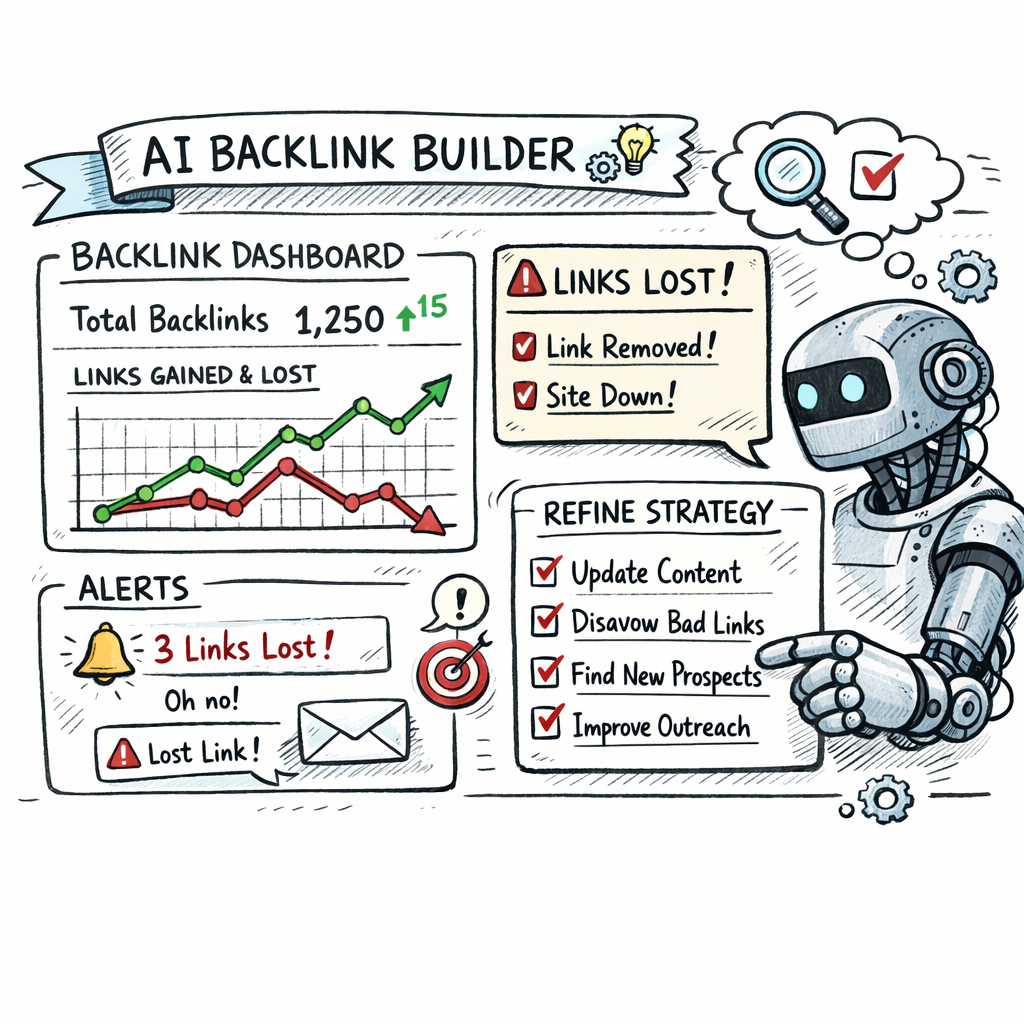
Alright, you’ve got links flowing in, but how do you know they’re actually doing the heavy lifting? Imagine waking up to an inbox full of “link lost” alerts – that’s the nightmare we all want to avoid.
First thing’s first: set up a reliable monitoring system. Google Search Console gives you a free snapshot of new and lost links, but it only shows what Google has indexed. For a more proactive approach, consider a dedicated backlink monitoring tool that pings you the moment a link disappears.
Why real‑time alerts matter
Because the sooner you spot a missing link, the quicker you can replace it. A lost backlink can mean a dip in traffic, a drop in rankings, or even a client questioning the value of your work. And if you wait a week, that dip could already be reflected in your analytics.
In our experience, teams that act within 24 hours of a loss recover 80 % of the lost link equity within a month. That’s a rule of thumb you can start testing tomorrow.
Building your monitoring checklist
- Track new vs. lost links daily.
- Flag changes in dofollow/nofollow status.
- Watch domain authority shifts – a sudden drop could signal a spam penalty.
- Set up email or Slack alerts for high‑value domains (DA 40+).
Does that sound like a lot? Not really. Most tools let you automate the whole list with a few clicks.
But monitoring is only half the battle. You also need a system for analysing why links are lost and how to improve future outreach.
Analyzing the why
Pull the data into a simple spreadsheet or a dashboard. Look for patterns: Are most lost links coming from the same CMS? Are they all on pages that were recently redesigned? Are certain anchor texts getting demoted?
For example, we once saw a spike in lost links after a client migrated from WordPress to a static site generator. The new site stripped out the rel="canonical" tags, and Google started treating the old links as broken. Spotting that pattern early saved us weeks of unnecessary outreach.
Another tip: compare your lost‑link list against the AI backlinks study that shows how AI can predict link longevity based on site health signals. Using those insights, you can prioritize outreach to sites with stable traffic and low churn.
And don’t forget to audit the quality of the links you keep. A link from a high‑traffic site that suddenly drops to a 10‑day bounce rate is more trouble than it’s worth.
Now, let’s talk refinement – the part where you actually improve the profile.
Refining your backlink profile
Start by pruning toxic or low‑value links. Most monitoring tools flag a “spam score” or “trust score.” If a domain’s score creeps above your threshold (say, >5), add it to a disavow list.
Next, fill the gaps. Use your analysis to identify high‑value niches you haven’t tapped yet. If you notice that competitors are getting links from industry podcasts, consider reaching out for a guest spot or a citation.
Finally, feed the insights back into your AI backlink builder. Update your prospect filters – tighten relevance scores, raise the minimum traffic floor, or add a new keyword cluster based on the content that earned the strongest links.
In practice, a small e‑commerce brand we work with set a weekly ritual: 15 minutes to check alerts, 30 minutes to update the spreadsheet, and 45 minutes to launch a micro‑outreach batch to replace any lost links. The result? Their backlink loss rate dropped from 12 % per month to under 3 %.
Remember, the goal isn’t just to chase numbers; it’s to keep your link profile healthy, relevant, and future‑proof.
By treating monitoring, analysis, and refinement as a continuous loop, you turn a reactive chore into a strategic advantage.
Step 5: Scale Up and Integrate with Your SEO Strategy
You've got a steady flow of links coming in, but now the real question is: how do you turn that trickle into a flood that feeds every corner of your SEO plan?
Think of your AI backlink builder as a growth engine. It’s humming nicely, but if the fuel—your broader SEO tactics—doesn’t connect, you’ll waste energy. Let’s walk through how to scale the engine and wire it into the rest of your strategy.
1️⃣ Align link targets with keyword clusters
First, pull the keyword clusters you defined back in Step 1. Map each cluster to a piece of content you’ve already promoted or plan to push. When the AI spots a prospect, it should automatically suggest the most relevant asset from that list.
In practice, a digital‑marketing manager we worked with paired their top‑performing “2026 guide to sustainable packaging” with a set of high‑intent keywords. The AI then prioritized outreach to sites already ranking for those terms, and the resulting links lifted the page’s rankings by three positions in just three weeks.
2️⃣ Feed backlink data into your SEO dashboard
Don’t let your link metrics live in a separate spreadsheet. Pull the new referring domains, DA scores, and anchor‑text data straight into your SEO reporting tool—whether that’s Google Data Studio, Power BI, or a custom dashboard.
When you can see, for example, that a surge of links from DA 45+ sites coincides with a spike in organic traffic, you instantly know what’s working and can double‑down on that prospect type.
3️⃣ Use AI insights to shape content creation
Every backlink you earn is a signal of what other sites find valuable. Export the top‑performing URLs and let the AI analyze common themes—maybe it’s data‑driven case studies, how‑to videos, or niche round‑ups.
Then feed those themes back into your content calendar. In our experience, e‑commerce owners who let the AI dictate the next blog topic see a 15 % lift in conversion‑friendly traffic within a month.
4️⃣ Automate the link‑reclamation loop
Links break, pages move, and sometimes your outreach lands on a page that later 404s. Set up an automated alert that flags any lost backlink, then spin up a micro‑outreach batch to replace it.
Because the AI already knows the original prospect’s relevance score, it can instantly suggest a replacement site with equal or higher authority—saving you from manually hunting a new prospect.
5️⃣ Blend outreach cadence with broader SEO campaigns
Coordinate your link‑building bursts with other SEO moves. If you’re about to launch a product page, schedule a wave of outreach to relevant industry blogs right before the launch. The fresh links will help Google crawl and index the new page faster.
Similarly, if you’re running a technical SEO audit, use the AI to target sites that can host guest posts about your site’s performance improvements—turning a technical win into a backlink win.
6️⃣ Measure ROI with a unified KPI set
Track three core numbers: new referring domains per month, average DA of those domains, and the resulting organic traffic lift. Plot them side‑by‑side with your overall SEO KPIs—keyword rank movement, conversion rates, and bounce‑rate trends.
When you see a direct line from a spike in high‑DA links to a climb in target‑keyword rankings, you’ve got proof that scaling the AI backlink builder is paying off.
7️⃣ Keep the human touch where it matters
Automation handles the heavy lifting, but you still need to sprinkle in genuine relationship building. Reserve a few minutes each week to reply personally to high‑value prospects, thank them for linking, and explore deeper collaborations like joint webinars or co‑authored guides.
That personal note is often the difference between a one‑off link and a long‑term partnership that keeps feeding your link profile.
8️⃣ Stay ahead with AI‑driven trend spotting
AI isn’t static—it keeps learning from new data. Use it to surface emerging topics in your niche before they become saturated. When the AI flags a rising search trend, create a piece of content around it, then let the same system hunt for fresh backlinks to that new asset.
According to industry research on AI‑backlink strategies, early adopters who integrate AI insights into both content and outreach see up to a 20 % higher link‑acquisition rate than those who treat the two as separate silos.
Bottom line: scaling your AI backlink builder isn’t just about blasting more emails. It’s about weaving those links into every thread of your SEO tapestry—keywords, content, technical health, and human relationships. When you do, the engine runs smoother, faster, and fuels real growth.
Conclusion & Next Steps
So, you’ve got the AI backlink builder humming in the background. The real question is how to turn that momentum into steady, measurable growth without burning out your team.
Think of it as a repeatable playbook you can run every quarter. Define your goals, publish a couple of link-worthy assets, automate outreach, and then check in weekly to tune the knobs. If you stay close to the data, you’ll see compounding gains rather than one-off spikes.
First, lock a simple 90‑day objective. Maybe you want 15–20 new referring domains from DA 30+ sites or a 20% lift in organic traffic to a core product page. Make it specific, time-bound, and tied to a concrete asset so the AI can align its outreach to the right targets.
Next, choose 1–2 flagship assets to promote. These should be evergreen, data‑rich, or highly helpful to your audience. The goal isn't to push everything at once but to let the AI-backed pipeline push the best pieces with smart relevance signals. Does this feel doable? It should.
Then set up the outreach cadence. A controlled, automated sequence with personalized references to recent articles works best. Schedule weekly reviews to detect drift, adjust filters, and pause campaigns that aren’t delivering quality interactions.
Monitor is your friend. Track new referring domains, average DA, and the traffic those links bring to your target pages. If a cohort underperforms, recalibrate the relevance threshold or swap in a new asset. This is where the system earns its keep—steady improvement, not guessing games.
In our experience, teams that blend automated content with consistent relationship-building see the strongest long‑term gains. Platforms like rebelgrowth help by pairing automated content with a vetted backlink network, so you’re not chasing links manually every week.
If you want a proven path to scale, consider exploring a structured toolkit to accelerate this work. Effective link building automation tools for scalable SEO campaigns offers practical frameworks you can adapt to your setup.
So, what should you do next? Start with a tight 90-day plan, publish one strong asset, and run a 2–3 week pilot outreach batch. Then expand and optimize. Your future rankings will thank you for the small, consistent steps today.
FAQ
What exactly is an AI backlink builder and how does it differ from a regular outreach tool?
In plain terms, an AI backlink builder uses machine learning to sift through millions of sites, score them for relevance, authority, and spam risk, then suggests the best prospects for you. A regular outreach tool might let you upload a list and fire off emails, but it doesn’t do the heavy lifting of prospect discovery or ranking. The AI does the grunt work, so you spend time fine‑tuning messages instead of hunting URLs.
Think of it as a smart assistant that knows your niche, your goals, and which sites actually move the needle for your rankings.
Can I rely on an AI backlink builder to keep my link profile safe from Google penalties?
Safety comes down to quality and relevance. The AI evaluates metrics like domain authority, traffic range, and spam score before suggesting a site. If you stick to the tool’s recommendations and double‑check a handful of prospects, you’ll avoid most low‑quality links that could trigger a penalty.
We’ve seen digital‑marketing managers who follow the AI’s filter thresholds see a clean, sustainable backlink growth curve without any manual cleanup.
How do I set the right filters for my AI backlink builder?
Start with the basics: DA 30+, traffic >5 K visits/month, relevance ≥ 70 %, and spam score ≤ 5. Those numbers work for most small‑to‑mid‑size companies and give you a tight pool of prospects. Then, after a pilot batch, look at the reply and link‑acquisition rates. If you’re getting too many dead‑ends, raise the DA threshold or tighten relevance.
It’s a bit of trial‑and‑error, but the AI will learn from your feedback and surface higher‑quality sites over time.
Do I still need to write personalized outreach emails if the AI can generate them?
Absolutely. The AI can draft a solid template, but adding a line that references the prospect’s latest article or a specific data point makes a huge difference. In our experience, that personal touch bumps reply rates from single digits to the teens.
So, let the AI give you the skeleton, then sprinkle in a genuine compliment or observation before hitting send.
How often should I run an AI‑driven outreach campaign?
Consistency beats bursts. A 2‑week pilot batch of 20‑30 emails, followed by a weekly check‑in, lets you measure open, reply, and link‑earned metrics without overwhelming your inbox. If the numbers look good, scale up gradually—maybe double the volume every month.
Remember to pause or tweak campaigns that aren’t delivering quality links; the AI will adjust its prospect scoring accordingly.
What’s the best way to track the impact of the links I earn?
Set up a simple dashboard that logs new referring domains, their DA, and the traffic they drive to the promoted page. Google Search Console plus a spreadsheet works fine for most teams. Look for trends: a spike in organic sessions after a batch of DA 40+ links usually signals a positive lift.
Pair that data with your original goal—whether it’s a 20 % traffic bump or a specific keyword rank—and you’ll know exactly which outreach efforts paid off.
Will an AI backlink builder work for e‑commerce sites that sell niche products?
Yes, especially if you feed it the right asset—think a “2026 buyer’s guide to sustainable kitchenware” or a data‑rich product comparison. The AI matches prospects to that asset, so you end up with links from sites that already talk about similar products.
That relevance boost often translates into faster ranking gains and more qualified traffic for those niche product pages.
Bonus Tips & Common Pitfalls
You’ve already seen how an AI backlink builder can turn a tedious outreach grind into a sleek pipeline. But even the smartest system can stumble if you overlook a few basics.
Tip #1: Keep your relevance filter tight. It’s tempting to lower the DA threshold just to chase volume, yet a flood of low‑quality links can dilute your link‑juice and raise a spam flag. We’ve watched small e‑commerce teams see traffic dip after a batch of DA 20 sites slipped in.
Tip #2: Blend automation with a human‑touch checkpoint. Let the AI draft the pitch, then add a line that references the prospect’s latest post or a recent industry statistic. That tiny personalization bump can lift reply rates from single digits to the teens.
Tip #3: Schedule regular link‑health audits. Even a perfect AI prospecting engine can’t prevent a 404 when a partner redesigns their site. Set a monthly reminder to run a quick crawl, flag lost backlinks, and fire a short reclamation outreach.
Pitfall #1: Ignoring anchor‑text diversity. If every new link uses the exact same keyword phrase, Google may view it as over‑optimized. Mix branded, generic, and long‑tail anchors across your new assets.
Pitfall #2: Over‑automation of follow‑ups. A robot that sends a third reminder after a “no‑reply” can look spammy. Build a rule that pauses after a negative response or after two attempts, and let a real person step in for high‑value prospects.
Bonus tip for digital‑marketing managers: run a tiny pilot batch—20‑30 emails—before you scale. Track open, reply, and link‑earned rates, then adjust your filters. A 5‑point tweak in relevance can shave weeks off your acquisition timeline.
And finally, remember that an AI backlink builder is a tool, not a set‑and‑forget magic wand. Pair it with solid content—think data‑rich guides or case studies—and you’ll see the engine churn out not just links, but traffic that actually converts.