
SEO management is the ongoing process of guiding a website to the top of search engine results and keeping it there. It’s not a one-time task you can check off a list. Instead, think of it as a continuous cycle of planning, testing, and fine-tuning your strategy to boost your online visibility and pull in more organic traffic.
Unpacking SEO Management: A Fitness Plan for Your Website

A great way to think about SEO management is like a dedicated fitness program for your website. You wouldn't expect to get in shape after a single workout, right? Lasting health requires a consistent, strategic approach. In the same way, SEO management is the sustained effort that keeps your website in peak condition to compete in the ever-shifting world of search rankings.
This process goes way beyond just sprinkling a few keywords onto a page. It's a comprehensive service built entirely for long-term growth.
More Than Just a Checklist
Truly effective SEO management is a strategic partnership. Let's say you own an amazing restaurant, but it's tucked away on a quiet side street. The food is incredible, but nobody knows you're there. SEO management is the work that moves your restaurant to the busiest street in town (the first page of Google) and builds a reputation so solid that a steady stream of customers starts flowing in.
This involves several key functions all working in sync:
- Strategic Planning: This is where it all starts. Defining your goals, figuring out who your target audience is, and digging into the keywords they actually use to find solutions.
- Technical Optimization: Making sure your website's foundation is rock-solid. This allows search engines to easily crawl, index, and understand what your content is all about.
- Content Creation: Developing valuable articles, guides, and pages that answer your audience's questions and cement your status as an authority in your field.
- Performance Monitoring: Keeping a close eye on your rankings, traffic, and conversions. This continuous tracking lets you adjust your strategy on the fly and jump on new opportunities as they appear.
At its core, SEO management is the difference between simply having a website and having a website that actively drives business. It transforms your site from a passive digital brochure into a powerful engine for finding new customers.
The end game is to create a sustainable source of organic traffic that turns visitors into loyal customers. This often starts with making sure your site has high-quality pages designed to convert, a topic covered in this guide to creating effective landing pages. It's all about making sure your business gets found by the right people, at the exact moment they need what you offer.
Why Your Business Can't Afford to Ignore SEO
Ignoring SEO in today's market is like setting up a fantastic shop on a forgotten backstreet with no sign out front. You could have the best products or services in the world, but if nobody can find you, does it even matter? This is where effective SEO management comes in—it’s the bridge connecting what you offer to the people actively looking for it.
Think about it. When people turn to Google, they aren't just window shopping. They have a specific need or a problem they want to solve, right now. A smart, well-managed SEO strategy puts your business directly in their path at that exact moment.
This isn’t just about getting clicks. Showing up high in the search results builds a powerful sense of trust and credibility. It’s an unspoken signal to potential customers that you're a legitimate authority in your field.
That trust translates directly into higher-quality leads. Unlike old-school advertising that shoves a message in front of people, SEO attracts users who are already interested in what you have to say. This means the organic traffic you get is far more likely to turn into actual customers.
Connecting SEO to Business Growth
The impact of a consistent SEO strategy isn't just theory; it's clear, measurable, and pretty staggering when you look at the numbers. In fact, studies show that organic search is the primary driver of website traffic for most businesses, accounting for a massive 53% of all site visits. This isn't just about volume; it's about value.
The infographic below really paints the picture of how SEO management fuels real business outcomes, from attracting visitors to improving lead quality and delivering a solid return on investment.
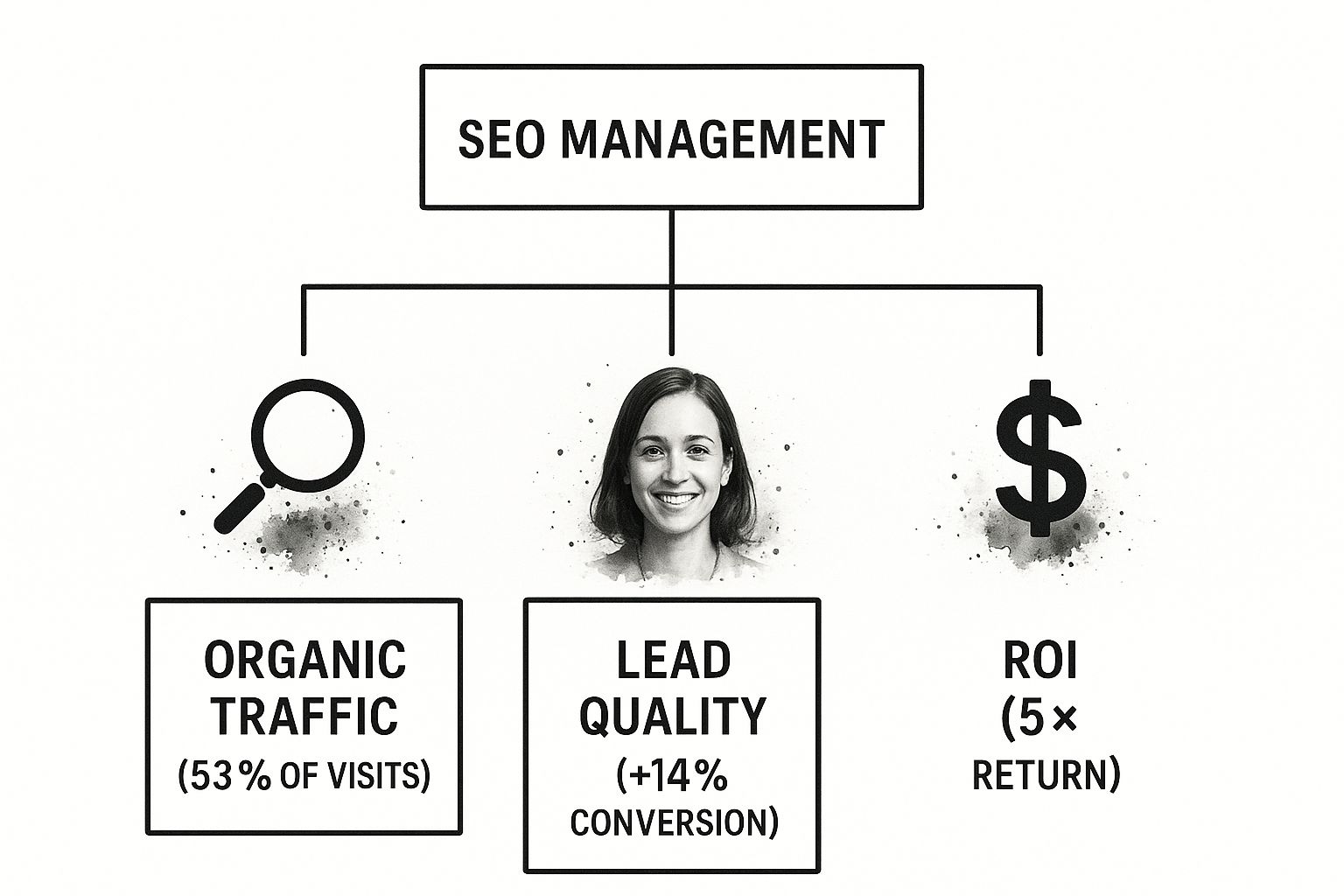
As you can see, leads generated from SEO have an impressive 14.6% conversion rate. That blows the 1.7% from traditional outbound marketing channels completely out of the water. This incredible efficiency is precisely why understanding what SEO management is becomes so critical for growth.
Ultimately, SEO isn't a marketing expense—it’s a powerful business investment. You're building a sustainable, long-term asset that continuously captures motivated customers and delivers returns that often outperform many other marketing channels.
The Four Pillars of SEO Management

A powerful SEO strategy isn't just one thing; it's a combination of different disciplines working together to boost your website's visibility. It's built on four distinct pillars that are deeply connected, and understanding how they support each other is key to grasping what SEO management is all about.
Think of it like building a house. Each part is crucial for creating a structure that's sturdy, welcoming, and easy for people to find. If you neglect one pillar, the whole thing can become unstable pretty quickly.
H3: Technical SEO: The Foundation
First up is Technical SEO, which is the rock-solid foundation of your digital home. This pillar is all about making sure search engines can efficiently crawl and index your website. After all, if Google’s bots can't easily find their way around your site, even the most amazing content might as well be invisible.
This means optimizing your site's backend and overall structure. Some of the core jobs here include:
- Boosting Site Speed: Nobody likes a slow website. Making sure your pages load in a snap is a huge win for user experience and a known ranking signal.
- Ensuring Mobile-Friendliness: Your site has to look and work perfectly on every device, from a giant desktop monitor to a tiny smartphone screen.
- Managing Crawlability: This involves using tools like a
robots.txtfile to tell search engines which pages they should crawl and which ones to skip. To get a better handle on this, check out our deep dive on therobots.txtfile here: https://rebelgrowth.com/robots.txt.
Without a solid technical base, any other SEO work you do is on shaky ground. It’s the non-negotiable first step.
H3: On-Page SEO: The Interior Design
With the foundation poured, it’s time for On-Page SEO. If technical SEO is the foundation, think of on-page as the interior design—it’s all about the content and structure of your individual pages. The focus here is on creating content that your audience finds incredibly valuable while also making its topic crystal clear to search engines.
The name of the game is to answer a user's question better than anyone else. This means crafting high-quality blog posts, product descriptions, and landing pages that are both relevant and engaging. To do this well, you need to keep up with the constantly evolving search engine ranking factors that influence where you show up in the results.
H3: Off-Page and Local SEO: Your Reputation and Signpost
Finally, we have two pillars that work to build your site's authority out in the wider world and pin your presence to a specific location.
Off-Page SEO is basically your online reputation—the digital equivalent of word-of-mouth recommendations. It covers all the things you do outside of your website to improve your rankings. The big one here is earning high-quality backlinks from other respected websites, which tells Google that your content is authoritative and trustworthy.
Local SEO is the sign on your front lawn. If you run a business with a physical storefront or a defined service area, this is absolutely critical. It involves optimizing your online presence to pull in more business from local searches, which usually means mastering your Google Business Profile and building local citations.
To put it all together, let's break down these four pillars in a simple table.
Four Pillars of SEO Management at a Glance
| SEO Pillar | Primary Goal | Example Activities |
|---|---|---|
| Technical SEO | Ensure search engines can easily find, crawl, and index your site. | Improving site speed, mobile optimization, managing robots.txt and sitemaps. |
| On-Page SEO | Create relevant, high-quality content that meets user intent. | Keyword research, content creation, title tag optimization, internal linking. |
| Off-Page SEO | Build authority and trust through external signals. | Earning backlinks from reputable sites, guest blogging, digital PR. |
| Local SEO | Attract local customers and improve visibility in a specific area. | Managing Google Business Profile, local citations, and online reviews. |
By mastering and balancing all four of these pillars, you create a holistic SEO strategy that's built to last and deliver real, measurable results.
How the SEO Management Process Works

Good SEO management isn’t just a random checklist of tasks you tick off and forget. Far from it. It’s a strategic, cyclical process built for continuous improvement—a repeatable loop that keeps your website evolving and climbing the search rankings over time.
This whole journey kicks off with a discovery phase. Picture a small e-commerce shop that sells handmade leather goods. Before touching a single line of code or writing a word of copy, we’d start with a deep-dive SEO audit. This uncovers technical glitches, content gaps, and what the competition is doing right. This initial analysis is absolutely critical for setting clear, measurable goals, like increasing organic traffic to product pages by 20% in six months.
From Strategy to Implementation
Once you have a clear baseline and know what you're aiming for, the next step is to build the actual strategy. This means doing comprehensive keyword research to figure out exactly what potential customers are searching for. Think phrases like "durable leather wallet" or "custom messenger bag." This research is the foundation for a detailed content plan designed to pull in and engage that specific audience.
Then, it's time for implementation. This is where the strategy comes to life. Technical issues found in the audit get fixed, and new, high-quality content gets created and published. For our leather goods store, this might mean writing a blog post on "How to Care for Your Leather Bag" or optimizing product descriptions with the keywords we just discovered.
The core of the SEO management process is its cyclical nature. It’s not about launching a campaign and hoping for the best; it's about launching, measuring, learning, and refining in a constant feedback loop.
Monitoring Performance and Refining the Approach
As soon as the initial strategy is live, the process shifts into an ongoing loop of monitoring, reporting, and refining. This is where data takes the driver's seat. By tracking things like keyword rankings, organic traffic, and conversion rates, you can see what’s hitting the mark and what’s falling flat.
Leveraging robust search engine marketing intelligence is a huge part of this, helping you make data-driven decisions that actually improve results. If that blog post on leather care starts ranking well, the strategy might be tweaked to create more "how-to" content. If a particular product page isn't performing, it might be time to re-optimize it. For anyone looking to get their initial audit and ongoing tasks in order, you can learn more about structuring your efforts with our AI-powered SEO checklist.
This cycle of analyzing results and making smart adjustments is what keeps your SEO efforts agile. It ensures you can adapt to market changes and drive progressively better results for the long haul.
Measuring SEO Success Beyond Traffic Numbers
How do you actually know if your SEO management is working? Sure, seeing a spike in website visitors is a thrill, but traffic alone doesn't pay the bills. It’s one of those vanity metrics that feels good but doesn't tell you the whole story.
To get the real picture, you have to look past the surface. Effective SEO management is about attracting the right people—the ones who are ready to become customers. This means we need to shift our focus from "how many visitors did we get?" to "what did those visitors do once they arrived?"
Key Metrics That Actually Matter
A good SEO report should connect the dots between search rankings and business growth. This is how you see your true return on investment (ROI) and hold your team or agency accountable.
Here are the numbers that really count:
- Organic Conversion Rate: This is the big one. It's the percentage of visitors from search who take a meaningful action—making a purchase, filling out a form, or signing up for your newsletter.
- Keyword Ranking for High-Intent Terms: It’s far more valuable to rank on page one for “emergency plumber near me” than for “how plumbing works.” Tracking your position for these ready-to-buy keywords shows you’re capturing customers, not just researchers.
- Lead Quality from Search: Are the leads coming from organic search actually turning into sales? This metric digs into the quality of the traffic your SEO strategy is pulling in.
- Cost Per Acquisition (CPA): When you compare your SEO investment to the number of new customers it brings in, you can see just how cost-effective it is. Often, it blows paid channels out of the water.
Ultimately, SEO management should be seen as a revenue driver, not a cost center. Success isn't just about traffic; it's measured in qualified leads, new sales, and a clear, positive return on your investment.
The data backs this up in a huge way. A staggering 91% of digital marketers see a positive impact on their website's performance directly from SEO.
Even more impressive? Leads generated from SEO have a 14.6% conversion rate. Compare that to the tiny 1.7% from traditional marketing, and you can see why this is so powerful. If you want to dive deeper, you can discover more insights about the state of organic marketing and its impact on business growth. This is what a valuable SEO report should show—real, tangible results that hit the bottom line.
Got Questions About SEO Management?
If you're thinking about SEO management, you've probably got a few questions swirling around. It's totally normal. Most business owners want to know the same things: "How much does it cost?", "How long until I see results?", and "What can I really expect?" Let's clear the air on some of these.
So, How Long Does This SEO Thing Actually Take?
This is probably the biggest question on everyone's mind. The short answer? SEO is a long game, not a quick fix. You might start seeing some positive signs within 3 to 6 months, but getting those solid, dependable rankings for the keywords that really matter takes time.
Think of it like planting a tree. You water it, you make sure it gets sunlight, and you're patient. It needs consistent care before it starts bearing fruit. The same goes for SEO. How long it takes really depends on how competitive your industry is, the current state of your website, and how aggressive your strategy is.
Can You Guarantee Me the #1 Spot on Google?
This is another big one, and the honest-to-goodness answer is no. Any SEO pro who guarantees you a #1 ranking isn't being straight with you. Why? Because at the end of the day, Google's algorithm calls the shots, and it’s constantly changing.
What a trustworthy SEO service can guarantee is a transparent, methodical process. They'll promise consistent effort and a strategy built on proven, white-hat techniques. The real goal isn't a risky shortcut to the top; it's about building sustainable growth that lasts.
The only real guarantee in SEO is a commitment to a smart, data-driven process. Success comes from doing the work, day in and day out—auditing, optimizing, creating great content, and building your site's authority. It's all designed to get you in Google's good graces and earn visibility over time.
And earning that visibility on Google is non-negotiable. Google has dominated the search market for decades, handling about 90% of all searches. When you consider that 75% of users never click past the first page, you can see why having a solid SEO management plan is so critical for getting noticed. You can dive into more of these crucial SEO statistics to see the full picture.
Ultimately, a great SEO partnership is built on clear communication and realistic expectations. The focus should always be on tangible business results—like more leads and more revenue—not just chasing rankings for vanity's sake.
Ready to turn your website from a digital brochure into a real growth engine? rebelgrowth gives you the AI-powered tools and strategic insights to climb the search rankings and drive measurable results. Check out our solutions and start your growth journey today at https://rebelgrowth.com.