
In 2025, content marketing is a multi-faceted discipline where a single format is no longer enough to succeed. Your audience is fragmented across platforms and consumes information in myriad ways, from quick vertical videos to in-depth research papers. Winning their attention requires a strategic and diverse arsenal of content types designed to meet them exactly where they are. Thriving in this environment means moving past a one-dimensional approach and building a robust, multi-channel strategy.
This comprehensive guide explores the 10 most impactful types of content for content marketing, moving beyond the basics to provide a practical roadmap. We will dissect each format's unique strengths, from the authority-building power of whitepapers to the engagement potential of user-generated content. For each of the content types covered, you will find:
- Actionable best practices you can implement immediately.
- Specific use cases to inspire your next campaign.
- Real-world examples to illustrate what success looks like.
Forget generic advice. This article is your toolkit for building a resilient content ecosystem that captures attention, builds genuine trust, and drives measurable business growth. Prepare to diversify your content portfolio and create a powerful engine for attracting and retaining your ideal customers.
1. Blog Posts & Articles
Blog posts and articles are the foundational pillars of a robust content marketing strategy. This written content, published on your website, serves to inform, educate, entertain, and engage your audience. It's a versatile format that can range from quick 500-word reads to comprehensive, 3,000+ word deep-dives, making it one of the most effective types of content for content marketing to build authority and drive organic traffic.

The primary function of blogging is to answer your audience's questions and solve their problems, establishing your brand as a trusted resource. This directly supports search engine optimization (SEO) by targeting specific keywords and demonstrating topical expertise, which helps you rank higher in search results.
When to Use This Content Type
Blog posts are ideal for top-of-funnel and middle-of-funnel marketing. They excel at attracting new visitors who are searching for information related to your industry and nurturing them by providing consistent value. Use them to build brand awareness, generate leads, and drive traffic to other important pages on your site.
Actionable Implementation Tips
To make your blog posts and articles stand out, focus on providing exceptional value and optimizing for user experience.
- Target Search Intent: Don't just focus on keywords. Understand the why behind a search query. Is the user looking for a definition, a comparison, or a step-by-step guide? Structure your content to provide the most direct and comprehensive answer.
- Incorporate Original Data: Stand out from the competition by conducting your own surveys, studies, or experiments. Publishing original research makes your content highly linkable and positions you as a thought leader.
- Optimize for Featured Snippets: Structure your content with clear H3/H4 headings, bullet points, and numbered lists. Directly answer common questions in concise paragraphs to increase your chances of capturing Google's "position zero."
- Embed Strategic CTAs: Every post should have a purpose. Guide readers to the next step with relevant calls-to-action (CTAs), such as downloading an ebook, signing up for a newsletter, or booking a demo. A classic example is the HubSpot blog, which seamlessly integrates CTAs for its various marketing tools and resources within its high-value content.
2. Video Content
Video content has become a powerhouse in the digital marketing landscape, leveraging visual storytelling to capture attention and convey messages with unparalleled impact. This dynamic format, combining moving images, audio, and text, is one of the most engaging types of content for content marketing. It can range from short, viral clips on TikTok to in-depth tutorials on YouTube, making it incredibly versatile for connecting with audiences on a more human level.

The primary power of video lies in its ability to simplify complex topics, showcase products in action, and build strong emotional connections. Campaigns like Dollar Shave Club's viral launch video demonstrated that a small budget can yield massive returns, while Blendtec’s "Will It Blend?" series turned a seemingly boring product into an entertainment sensation, boosting sales by 700%.
When to Use This Content Type
Video is highly effective across all stages of the marketing funnel. Use short-form videos on social media for top-of-funnel brand awareness, product demos and tutorials for middle-of-funnel consideration, and customer testimonials or personalized video messages for bottom-of-funnel decision-making. It excels at building brand personality and driving higher engagement rates on social platforms.
Actionable Implementation Tips
To maximize the impact of your video content, focus on grabbing attention quickly and optimizing for modern viewing habits.
- Hook Viewers Immediately: The first 3-5 seconds are critical. Start with a compelling question, a surprising statement, or dynamic visuals to prevent viewers from scrolling past.
- Optimize for Silent Viewing: A significant portion of social media videos are watched without sound. Use clear, bold on-screen text and captions to ensure your message is understood even when muted.
- Create Platform-Specific Versions: Don't use a one-size-fits-all approach. Adapt your video's aspect ratio (e.g., 9:16 for TikTok/Reels, 16:9 for YouTube) and length for each platform to meet audience expectations.
- Repurpose Strategically: Turn a single long-form video, like a webinar or podcast, into dozens of micro-content pieces. Create short clips, quote graphics, and audio snippets to extend the life and reach of your core content. A prime example is Gary Vaynerchuk's content model, which shows how to scale video production efficiently.
3. Infographics
Infographics are powerful visual tools that distill complex information, data, or knowledge into an easily understandable and shareable graphic. By combining charts, icons, and concise text, they transform dense subjects into engaging visual narratives. This format is one of the most effective types of content for content marketing because it caters to the human brain's preference for visual information, making your message more memorable and impactful.
As the infographic below highlights, this visual appeal translates directly into measurable engagement and traffic gains.
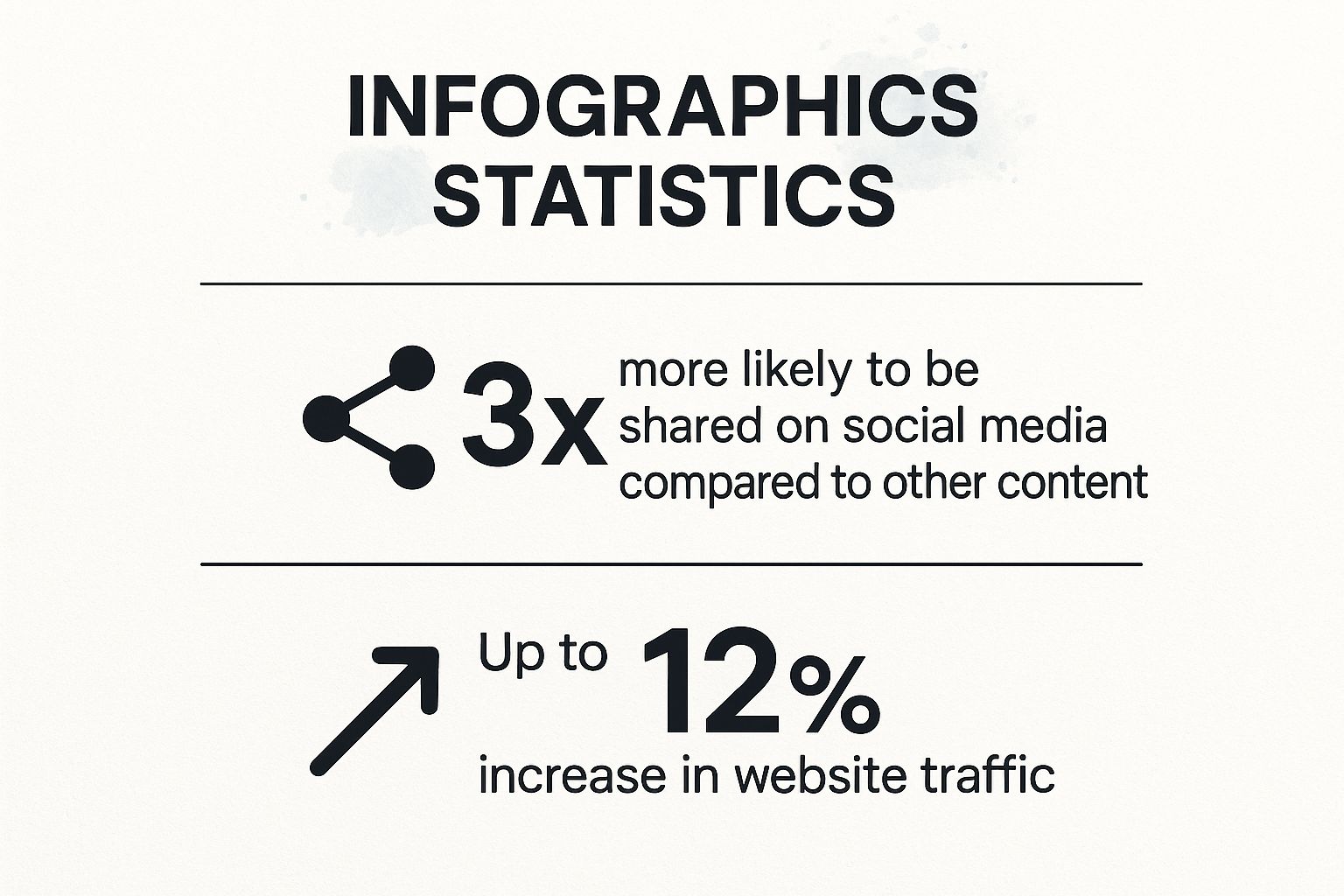
The data clearly shows that the highly shareable nature of infographics can lead to a significant boost in website traffic, making them a high-ROI content asset.
When to Use This Content Type
Infographics are perfect for presenting data-heavy information, summarizing long-form content like a blog post or whitepaper, or explaining a complex process step-by-step. They excel at the top and middle of the marketing funnel, where the goal is to grab attention, build brand awareness, and generate social shares and backlinks. Use them to make statistics compelling and simplify intricate topics for your audience.
Actionable Implementation Tips
To create infographics that capture attention and drive results, focus on a clear story and strong design principles.
- Tell a Cohesive Story: Don't just present random data points. Structure your infographic with a clear narrative arc: a compelling headline, an introduction, supporting data points, and a concluding call-to-action. Each element should guide the viewer logically through the information.
- Prioritize Data Credibility: Build trust by using reliable data from reputable sources. Always cite your sources clearly at the bottom of the infographic. This not only adds authority but also encourages others to reference your work.
- Embrace Visual Hierarchy and White Space: Guide the viewer's eye using size, color, and placement to emphasize the most important information. Avoid clutter by using ample white space, which makes the design feel clean, professional, and easy to follow.
- Include an Embed Code: Make it effortless for others to share your infographic on their own websites. Provide a pre-formatted HTML embed code directly below the graphic on your blog. This practice, used effectively by brands like Visual.ly, is a simple yet powerful way to generate valuable backlinks.
4. Podcasts
Podcasts are episodic audio series that have exploded in popularity, offering an intimate and convenient way to reach audiences. This format allows brands to build deep connections with listeners who can consume content while commuting, exercising, or multitasking. As one of the most engaging types of content for content marketing, podcasts excel at establishing authority and fostering a loyal community around your brand.
Through interviews, storytelling, or educational discussions, podcasts position you as a thought leader in your industry. This format humanizes your brand, giving it a literal voice and personality that written content cannot always convey, making it a powerful tool for building trust and brand affinity.
When to Use This Content Type
Podcasts are exceptionally effective for middle-of-funnel and bottom-of-funnel marketing. They are perfect for nurturing leads and building long-term loyalty with your existing audience. Use them to share deep industry insights, showcase company culture, and provide value to an engaged audience that has already demonstrated interest in your niche.
Actionable Implementation Tips
Launching a successful podcast requires more than just hitting record. Focus on quality production and strategic promotion to capture and retain listeners.
- Invest in Quality Audio: Poor audio is the fastest way to lose a listener. Invest in a decent microphone and find a quiet space to record. You don't need a professional studio, but clear, crisp audio is non-negotiable.
- Feature Strategic Guests: Invite guests who have their own established audiences. This cross-promotion introduces your show to new, relevant listeners and adds fresh perspectives to your content.
- Repurpose Every Episode: Maximize the reach of each episode by turning it into multiple pieces of content. Create audiograms for social media, write a summary blog post with a transcript, pull out key quotes for graphics, and create short video clips for TikTok and Reels.
- Optimize for Discovery: Craft compelling episode titles and detailed show notes that include relevant keywords. Submit your podcast to all major directories like Apple Podcasts, Spotify, and Google Podcasts. A great example is the Marketing School podcast, which uses keyword-rich titles for its short, daily episodes to capture search traffic within podcast apps.
5. Social Media Posts
Social media posts are the fast-paced, high-engagement pulse of a modern content strategy. This category includes everything from ephemeral stories and short-form videos to text updates, image carousels, and interactive polls. Designed for immediate consumption and interaction, this content fuels community building, brand personality, and real-time conversation, making it one of the most dynamic types of content for content marketing.
Unlike evergreen blog content, social media thrives on timeliness and personality. Its primary function is to build and nurture a community by providing a direct line of communication with your audience. Brands like Duolingo on TikTok or MoonPie on Twitter have mastered this by creating distinct, entertaining personas that drive massive organic reach and brand loyalty.
When to Use This Content Type
Social media is a full-funnel tool but is particularly powerful for top-of-funnel brand awareness and bottom-of-funnel community retention. Use it daily to stay top-of-mind, share user-generated content, drive traffic to your website, announce product updates, and engage directly with customers. It's essential for humanizing your brand and building relationships at scale.
Actionable Implementation Tips
To succeed on social media, you must adapt to each platform’s unique culture and algorithm, prioritizing authenticity and engagement over overt selling.
- Create Platform-Native Content: Avoid a one-size-fits-all approach. A professional, text-based post on LinkedIn will not perform well as a copy-paste on Instagram. Tailor your message, format, and tone for each platform, utilizing features like Reels, Stories, Polls, and Questions.
- Prioritize Engagement, Not Just Broadcasting: Social media is a two-way conversation. Respond to comments and messages quickly, especially within the first hour of posting, to signal to algorithms that your content is engaging. Ask questions and encourage user participation.
- Analyze Performance Data Relentlessly: Use each platform’s built-in analytics to identify what resonates. Track metrics like engagement rate, reach, and shares to understand which content formats (e.g., video, carousels, memes) and topics perform best for your specific audience.
- Develop a Distinct Brand Voice: Whether you’re witty like Wendy's, inspirational like Nike, or conversational like Innocent Drinks, a consistent and memorable personality is key. This voice should be present in every post, comment, and reply.
6. E-books & Whitepapers
E-books and whitepapers are long-form, downloadable assets that offer a comprehensive exploration of a specific topic. E-books tend to be more conversational and visually driven, while whitepapers are typically more academic, data-heavy, and persuasive. Both serve as powerful lead magnets and are essential types of content for content marketing for demonstrating deep expertise and generating high-quality leads.
The core function of this content is to provide substantial value that warrants an exchange for a user's contact information. This makes them a cornerstone of middle-of-the-funnel (MOFU) and bottom-of-the-funnel (BOFU) strategies, as they capture leads who are actively researching solutions and are serious about a particular subject.
When to Use This Content Type
Deploy e-books and whitepapers when you need to educate prospects on complex topics, present original research, or guide them through a detailed process. They are perfect for capturing leads that are past the initial awareness stage and are evaluating different approaches or solutions. Use them to segment your audience based on their interests and nurture them toward a purchase decision.
Actionable Implementation Tips
To maximize the impact of your long-form gated content, focus on substance, design, and strategic promotion.
- Solve a Specific, High-Value Problem: Your topic should be narrow enough to cover in-depth but broad enough to be valuable. Focus on providing actionable solutions and frameworks, not just theoretical information.
- Design for Skimmability and Retention: Use a professional layout with a clear table of contents, compelling visuals, callout boxes, and bolded text. Readers should be able to grasp key takeaways even if they only skim the content.
- Create a High-Converting Landing Page: The landing page is just as important as the content itself. Clearly articulate the value proposition, use bullet points to highlight key learnings, and keep the submission form simple to minimize friction.
- Implement an Email Nurture Sequence: A download should trigger an automated email follow-up. This sequence can deliver the asset, thank the user, and then guide them with related content, slowly introducing them to your product or service. HubSpot's resource library is a masterclass in this, offering a vast range of e-books to capture leads and nurture them effectively.
7. Case Studies & Customer Success Stories
Case studies and customer success stories are powerful, narrative-driven assets that provide tangible social proof. This form of content moves beyond telling your audience what you can do and instead shows them through a detailed account of how a real customer solved a problem and achieved measurable results using your product or service. As one of the most persuasive types of content for content marketing, it builds trust by showcasing real-world value.
These stories follow a classic problem-solution-results framework, making them relatable and easy for prospects to follow. By documenting a customer's journey, from their initial challenge to their ultimate success, you allow potential buyers to envision themselves achieving similar outcomes, directly addressing their own pain points and objections.
When to Use This Content Type
Case studies are ideal for middle-of-funnel (MOFU) and bottom-of-funnel (BOFU) marketing. They are perfect for prospects who are already aware of their problem and are actively evaluating different solutions. Use them to validate your claims, build credibility, and provide the final push needed to convert a lead into a customer. They are invaluable assets for sales teams to share during demos and proposals.
Actionable Implementation Tips
To create compelling case studies that convert, focus on authenticity and hard data.
- Quantify Everything: The most impactful case studies are built on specific metrics. Instead of saying "sales increased," state "sales increased by 45% in Q2." Use hard data, ROI calculations, and specific KPIs to demonstrate concrete value.
- Showcase Diversity: Feature a range of customers across different industries, company sizes, and use cases. This allows a broader set of prospects to find a story that resonates with their specific situation. Platforms like Salesforce's Trailblazer stories excel at this by creating a searchable library.
- Structure for Scannability: Present the case study with clear headings for "The Challenge," "The Solution," and "The Results." Use pull quotes to highlight powerful testimonials and bullet points to list key outcomes, making the information easy to digest.
- Repurpose for Maximum Impact: A single case study can be repurposed into multiple assets. Create a detailed PDF, a short video testimonial, a one-page sales slick, social media graphics, and a blog post from the core story to maximize its reach and utility.
8. Email Newsletters
Email newsletters are a powerful, direct line of communication to your audience, delivering curated content, company news, and exclusive offers straight to their inboxes. Unlike content that waits to be discovered, newsletters actively reach out to an audience that has already opted in, making it one of the most effective types of content for content marketing for nurturing leads and building lasting relationships.
The core function of a newsletter is to maintain an ongoing connection with your subscribers by providing consistent value. This direct, permission-based channel allows you to drive repeat traffic to your website, promote other content formats, and guide subscribers through the marketing funnel with targeted messaging.
When to Use This Content Type
Newsletters are incredibly versatile and serve the entire marketing funnel. They are perfect for top-of-funnel engagement by sharing valuable content, ideal for middle-of-funnel lead nurturing with targeted information and case studies, and crucial for bottom-of-funnel conversions through promotions and product updates. Use them to foster loyalty, increase customer lifetime value, and keep your brand top-of-mind.
Actionable Implementation Tips
To create a newsletter that people genuinely want to open and read, focus on relevance, consistency, and a subscriber-first mentality.
- Craft Compelling Subject Lines: Your subject line is the gatekeeper to your content. A/B test different approaches (e.g., questions, statistics, curiosity-driven statements) to understand what resonates with your audience and boosts open rates.
- Segment for Relevance: Not all subscribers are the same. Segment your email list based on behavior, demographics, or interests to deliver more targeted and valuable content. To truly stand out in crowded inboxes, mastering the ultimate guide to email marketing personalisation is key to transforming your campaigns and driving results.
- Provide Exclusive Value: Give your subscribers a reason to stay. Offer exclusive content, early access to products, or special discounts that aren't available anywhere else. This rewards them for their loyalty and strengthens the relationship.
- Maintain a Consistent Cadence: Whether it’s daily like Morning Brew or weekly, stick to a predictable schedule. Consistency builds anticipation and turns your newsletter into a reliable habit for your readers, reinforcing your brand's presence.
9. Webinars & Virtual Events
Webinars and virtual events are live or pre-recorded online presentations that offer a powerful way to deliver in-depth educational content directly to an engaged audience. This format combines video, screen sharing, and interactive elements like Q&A sessions and live polls, making it one of the most effective types of content for content marketing for generating high-quality leads and fostering direct audience connection.
The primary function of a webinar is to provide significant value in real-time, allowing brands to demonstrate expertise, showcase products, and answer specific customer questions. Because attendees must register, webinars are exceptional lead generation tools that capture contact information from individuals who have a demonstrated interest in a specific topic.
When to Use This Content Type
Webinars are perfectly suited for middle-of-funnel and bottom-of-funnel marketing activities. They excel at nurturing leads by providing deep educational value and can be used to drive conversions through live product demos or exclusive offers. Use them to educate prospects, onboard new customers, or announce major product updates.
Actionable Implementation Tips
To host a successful webinar, your focus must be on promotion, engagement, and post-event follow-up.
- Promote Strategically: Begin promoting your event 2-3 weeks in advance across email, social media, and your website. Send multiple email reminders to registrants to maximize live attendance rates.
- Keep it Concise and Engaging: Aim for a 30-45 minute presentation followed by a dedicated 15-minute Q&A session. This structure respects attendees' time while encouraging active participation.
- Co-host to Expand Reach: Partner with a complementary, non-competing brand to co-host a webinar. This tactic allows you to tap into their audience, adding credibility and significantly expanding your promotional reach.
- Maximize Post-Event Value: Always send a recording of the webinar to everyone who registered, including those who didn't attend. This simple action provides continued value and gives you another touchpoint, like in the popular webinar series from a platform like Drift, which repurposes its event content to extend its lifecycle.
10. User-Generated Content (UGC)
User-Generated Content (UGC) is any form of content, such as images, videos, text, and reviews, created by customers or fans rather than the brand itself. This powerful approach leverages the authentic voice of your audience to build trust and provide compelling social proof, making it one of the most credible types of content for content marketing available today.
The primary power of UGC lies in its authenticity. Consumers often trust recommendations from peers far more than they trust direct brand advertising. By featuring content from real users, you can foster a strong sense of community, increase engagement, and significantly influence purchasing decisions while reducing the content creation burden on your marketing team.
When to Use This Content Type
UGC is exceptionally effective for bottom-of-funnel marketing, where social proof and trust are critical for conversion. It's also a fantastic tool for building mid-funnel engagement and community. Use it across your social media channels, product pages, and email campaigns to showcase real-world use of your products and build a loyal following.
Actionable Implementation Tips
To effectively harness the power of UGC, you must encourage and curate it strategically.
- Create Branded Campaigns: Launch campaigns with a specific, memorable, and unique hashtag to aggregate submissions. A great example is Apple's long-running #ShotOniPhone campaign, which encourages users to share their best photos and creates a massive, high-quality content library.
- Always Ask for Permission: Before repurposing any user's content on your official channels, always obtain explicit permission. This respects the creator and protects your brand legally.
- Feature and Credit Creators: Publicly recognize and credit the creators of the content you feature. This simple act of appreciation not only validates their contribution but also incentivizes others to participate.
- Incentivize Participation: Encourage submissions by running contests, offering discounts, or providing exclusive access. Starbucks' annual #RedCupContest generates thousands of festive photos by offering gift cards as prizes, creating a massive wave of organic promotion each holiday season.
Content Types Comparison Matrix
| Content Type | Implementation Complexity 🔄 | Resource Requirements ⚡ | Expected Outcomes 📊 | Ideal Use Cases 💡 | Key Advantages ⭐ |
|---|---|---|---|---|---|
| Blog Posts & Articles | Medium - requires writing skill | Low - mainly writing & SEO | Long-term SEO growth, organic traffic | Building organic traffic, establishing expertise, lead nurturing | Cost-effective, SEO improvement, thought leadership |
| Video Content | High - technical and creative | High - equipment, editing time | High engagement, emotional connection | Product demos, brand storytelling, social media engagement | Highest engagement, favored by algorithms, memorable |
| Infographics | Medium - design skills needed | Medium - design tools/expertise | Increased sharing and traffic | Summarizing research, explaining processes, presenting data | Highly shareable, visual clarity, drives backlinks |
| Podcasts | Medium - audio production skills | Medium - recording/editing gear | Builds loyalty, trust, and expert positioning | Community building, thought leadership, multitasking audiences | Intimate medium, multitask friendly, strong monetization |
| Social Media Posts | Low - quick creation | Low - basic tools | Immediate engagement, brand awareness | Community building, real-time engagement, customer service | Fast to publish, direct interaction, wide reach potential |
| E-books & Whitepapers | High - research and design | High - time, research, expertise | High-value leads, authority building | Lead generation, expert education, sales support | Deep expertise, evergreen content, strong lead magnet |
| Case Studies & Customer Stories | High - research & collaboration | Medium - data and customer input | Strong sales conversion and trust | Sales enablement, demonstrating ROI, closing leads | Powerful social proof, data-driven, versatile formats |
| Email Newsletters | Medium - content & design | Medium - writing, tools | High ROI, direct subscriber engagement | Relationship nurturing, driving repeat traffic, segmentation | Owned audience, personalized, consistent results |
| Webinars & Virtual Events | High - planning, tech setup | High - platform, promotion | High engagement, qualified leads | Product demos, lead generation, education, partner collaboration | Direct interaction, scalable reach, repurposable content |
| User-Generated Content (UGC) | Low to Medium - moderation needed | Low - mainly curation | High trust, engagement, cost-effective content | Building trust, community engagement, social proof | Authenticity, cost-saving, boosts conversions |
Choosing Your Content Mix for Maximum Impact
Navigating the vast landscape of content marketing can feel like a monumental task. After exploring ten distinct types of content for content marketing, from the foundational power of blog posts to the authentic voice of user-generated content, it's clear that the path to success isn't about doing everything at once. The true power lies in strategic selection and masterful execution.
The most effective content strategies are not born from a desire to master all formats simultaneously. Instead, they are built by making deliberate choices based on three core pillars: your specific business goals, the unique preferences of your target audience, and the practical resources you have at your disposal.
Building Your Strategic Content Toolkit
The key takeaway from this comprehensive list is that content is not a one-size-fits-all solution. Each format serves a distinct purpose and resonates differently with various audiences at different stages of their buyer's journey.
- For Awareness & Discovery: Blog posts, infographics, and engaging social media content are excellent for attracting new audiences and introducing them to your brand. They answer initial questions and establish your presence.
- For Consideration & Engagement: Dive deeper with video content, podcasts, and webinars. These formats allow you to build a stronger connection, showcase expertise, and nurture leads who are actively evaluating their options.
- For Conversion & Decision-Making: When your audience is ready to make a choice, compelling case studies, detailed e-books, and targeted email newsletters provide the proof and in-depth information needed to convert them into customers.
Your job is not to become an expert in all ten formats overnight. It's to become a strategist who understands which tool to pull from the toolkit for a specific job. A B2B tech company might find that a combination of detailed whitepapers, insightful webinars, and data-rich case studies drives the best results. In contrast, a direct-to-consumer lifestyle brand could build an empire on visually stunning social media posts, authentic user-generated content, and relatable video tutorials.
The Power of an Integrated Content Ecosystem
The ultimate goal is to create a symbiotic content ecosystem where each piece supports the others, creating a force multiplier for your marketing efforts. Think of how these types of content for content marketing can be interconnected:
A single hour-long webinar can be the seed for a month's worth of content. It can be transcribed into a long-form blog post, its key statistics can become a shareable infographic, powerful quotes can be turned into social media graphics, and short video clips can be used for promotion across multiple platforms.
This "create once, distribute many" approach is the secret to scaling your content production without burning out your team. To effectively determine your content mix and ensure maximum impact, it's vital to develop a comprehensive overall content marketing strategy. For a detailed guide on this, consider reading our essential content marketing strategy guide to lay the right foundation.
Don't view this list as an overwhelming menu of obligations. See it as a palette of creative possibilities. Start small. Choose one or two formats that align perfectly with your audience's needs and your team's strengths. Master them, build momentum, measure your results, and then strategically expand your repertoire. By focusing, integrating, and consistently delivering value, you will transform your content from a simple marketing task into an unstoppable engine for growth.
Ready to streamline your content creation and build an unstoppable growth engine? rebelgrowth uses AI to help you create high-quality blog and social media posts in a fraction of the time, while also building valuable backlinks to amplify your reach. Visit rebelgrowth to see how you can supercharge your content strategy today.