For years, we’ve all been playing the same SEO game: crank out content, nail those keywords, grab the top spot on Google. But here’s the catch—what if that’s only half the battle now? Imagine this: you’re an expert, you know your stuff, but when someone asks AI search engines like ChatGPT or Perplexity, they quote your competitor instead. Frustrating, right? That’s the reality many marketers face today.
It feels like all your Google rankings might not mean much in this new world of AI-driven answers, where search results aren’t just lists but conversational replies. So, how do you make sure your hard work doesn’t just get lost in the void but actually gets cited — recognized as *the* go-to authority?
I get it. This isn’t just a tweak here or there—it’s a full mindset reboot. Instead of solely aiming for rankings, we need to focus on being *cited* by AI engines. Think about it this way: AI models look for consensus. If your insights show up in multiple places across the web, they’re more likely to trust and cite you. If you’re only on your blog, that’s just one voice in a noisy room.
Sounds complicated? It’s not, really. It’s about spreading your message smartly: sharing your key ideas on social media, forums, and building pages that compare alternatives, even cleverly positioning yourself against competitors in a helpful way.
And while this new approach takes on a life of its own, classic SEO fundamentals like backlinks and on-page optimization still lay the groundwork. Without them, you’re building on shaky ground.
If you’re wondering where to start or how to weave this all together effortlessly, you might find it useful to explore how an automated content engine and backlink network can simplify this discovery and execution process. For example, Rebelgrowth offers a platform that analyzes your niche and competitors, generates SEO-optimized content, and builds high-quality backlinks without the usual headache.
Ready to stop being invisible and start building that consensus that AI search engines crave? Let’s dive in.
TL;DR
Want to rank not just on Google but also get cited by AI engines? It’s all about building consensus—getting your ideas everywhere online, from your blog to social media and forums.
Classic SEO still matters, but you’ve got to syndicate your content and create comparison pages that spotlight competitors to win the AI game.
Step 1: Understand How AI Search Engines Work
Let’s be real for a second: AI search engines aren’t just fancy versions of Google. They’re a whole different beast. Instead of serving you a stack of links, they digest mountains of information and spit out a crafted answer. It’s more like chatting with an expert who’s read everything online and is summarizing the consensus for you.
That shift changes the entire game of SEO. You’re not just trying to rank numerically anymore. Now, it’s about getting cited as a trusted source in AI-generated answers. Sounds tricky? It can be, but once you get how these engines work, you’re already ahead.
Why AI Search Isn’t Just About Keywords
Remember when all SEO revolved around stuffing the right keywords? That’s pretty much ancient history. AI search engines use Natural Language Processing (NLP) to understand context, not just keywords. They interpret the meaning behind a user’s query, the intent, and the nuances in language.1 This means your content needs to answer real questions deeply and clearly—not just repeat popular terms.
Think about it this way: If someone asks, "What’s the best CRM software?", the AI looks beyond just those words. It analyzes tons of data sources, checks how trustworthy they are, and then crafts an answer that fits what it infers the user wants. It’s a level up from the old-school list of blue links.
Consensus Is King - And AI Loves It
Here’s a critical insight: AI models hate relying on just one source. They look for consensus—multiple trusted signals across different platforms that back up a fact or opinion. So even a brilliant blog post won't hold much weight if it's the only place where that insight lives.
That’s why syndicating your content—spreading it across social media, forums, and other sites—matters so much. The AI crawls these places too. When your ideas pop up consistently in many spots, suddenly you’re not just a single voice; you become the consensus. And that’s how you get cited, not just ranked.2
Does this mean your original post isn’t important? Not at all. It’s the cornerstone. But without those multiple touchpoints, it’s like shouting into the void.
Machine Learning and Behavioral Data: The Invisible Forces
Beyond just understanding language, AI engines use machine learning to analyze how users interact with search results. They look at what people click, how long they stay on a page, bounce rates, and more. These behavioral signals help the AI figure out which sources actually satisfy real users, not just which ones are stuffed with keywords.3
So your content’s quality and engagement matter more than ever, even if you're optimizing for AI search. That means timely updates, clear answers, fast-loading pages, and genuine value are non-negotiable.
How to Start Wrangling This New World
Understanding how AI search works is your first step—and it’s not just techy jargon. It’s about seeing the bigger picture of what the AI wants: trust, clarity, and consensus. Think of it like becoming the go-to expert in a group conversation where everyone’s listening for the most reliable advice.
Take a moment. Review your current content and ask yourself: is it just sitting on your blog, or is it echoing across other platforms? Is it built on real insight that users find valuable? Could it be clearer or more comprehensive? These questions set the foundation for effective AI optimization.
Because at the end of the day, knowing your audience’s questions and making your answers impossible to ignore across the web—that’s the heart of how to optimize for AI search.

To dive deeper into how modern search engines tweak their algorithms daily, you might want to check out this extensive overview of Google's algorithm updates. It’s wild how often things shift.
Also, if you’re curious about the nuts and bolts of how AI interprets user intent through language and behavior, this detailed guide on AI and search intent breaks it down without the fluff.
And here’s a pro tip: AI engines incorporate content from social platforms and forums, so ignoring those spots is like hiding your best insights in a locked box. Learn why AI values widespread content presence and how that affects your visibility.
Step 2: Optimize Content for Natural Language and Semantic Search
Let’s be real: the days of stuffing your content with exact keywords and hoping for the best are long gone. AI-driven search engines aren’t just looking for words—they want meaning. So how do you start writing in a way that speaks the language of both humans and machines?
It all comes down to natural language and semantic search. Instead of focusing on single keywords, you’re aiming to cover entire topics and the many questions your audience might have around them. Think of it like telling a story that answers not just the obvious question, but also the follow-ups people didn’t even know to ask.
Here’s what I mean: if someone searches for "best productivity apps," they probably want to know what features to look for, how they stack up against each other, and maybe even how to pick the right one for their specific needs. A piece that covers all that thoroughly is far more valuable—and more likely to get cited by AI—than a shallow list that just repeats the phrase a bunch of times.
So how do you optimize your own content for this? Start by mapping out search intent. What’s the real problem your reader wants to solve? What questions might follow? Aim to cover those naturally within your content. Tools like semantic SEO guides from weDevs offer great insights on understanding and answering user intent fully.
Next, don’t just write one long article tackling a topic from all angles at once. Break it down into clear sections and subtopics. Treat each main point like a mini-article, linked together in a logical flow. This helps search engines (and readers) grasp the full context and depth of your expertise.
Ever heard of topic clusters? They’re your best friend here. Imagine a pillar page acting as the main hub, with cluster pages diving into individual subtopics that link back and forth. This structure screams authority to AI, telling it you’re covering the subject from every useful perspective.
But don’t stop at just words. Adding structured data (or schema markup) gives search engines more clues about what your content actually is. Whether it’s a product review, tutorial, or FAQ, structured data makes your site easier to read for AI so it’s more likely to feature you prominently in answers and featured snippets. You can check out resources like Schema.org for friendly guides on implementing this.
Also, let’s talk language. AI search engines are getting smarter about understanding conversational phrasing, complex questions, and even context that changes based on previous queries. For example, you might write a headline like “How to choose a CRM” rather than just “CRM software.” This matches how real people talk, and AI responds to that better.
Are you optimizing for just English? Think again. The AI engines often prefer content in the same language as the user’s query, meaning translating your best posts into other languages can drop you into less crowded markets with massive growth potential. Maybe it’s time to explore Spanish, French, or Mandarin versions of your key pages.
And here’s a truth many ignore: all this semantic magic sits on top of classic SEO fundamentals. You still need a strong foundation—fast site speed, mobile usability, and high-quality backlinks—to convince AI that you’re a trustworthy, authoritative source.
In short, how to optimize for AI search isn’t about tricks or hacks; it’s about genuinely understanding your audience, communicating clearly in their language, and structuring your content like a helpful guide. When you do this, your content stops being just another page and starts being a go-to resource AI engines want to cite.
Step 3: Leverage Structured Data and Schema Markup
Ever feel like your well-crafted content just blends into the search results, no matter how much SEO elbow grease you put in? Yeah, I get that. You’re not alone. But here’s the thing—there’s a smarter way to get noticed, especially with AI-driven search engines on the rise. And it starts with structured data and Schema Markup.
Think of Schema Markup as a neat little cheat sheet for AI and search engines. Instead of guessing what your page is about, they get explicit clues. This means they can really understand your content—what’s a product, what’s a review, what’s an event, who’s the author—and show it in search results with eye-catching extras, called rich results or rich snippets.
Why Should You Care About Structured Data?
Because it helps you communicate directly with AI’s “brain.” AI search engines love content they can quickly and accurately understand. You help them by adding standardized Schema Markup, which is basically a set of labels based on schema.org vocabularies. This tells the AI, “Hey, this is a recipe, here’s the cooking time, these are the ingredients,” or “This is a product, here’s its price and availability.”
But it’s not just for neatness—it actually changes the way your results appear in search, which grabs attention and increases clicks. Imagine your product listing showing not just the title and description, but also star ratings, price info, or even availability status right on Google. That’s powerful real estate, and it’s earned through structured data.
How Does This Play Into AI Search Optimization?
AI engines don’t just rank pages—they generate answers. And they’re built on consensus and context. When you add Schema Markup, you create a Content Knowledge Graph, connecting pieces of information about your brand and content. This graph helps AI models grasp your site’s full story and relationships, so they can cite you confidently as a trusted source—not just throw in a random link.
Plus, this structured approach mitigates the infamous AI hallucination problem where AI guesses facts and can get your information wrong. By feeding them precise structured data, you’re effectively telling the AI, “Here’s the real deal.” This reduces errors and keeps your brand's reputation intact.
Getting Started: Practical Steps to Implement Schema Markup
Wondering how to actually do this? First, familiarize yourself with Google’s recommended structured data types. Depending on your content, you might use markup for articles, products, events, local businesses, FAQs, or reviews. Google’s technical guide is a solid place to start.
Next, try using tools like Google’s Structured Data Markup Helper or Schema App’s Editor to create your markup without diving deep into code.
Once generated, add the markup (preferably JSON-LD format) to your web pages. Then, test it with Google’s Rich Results Test to make sure it’s set up right.
Keep in mind, Schema Markup isn’t a one-and-done task. Track your performance using tools like Google Search Console to verify your rich results and keep schema updated as your content evolves.
Got Some SEO Weight Already? Boost It Even More
Think about it like this: classic SEO gives you a solid foundation—fast site, good links, great content. Schema Markup adds a vibrant layer on top, making your data clearer not just for Google but for the new AI engines too.
Many brands that lean into Schema Markup see significant lifts in clicks and engagement. For example, companies using advanced semantic Schema Markup to build Content Knowledge Graphs report that AI models can better understand and cite them, which is crucial in the battle to get picked as the authoritative source.
And yes, adding Schema Markup can feel technical at first, but the payoff is real. You literally shape how your brand appears in search, giving you more control amid an AI-driven landscape. So, why wait?
To learn more about the undeniable benefits and to get started with Schema Markup, this comprehensive guide from Schema App breaks down the details and success stories that might just convince you.
So, what’s your next move? Start by picking a high-value page and layering in Schema Markup. Test it, watch your snippets grow richer, and keep syndicating your content to boost that consensus. That’s how you’re not just optimizing for Google but mastering how to optimize for AI search in this brave new world.
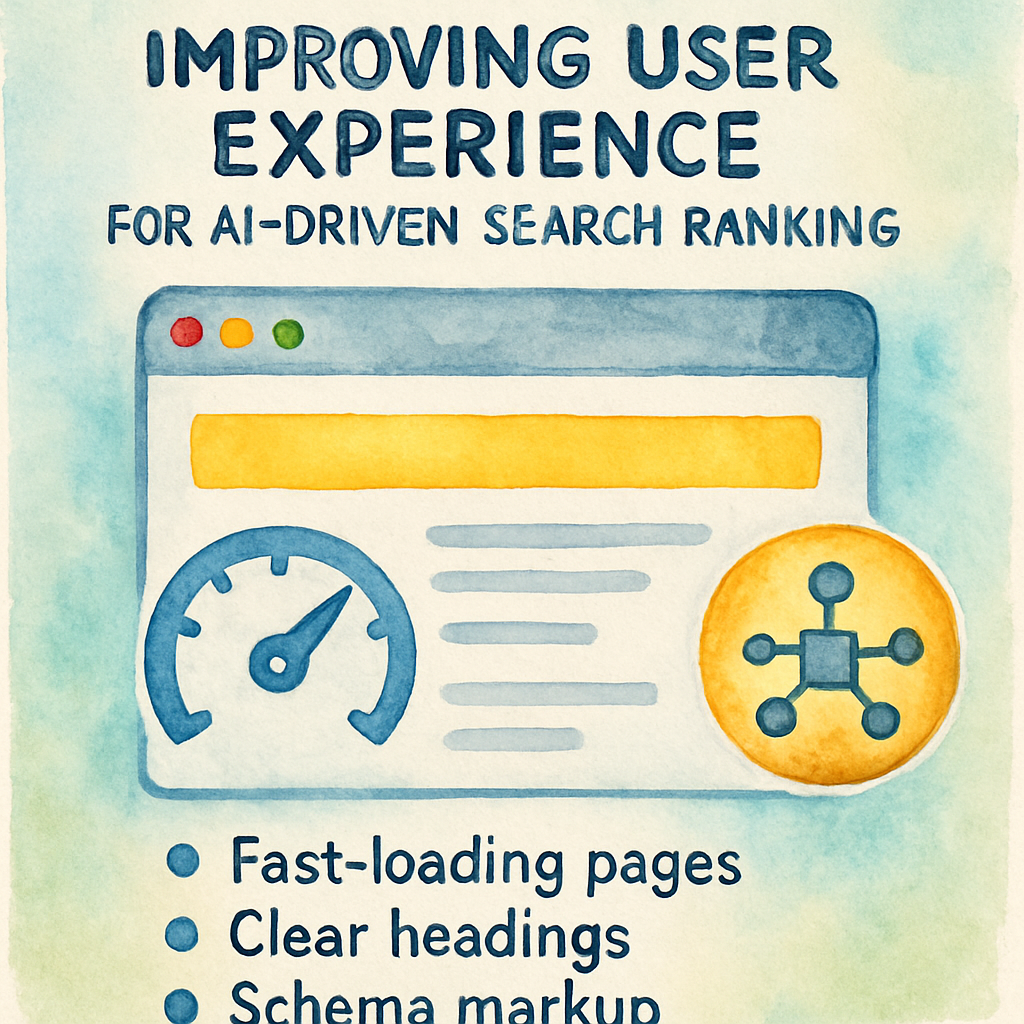
Step 4: Improve User Experience for AI-Driven Search Ranking
Let’s be honest: AI-driven search isn’t just about stuffing keywords anymore. It’s about creating experiences that AI recognizes as genuinely helpful and trustworthy. If your website feels like a maze or your info is buried under jargon, guess what? AI won’t pick you as a top source.
So, where do you start to improve user experience (UX) that boosts your AI search ranking? Here’s the secret: focus on clarity, speed, and organization. These are non-negotiable if you want your content not just found but cited.
Make your content a breeze to digest
Think about that moment you open a page and it just clicks—headings guide you, bullet points highlight key ideas, answers come fast and clear. AI engines love structured content like this because it mirrors how they parse info.
Break your content into small chunks with descriptive headings that answer specific questions. Use lists, tables, and text highlights to make key points jump out. This style isn’t just user-friendly; it’s AI-friendly.1
Clear, concise content that answers intent directly increases the chances your page will feature in AI overviews or voice search answers. It’s like you’re giving AI the exact blueprint to pull citations from.
Speed matters like never before
You know that sinking feeling when a site takes forever to load? Your visitors feel it, and so does AI. Search engines factor site speed tightly into rankings since slow loads translate to bad UX.
Fix this by optimizing images, cutting unnecessary scripts, and choosing a reliable host. Tools like Google’s PageSpeed Insights pinpoint problem areas fast.2
Faster sites don’t just hold human attention better; they also get boosts in indexing and ranking, which means more chances to rank high in AI-driven results.
Organize with schema and internal linking
We touched on schema earlier, but here’s why it’s critical for UX with AI: it helps search engines understand your content contextually. This means AI can more confidently use your info as a source reference.
Pair schema with smart internal linking. Link related articles and key pages naturally to reduce bounce rates and show AI your site's depth and authority.
Don’t underestimate this combo—it’s part technical, part editorial, and totally worth the effort to increase AI citations.3
Why human authority still rules
Lastly, AI is getting smart about who’s really an expert. That means a clean, trustworthy site with real user signals like engagement and backlinks counts. Your UX should inspire trust: easy navigation, clear calls-to-action, and visible contact info all play a part.
Getting these basics right means AI engines not only find your content but believe in it enough to cite it. And that’s the new SEO game.
If you want to dig deeper into these UX improvements and how to automate content optimization seamlessly, check out our step-by-step guide on how to automate SEO content creation for scalable organic growth. It’s packed with smart insights and practical steps.
Remember, your goal is to be the obvious, trusted choice AI wants to pull from—not just a site that ranks but one that earns authoritative citations.
Want an edge that AI can’t ignore? Start by running a UX audit focused on speed and clarity. Fix one big usability issue today—it might just tilt AI citations in your favor tomorrow.
Oh, and speaking of trust, if you’re curious about quick real-world examples of clear documentation helping folks, this detailed listicle on impounded car insurance documents nails it with clarity and structure. That’s exactly the kind of content AI rewards.
Step 5: Evaluate and Use the Best AI SEO Tools
So, you’ve been hustling to “optimize for AI search,” but how do you actually know if your efforts are landing where they should? It’s one thing to create great content and syndicate it, but without the right tools, you’re flying blind. The landscape is shifting fast, and the AI engines don’t rank pages the old-fashioned way anymore—they pick what to cite, how to combine sources, and how to generate those neat answers users see in chatbots and AI search results.
That’s why getting your hands on the right AI SEO tools is non-negotiable. They show you where your brand and content show up across AI-driven platforms like ChatGPT search, Perplexity, Microsoft Copilot, and Google’s AI Overviews. And yes, the granularity and freshness of this data can make or break your next move.
Why Traditional Rank Trackers Aren't Enough
You might be thinking, “Can’t my usual SEO tools do this?” Not quite. Classic trackers focus on where you land on SERPs—the blue links Google used to be all about. AI search is a different ballgame. Here, being cited within AI-generated answers matters more than traditional rankings.
Some tools are evolving. For example, Advanced Web Ranking (AWR) adds AI-specific SERP feature filters, helping you monitor GPT and AI Overviews within Google results. But even the best classic tools need help to catch emerging, conversational search behavior.
Picking Tools That Work for You
Not all AI SEO tools are created equal. The best ones don’t just spit out data—they help you understand how AI interprets your content and how often your brand gets cited.
Here’s a quick breakdown of some favorites to get you started (Self Made Millennials offers great reviews, by the way):
| Tool | Key Feature | Best For |
|---|---|---|
| Rankscale | Tracks AI citations and entity mentions across platforms | SEO teams wanting detailed AI visibility insights |
| Scrunch AI | Monitors AI visibility across clients with customizable dashboards | Agencies managing multiple brands |
| Semrush AI Analytics | Early AI presence signals integrated with keyword research | Teams looking for smooth AI tracking additions |
Tools like Rankscale offer something unique with their "AI Search Rising Score," a sort of health check on how well your content is doing in AI spaces. Imagine finally knowing if your “alternate pages” or your freshly syndicated Twitter threads are actually making a difference.
But here’s the kicker: No tool is perfect yet. AI search changes fast, and these platforms update features almost monthly. The smart move? Test a few, see which one fits your workflow best, then use them as a lens—not the whole strategy.
How to Make These Tools Work For You
It’s tempting to just glance at dashboards and move on, but the real power comes when you act on insights. Here’s a simple way to integrate AI SEO tools into your routine:
- Set regular check-ins (weekly or biweekly) to review how and where your content is cited.
- Spot topics or keywords where your AI visibility lags and tweak content or syndication accordingly.
- Keep an eye on competitors' citations to find gaps you can fill, especially with your “Alternative” pages or language-specific content.
- Combine AI tool insights with your classic SEO metrics for a full picture—domain authority still matters.
Think about it this way: Your AI SEO tool is your backstage pass, showing you who’s talking about you and where. Use that intel to stay one step ahead rather than scrambling after the fact.
Does this sound like more work? Maybe a bit. But the payoff is worth it. These tools equip you to move beyond guesswork and start optimizing content precisely where AI engines are making decisions.
Curious to explore which tools might match your specific goals and team size? Dive into the detailed review of AI SEO tracking solutions to see features, pricing, and use cases laid out clearly.
At the end of the day, remember: How to Optimize for AI Search isn’t about just having tools. It’s about knowing how to read the signals and turn data into action. Get that right, and AI engines can’t help but notice you.
Conclusion
So, where does this leave you and your content game? If you've felt that sinking feeling of putting in tons of work only to see AI engines cite someone else, you're not alone.
Here’s the thing: How to Optimize for AI Search isn’t just about tweaking a few SEO tricks. It’s about a whole new mindset—building consensus across the internet so AI can’t ignore you.
Think about spreading your message like ripples in a pond. Your blog post is just the splash, but the tweets, LinkedIn shares, helpful Reddit answers? Those are the ripples reaching every corner where AI hunts for answers.
And don’t forget those “Alternative” pages. They’re your secret weapon to pull authority by owning conversations around your competitors. It's like turning their spotlight into your stage.
But remember, you can’t ditch classic SEO—the backbone still matters. Getting backlinks, speeding up your site, and clear on-page SEO all build the trust AI looks for.
Now, what’s the next move? Start syndicating your content like it’s an all-star campaign. Write those social posts, craft your comparative pages, and maybe try a translated version if you’re feeling adventurous.
It might feel like a lot, but trust me—this integrated approach is where today's winning content lives. So don’t just chase rankings, chase citations. That’s the new way to get noticed by AI and human customers alike.
Frequently Asked Questions
What exactly does “being cited” by AI mean?
Great question. Unlike traditional SEO where your goal is to rank and get clicks, with AI search, you want the AI to use your content as a source when it crafts answers. So, it’s not just about showing up in results — it’s about becoming a trusted reference the AI quotes. When that happens, you’re winning the new game.
How can I make sure AI finds my content across the web?
It’s all about creating multiple touchpoints. Instead of just one blog post, spread your ideas across tweets, LinkedIn posts, Reddit answers, even forums. AI engines crawl everywhere, so when they see your brand popping up at several points discussing the same topic, it builds consensus — that’s the secret sauce.
Is building “Alternative” pages really worth it? Isn’t that just giving my competitors attention?
Funny enough, you’re not helping your competitors here. You’re positioning your site as the go-to authority on comparisons. When you publish a page listing the best alternatives — yes, including your competitors — AI loves that because it’s helpful, objective content. The kicker? The AI often cites your page as the official source, boosting your authority and stealing some of your competitors’ spotlight.
Do I have to produce content in multiple languages to win at AI search?
Not necessarily, but it’s a huge edge if you can. AI models tend to prefer native-language content when answering questions. So, if you serve markets in Spanish, French, or German with well-translated, high-quality content, you’re swimming in less competitive waters. It’s like finding an untapped goldmine in the vast SEO landscape.
Is classic SEO completely dead with this new AI-focused approach?
Absolutely not. Classic SEO — think backlinks, site speed, on-page optimization — remains the foundation. AI engines still look at these factors when vetting sources. So, your GEO strategy (that’s Generative Engine Optimization) sits on top of a strong SEO base. Without that, you’re building on quicksand.
How often should I syndicate and update my content to keep that AI consensus strong?
No “set it and forget it” here. Syndicating once isn’t enough. You want to create a steady stream of related content that reinforces your main ideas across platforms over time. Think of it like watering a garden — consistent care keeps your authority growing and visible.
Can tools really help automate syndication and backlink building for this strategy?
Honestly, yes. Managing all these touchpoints manually is exhausting. Platforms that analyze your niche and competitors can automatically generate SEO-optimized articles and build high-quality backlinks. It’s the easiest way to scale your authority without burning out. And when you combine automation with smart strategy, you’re way ahead.
So, what’s your next move? Start thinking beyond Google ranking — build your brand’s footprint everywhere AI looks. Keep feeding those content ripples, and soon enough, you won’t just rank. You’ll get quoted.