
Creating a buyer persona isn't just a marketing exercise; it's about deeply understanding your audience, spotting common threads in their behaviors and goals, and then weaving those insights into detailed, fictional profiles. These profiles need to feel real enough to steer your marketing decisions with confidence.
Moving Beyond Guesswork in Marketing

Let's be real: marketing to a vague, undefined audience is like shouting into a canyon. You might get an echo back, but you're not starting a conversation. This is exactly why detailed, data-backed personas are a non-negotiable for any business that's serious about growth. They shift your marketing from a generic broadcast into a focused, personal dialogue.
Of course, before you can truly ditch the guesswork and define your personas, you need a solid grasp of understanding market segmentation. Think of personas as the human face you put on those segments, which makes them far more relatable and actionable.
The Real-World Impact of Personas
Imagine you sell project management software. Targeting "small business owners" is way too broad. That net catches everyone from a solo freelance photographer to the owner of a 50-person construction company. Their day-to-day needs, challenges, and buying habits couldn't be more different.
Now, let's get specific. What if you target "Startup Sam," a tech-savvy founder managing a remote team of ten? Suddenly, the picture gets crystal clear. You know Sam is all about efficiency, struggles to keep projects on track across time zones, and probably scours tech blogs for software recommendations. Just like that, your marketing has a clear direction. You know what content to create, where to share it, and which pain points to hit in your messaging.
A well-crafted buyer persona does more than guide marketing. It aligns your entire organization—from product development and sales to customer support—around a single, clear vision of who you're serving.
Turning Data Into Direction
The benefits of this focused approach aren't just theoretical; they show up in the numbers. Companies actively using personas see tangible results. For example, persona-driven marketing can boost email click-through rates by 14% and conversion rates by 10%.
What's more, over 60% of companies that refreshed their personas within the last six months blew past their lead and revenue goals. This just goes to show how powerful it is to stay in sync with your audience's evolving needs.
Ultimately, building a buyer persona isn't a task to just check off your list. It’s a core business strategy that directly impacts your bottom line.
- Lead Quality: You start attracting prospects who are a much better fit for your solution.
- Engagement: Your content resonates on a deeper level, building genuine trust.
- Return on Investment (ROI): Your marketing budget is spent wisely, reaching the right people with the right message.
Gathering the Right Insights for Your Personas
Authentic personas are built from real, hard data—not just boardroom assumptions. This is your chance to finally move beyond guesswork and get to know the human beings on the other side of the screen. To do that, you need to gather raw materials from several different places to build a complete, nuanced picture.
The best process blends two distinct types of data: qualitative data (the "why" behind their decisions) and quantitative data (the "what" and "how many"). For example, your analytics can tell you what path a user takes from a blog post to a purchase. But only an interview can tell you why they felt compelled to take that path in the first place. This blend is what makes a persona a powerful, data-driven marketing tool.
Talk to Your Actual Customers
Hands down, the most valuable insights come directly from the people who already chose you. Customer interviews aren't really about your product; they're about understanding their world. Your mission is to uncover their true motivations, daily frustrations, and whatever "trigger event" sent them looking for a solution like yours.
Forget questions like, "Why did you choose us?" Instead, ask questions that tell a story:
- "Can you walk me through the day you realized you needed a fix for [the problem]?"
- "What were the biggest roadblocks you ran into while looking for answers?"
- "What does success look like for you now that you've put that problem behind you?"
These open-ended questions push past generic praise and get you to the good stuff. You’ll hear the exact language they use, learn what they really care about, and get powerful quotes that bring your persona to life.
Tap Your Internal Experts
Your sales and customer support teams are on the front lines every single day. They hold a treasure trove of customer knowledge that, frankly, most companies never touch. They hear the unfiltered feedback, the same questions over and over, and the most common objections that stop a deal in its tracks.
Your frontline teams are a goldmine of qualitative data. Schedule regular, informal chats with them to ask what they're hearing. You'll uncover patterns and pain points that analytics alone will never show you.
Make it a habit. A quick 15-minute sync-up with your support lead can reveal more about a customer’s real-world challenges than hours spent digging through spreadsheets.
Use Surveys and Analytics to Scale Your Research
While interviews give you depth, surveys and analytics deliver the breadth you need. They help you confirm if the themes you heard in a few one-on-one calls hold true across a much larger audience.
Here’s how to put them to work:
- Targeted Surveys: Send short, focused surveys to different segments of your email list. Ask about their biggest challenges, their go-to social media platforms, or the tools they can't live without. Keep it brief to get more responses.
- Website Analytics: Dive into your website's user flow. Where do your best customers come from? Which content gets the most attention? This data is a direct window into their interests and how they research solutions.
- CRM Data: Your Customer Relationship Management system is packed with key demographic and firmographic details. Look for common threads among your best customers—things like company size, industry, or job titles.
By weaving these methods together, you build a multi-dimensional view of your customer. It’s this solid foundation that turns your persona from a fun, fictional character into a genuinely strategic tool. And once you have these insights, our AI SEO Checklist can show you exactly how to optimize your content for them.
Finding the Patterns in Your Customer Data
You've done the hard work of gathering insights—now you're sitting on a pile of interview transcripts, survey responses, and analytics reports. This is where the real magic happens. It's time to sift through all that raw information and find the recurring themes that will become the backbone of your buyer personas.
Your first job is to stop thinking about individual customers and start looking for the common threads that tie them together. You’re not just grouping people by job title; you’re digging deeper to find shared motivations, challenges, and goals. This is the crucial step where messy data transforms into clear, strategic segments.
This infographic breaks down the process of moving from initial contact to actionable analysis.
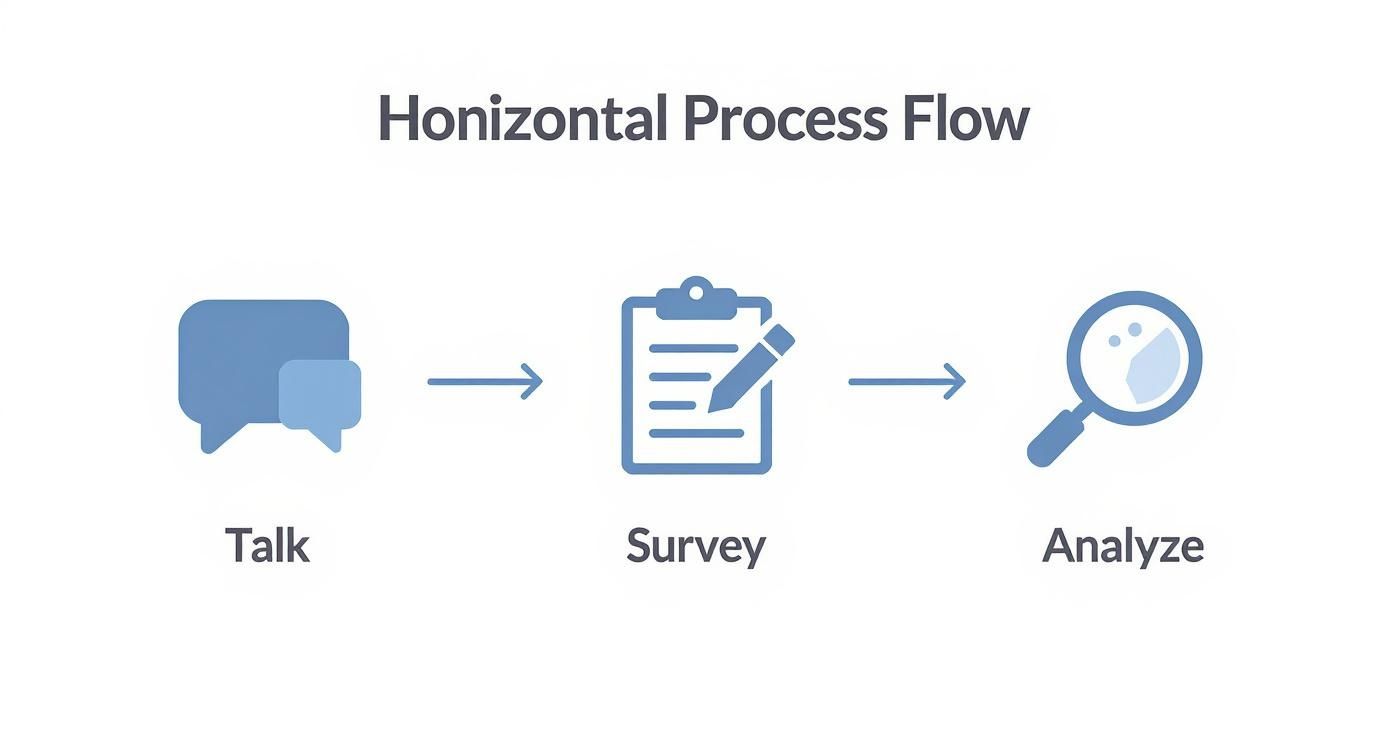
Each stage builds on the last, making sure your final analysis is grounded in both qualitative stories and hard numbers.
From Raw Data to Persona Groups
Start by getting your qualitative data organized. Pull out key quotes, pain points, and success metrics from your interview notes. Honestly, a simple spreadsheet is perfect for this. As you go, you’ll start to see certain phrases and problems popping up over and over.
For example, you might notice that multiple customers mentioned "struggling to keep remote teams aligned" or "needing a single source of truth for project updates." These are your first clues.
Now, create clusters based on these shared challenges. You might have one group obsessed with efficiency and another focused on budget control. These behavioral clusters are way more insightful than simple demographic buckets.
Validate Your Insights with Hard Numbers
Once you have your initial qualitative groupings, it’s time to back them up with quantitative data from your analytics and CRM. If one of your emerging personas seems to be "Startup Sam," who values speed and integration, your analytics should tell a similar story.
Look for evidence that supports your narrative:
- Behavioral Data: Does the "Startup Sam" segment visit your integration pages more often? Do they spend more time on articles about productivity hacks?
- Demographic Data: Do these users typically come from companies with fewer than 50 employees?
- Acquisition Channels: Did they find you through a specific tech blog or social media platform?
This blend of qualitative stories and quantitative proof is what gives your personas their power. It turns a good guess into a reliable tool. The evolution of buyer personas now often includes advanced statistical methods to create more dependable profiles, reducing bias and uncovering patterns you might otherwise miss. You can discover more insights about this hybrid approach on delve.ai.
This table shows how different data points can be translated into persona insights.
Data Source vs Persona Insight
| Data Source | Example Data Point | Persona Insight Derived |
|---|---|---|
| User Interviews | "We waste hours switching between apps just to track project status." | Pain Point: Tool fragmentation is killing productivity. This persona values all-in-one solutions. |
| Google Analytics | High traffic to "API & Integrations" page; low bounce rate. | Goal: Wants to connect your tool with their existing tech stack. Seamless integration is a key selling point. |
| CRM Data | Most valuable customers are in companies with <50 employees. | Demographic: Ideal customer is likely a small, agile business or startup. |
| Customer Surveys | Rated "Ease of Use" as the most important feature. | Motivation: Prioritizes a simple, intuitive user experience over a complex feature set. |
By connecting the why from your interviews with the what from your analytics, you create a solid foundation for building persona profiles that are both empathetic and accurate.
The goal is to confidently identify 3-5 core segments that represent your most valuable customers. Any more than that can become unwieldy, and any fewer might be too broad to be actionable.
For more actionable marketing advice and growth strategies, check out the resources on the Rebel A.I. blog.
Building a Persona Profile That Breathes
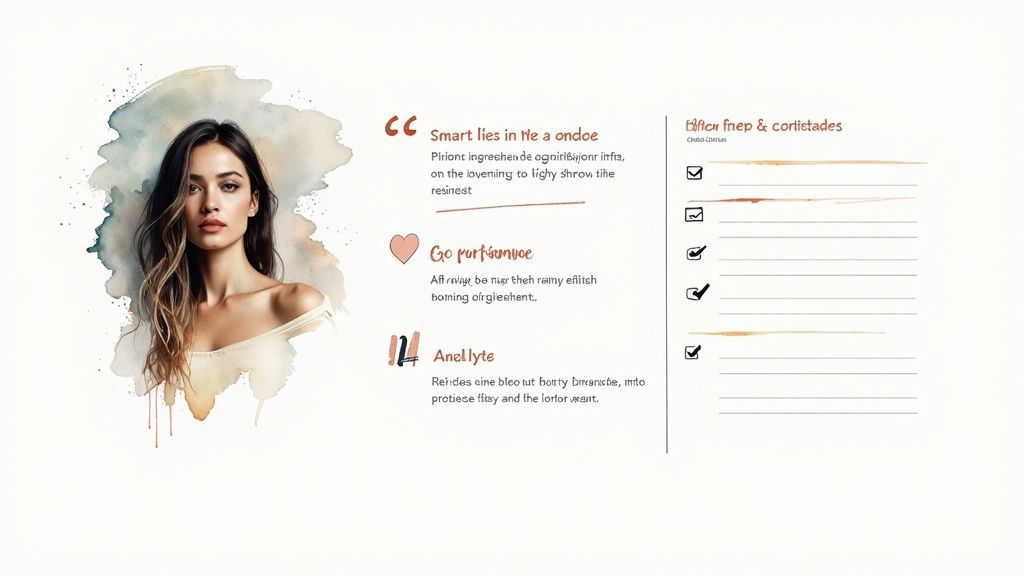
You've done the hard work of research and spotted the key patterns in your data. Now for the fun part: bringing your ideal customer to life. This is where you trade spreadsheets and interview transcripts for a compelling, human profile your team will actually care about and use.
A truly great persona isn't just a list of facts; it tells a story. The whole point is to distill your insights into a simple, one-page reference that makes your ideal customer totally unforgettable. It needs to feel like you're looking at a snapshot of a real person, complete with their own motivations, frustrations, and voice.
Crafting the Core Narrative
First things first, give your persona a name and find a stock photo that feels right for their role and industry. This sounds small, but it's a huge step toward building real empathy. Suddenly, you're not talking about "the target market." You're talking about "Marketing Manager Michelle."
From there, you build out the essential details that give Michelle context and depth. This simple framework makes sure you're hitting the critical insights that will actually drive your strategy.
- Role & Responsibilities: What does her job title really mean? Get specific about her key responsibilities and the metrics she's judged on.
- Goals: What does a "win" look like for her, both at work and in her personal life? This could be anything from "earning a promotion by improving lead quality" to "leaving the office by 5 PM to have dinner with her family."
- Challenges: What roadblocks are constantly in her way? Pull direct quotes from your interviews here—they make the pain points feel so much more real.
This foundational info sets the stage, giving you a clear picture of her daily life and what makes her tick.
A well-built persona bridges the gap between raw data and genuine empathy. It forces you to see your product and marketing through your customer’s eyes, asking "How does this help Michelle solve her problem?"
Adding Authentic Details That Stick
To make your persona truly memorable, you need to layer in the details that paint a vivid picture of their world. This is where your qualitative research—all those stories and quotes from your interviews—really gets to shine.
Include a 'Day in the Life' Scenario
Try writing a short, first-person story that walks through a typical workday for your persona. What’s the first thing they do when they get to their desk? What meetings are always on the calendar? Which tasks make them want to pull their hair out? This exercise is incredibly powerful for pinpointing exactly where your solution fits in.
For example, Michelle’s day might kick off with her feeling completely overwhelmed trying to juggle three different marketing platforms before she's even had her first coffee. That single detail is way more powerful than just listing "needs better tool integration" as a generic pain point.
Document Their Decision Drivers
Finally, pull together everything you learned about how they make purchasing decisions. Create a quick summary that answers these key questions:
- Watering Holes: Where do they hang out online to get information? List the specific blogs, influencers, or social media groups they actually trust.
- Motivations: What's pushing them to look for a new solution in the first place? Is it a desire for efficiency, pressure to cut costs, or a mandate to innovate?
- Barriers: What are their biggest hesitations or objections? Think budget constraints, fear of a painful implementation, or just plain loyalty to a competitor.
When you combine a strong core narrative with these practical, real-world details, you create a living document. You create a persona that actually breathes and helps guide your entire team toward making smarter, more customer-focused decisions.
Putting Your Personas to Work Across the Business
https://www.youtube.com/embed/aLYT9tbD2EE
Creating a detailed buyer persona is a huge milestone. But let's be honest—its true power is only unlocked when it leaves that dusty folder and actually gets put into your team's daily workflow.
A persona profile isn't a trophy to admire. It's a practical tool, a compass designed to sharpen decision-making across your entire organization. Its real value comes from being used, consistently.
When your personas become part of your company's DNA, every team starts speaking the same customer-centric language. This alignment ensures every decision—from a single email subject line to a major product update—is made with a clear, shared picture of the customer in mind.
How Marketing Teams Win with Personas
For marketers, personas are the ultimate cure for generic, "spray and pray" content.
Instead of brainstorming topics in a vacuum, your team can ask, "What would 'Startup Sam' find genuinely useful this week?" This simple shift leads to marketing that actually resonates and, more importantly, works.
A well-defined persona directly informs several key marketing activities:
- Content Strategy: You can finally create blog posts, guides, and videos that directly tackle your persona's biggest pain points and aspirations.
- Email Personalization: Segment your email lists by persona. This lets you send targeted messages that speak their language and solve their specific problems.
- Channel Selection: You'll know exactly where your personas hang out online, allowing you to focus your ad spend and social media efforts where they’ll have the most impact.
Once you've defined your buyer personas, the logical next step is to use them to implement effective segmentation and personalization strategies that drive real results. This is where you truly start tailoring the customer journey from start to finish.
Personas transform your marketing from a wide-net broadcast into a series of meaningful, one-on-one conversations. You stop shouting into the void and start whispering valuable advice directly to the people who need to hear it.
Sales and Product Development Applications
The influence of a good buyer persona extends far beyond the marketing department. It's a critical guide for your sales and product teams, helping them connect with and build for your ideal customer more effectively.
Your sales team can use personas to sharpen their pitch and anticipate what a prospect really needs. By understanding a persona's primary motivations and potential objections, they can tailor their conversations, making them feel less like a sales call and more like a helpful consultation.
For instance, they'll know whether to lead with hard data on ROI or focus on ease of use. This insight helps them build rapport and close deals faster.
Meanwhile, your product developers can use personas as a north star for prioritizing new features. When faced with a long list of potential updates, the team can ask, "Which of these will solve the most significant problem for 'Marketing Michelle'?"
This ensures your development resources are spent creating solutions that customers will actually value and use. It directly links your product strategy to real user needs. You can learn more about crafting pages that resonate by studying how to build high-converting landing pages.
Common Questions About Building Buyer Personas
Even with a clear process, a few common questions always pop up when teams dive into creating buyer personas. Answering these early on can save you a ton of headaches and make sure your personas become genuinely useful tools, not just another file collecting digital dust. Let’s tackle some of the most frequent ones I hear.
How Many Buyer Personas Do We Actually Need?
This is, without a doubt, the number one question people ask. And the answer is almost always, "fewer than you think." It's tempting to create a persona for every tiny variation you see in your customers, but that path usually leads to a messy, unusable pile of documents that no one can keep straight. The goal isn't to capture every single customer type; it's to represent your most significant, valuable segments.
For most businesses, starting with three to five well-defined buyer personas is the sweet spot. This is a manageable number for your teams to actually remember and use, but it's also enough to cover the core motivations driving your best customers.
Now, if you have wildly different product lines or serve completely distinct markets (like B2B vs. B2C), you might need a separate small set of personas for each. The key is to prioritize quality and depth over sheer quantity. A persona is only useful if it represents a group big enough to matter to your strategy.
How Often Should We Update Our Personas?
Buyer personas are not a "set it and forget it" exercise. Markets change, your customers' needs evolve, and new challenges are always popping up. A persona you built three years ago probably doesn't capture the reality of your ideal customer today.
As a rule of thumb, plan on giving your personas a formal review and refresh at least once a year.
That said, you should be ready to revisit them sooner if something big happens. Look for triggers like:
- A major product launch: This could bring in a totally new type of customer or shift the priorities of your existing ones.
- Entering a new market: You’ll need to build new personas from scratch with fresh research for that specific audience.
- A noticeable shift in customer feedback: If your support team keeps hearing new complaints or your sales team is running into new objections, that's a huge signal that your customers' world has changed.
Think of your personas as living documents. They should grow and adapt right alongside your business.
What If Our Customers Are Really Different?
It's completely normal—and actually a good thing—to have a diverse customer base. The point of a buyer persona isn't to cram everyone into the same box. It’s about finding the meaningful patterns within that diversity.
If your research uncovers a few distinct customer groups with fundamentally different goals and motivations, that’s a win! It means you've correctly identified your key segments. Each of those groups deserves its own persona.
For instance, a software company might have one persona for the hands-on "Technical User" who lives in the product daily, and another for the "Strategic Decision-Maker" who only cares about ROI and business impact.
These two people have completely different goals, challenges, and ideas about what "success" even looks like. By creating separate profiles, you can tailor your messaging to speak directly to each one's unique world instead of trying (and failing) to be everything to everyone.