
An enterprise SEO strategy is a large-scale game plan for boosting search visibility on massive websites—we’re talking sites with thousands or even millions of pages. This isn't about tinkering with individual pages one by one. It’s about creating scalable, automated, and repeatable systems that drive organic growth across the entire business.
What Is Enterprise SEO, Really?
Think of standard SEO as building a custom home. It takes skill, a sharp eye for detail, and a solid blueprint. You're focused on one structure, making sure every window and wire is perfect.
Enterprise SEO, on the other hand, is like designing and constructing a skyscraper. The basic principles of architecture are the same, sure, but the scale is monumental. The tools, the processes, the teams, and the number of things that can go wrong are all exponentially greater.
This isn’t just "doing more SEO." It’s a total shift in thinking—moving away from one-off campaigns and toward building a predictable engine for organic growth.
A New Level of Complexity
The sheer size of an enterprise website brings a whole new set of challenges that smaller sites just don't face.
For instance, you can't manually create internal links for a site with a million pages; you need automated systems to build a logical site architecture. You don't just "create content"; you build a scalable content engine that can churn out quality material for countless topics.
This is why an enterprise SEO strategy lives and dies by three core ideas:
- Automation: Using technology to handle tasks that are flat-out impossible for humans to manage at this scale, like technical audits, internal linking, and generating metadata.
- Scalability: Building frameworks and processes that work just as well on page 1,000 as they do on page 1,000,000, across multiple subdomains and even international markets.
- Collaboration: Weaving SEO into the DNA of other departments. It has to be part of the conversation with IT, product development, and marketing to make sure changes actually get implemented right the first time.
To really nail down the differences, let's look at a quick comparison.
Standard SEO vs. Enterprise SEO at a Glance
This table breaks down the fundamental shift in approach when you move from building a house to building a skyscraper.
| Aspect | Standard SEO (Building a House) | Enterprise SEO (Building a Skyscraper) |
|---|---|---|
| Scale | Tens to hundreds of pages. Manageable manually. | Thousands to millions of pages. Impossible without automation. |
| Tools | Standard analytics, keyword tools, and crawlers. | Advanced, custom-built tools; large-scale data platforms. |
| Focus | Ranking for specific, targeted keywords. Campaign-based. | Capturing market share across entire topic verticals. System-based. |
| Team | Small team or single specialist. | Large, cross-functional teams (IT, content, product, SEO). |
| Risk | A single bad change has limited impact. | A single bad change can cost millions in lost revenue. |
| Process | Ad-hoc tactics and manual implementation. | Standardized, repeatable processes and automated workflows. |
As you can see, enterprise SEO operates on a completely different plane of existence, where automation and global strategy aren't just helpful—they're essential for survival.
The following infographic drives this point home, visualizing the jump in complexity.
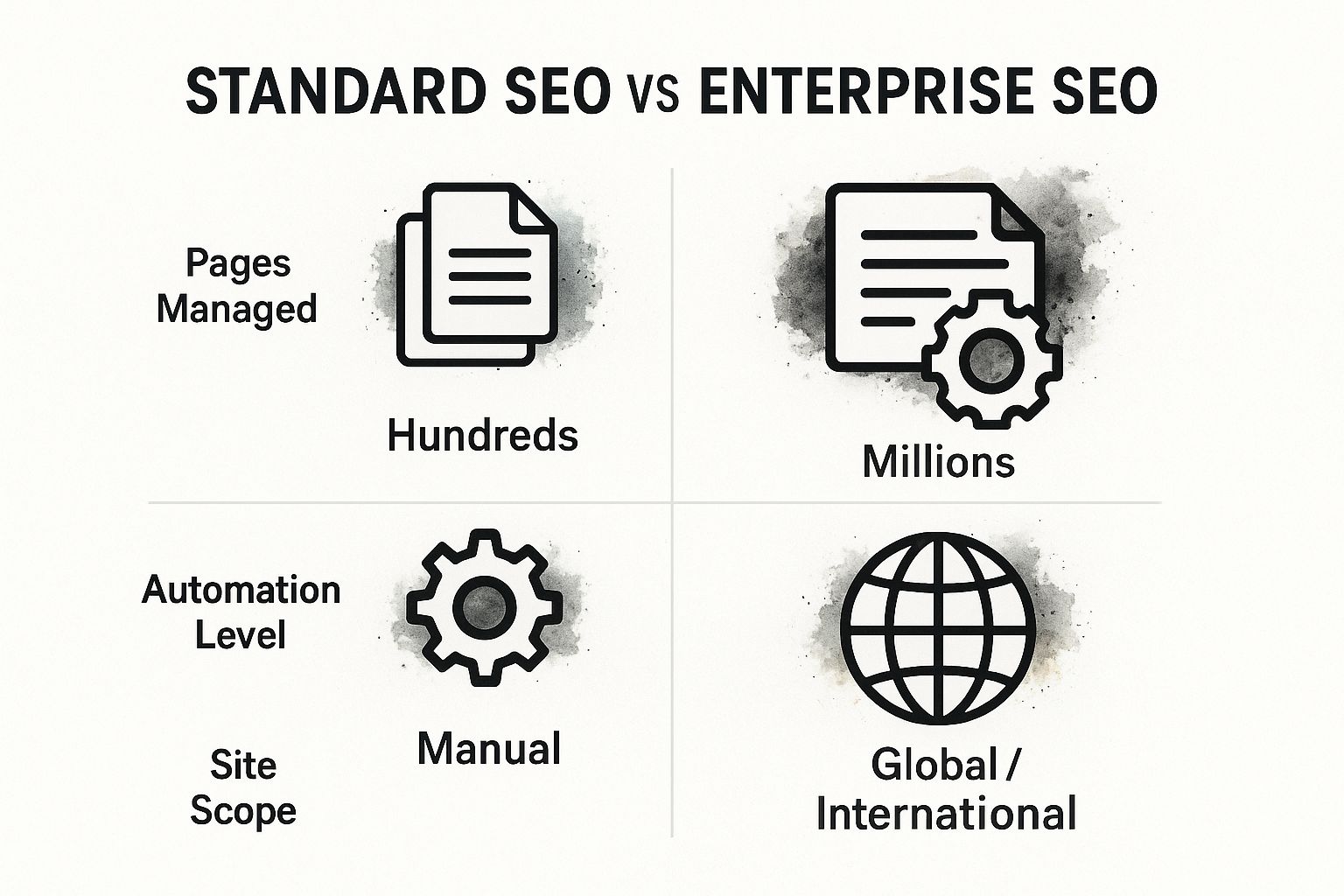
As the graphic shows, moving from hundreds of pages to millions demands a total reliance on automated systems and a big-picture, global perspective.
The True Goal of Enterprise SEO
At the end of the day, enterprise SEO isn't just about ranking for a few keywords. It's about aligning organic search performance with high-level business goals—driving revenue, growing market share, and supporting every single business unit. To see how this powerful approach drives results, you can find more growth-focused insights on the RebelGrowth blog.
An enterprise SEO strategy transforms organic search from a marketing channel into a core business asset. It's about building a sustainable competitive advantage that is difficult for smaller competitors to replicate.
Of course, before you can build a skyscraper, you need to understand the laws of physics. If you're new to the game or just want a refresher on the basics, it's worth taking a look at the fundamental principles of SEO in digital marketing.
Building Your Technical SEO Foundation

Think of a massive website with millions of pages like a skyscraper. You can't just slap a fresh coat of paint on a crumbling foundation and expect it to hold up. An effective enterprise SEO strategy is built on an unshakeable technical framework that can handle immense scale and constant change.
Forget about manual fixes and one-off tweaks. At this level, the game shifts to creating robust, automated systems that enforce site-wide consistency. This isn't about adjusting a few meta tags; it's about architectural integrity that prevents problems before they ever hit your bottom line.
Mastering Crawl Budget at Scale
Search engine crawlers, like Googlebot, don’t have unlimited time and resources to spend on your site. This is your crawl budget. For a small blog, it’s rarely an issue. For an enterprise site, it's a mission-critical resource you have to manage with military precision.
If you let Googlebot get lost wandering through millions of low-value pages—like outdated product listings or a maze of filtered navigation—it might run out of time before it ever finds your most important content. That's a disaster.
Your job is to guide crawlers directly to your high-priority pages and steer them away from digital dead ends. This is done with systematic, automated rules, not page-by-page fixes.
- Programmatic Canonicalization: Set up rules to automatically apply
rel="canonical"tags across entire page templates. This ensures that as new pages are created, you’re already ahead of any potential duplicate content issues, telling crawlers exactly which version is the master copy. - Intelligent
robots.txtManagement: Yourrobots.txtfile is the traffic cop for search engine bots. It's not a set-it-and-forget-it document. It needs to be strategically managed to block off sections with zero SEO value, saving that precious crawl budget for the pages that actually make you money. To dive deeper, check out our guide on how to create a proper robots.txt. - Automated Parameter Handling: For e-commerce sites, URL parameters from filters and tracking can create a nearly infinite number of duplicate pages. You need to set up rules in your CMS and Google Search Console to tell crawlers which parameters to ignore, stopping crawl budget waste in its tracks.
A tiny 0.1-second improvement in mobile site speed can lead to an 8.4% increase in retail conversions. Technical SEO isn't just a backend chore; it directly impacts revenue by creating a faster, smoother user experience.
Automating Technical Health Monitoring
Manually auditing a million-page website is impossible. By the time you finished, the data would already be useless. That’s why enterprise teams rely on automated technical monitoring to catch problems the moment they happen.
Think of these systems as an early-warning alarm. They flag issues like a sudden spike in 404 errors, broken internal links, or creeping redirect chains before they can escalate into a full-blown crisis and cause your rankings to tank.
Implementing Schema Programmatically
Structured data, also known as schema markup, is the language search engines use to really understand your content. It’s the magic behind the rich snippets you see in search results—things like star ratings, prices, and FAQs.
For an enterprise, manually adding schema to every single product or article is a non-starter. The only scalable solution is to implement it programmatically.
By baking schema directly into your page templates within the CMS, you guarantee that every new page is automatically marked up with the correct structured data from the moment it's published. An e-commerce site, for instance, can apply Product schema to millions of pages, dynamically pulling in the current price, stock availability, and review data without anyone lifting a finger.
This approach transforms technical SEO from a reactive, manual chore into a proactive, automated engine for growth. It creates a resilient foundation that supports complexity and drives real business results at a scale that would otherwise be completely unmanageable. It’s the architectural bedrock of any successful enterprise SEO strategy.
2. Creating a Scalable Content and Keyword Engine

At the enterprise level, the sheer volume of user needs can feel overwhelming. Trying to create quality content for thousands of unique search intents is a recipe for failure. You simply can't hire enough writers to tackle every single niche keyword manually.
The only way to win is to stop thinking in terms of individual articles and start building a genuine content engine. This is about designing a system—a machine, really—that pumps out valuable, optimized content at a massive scale, often with a surprisingly lean team. A powerful enterprise SEO strategy is built on this kind of efficiency, allowing you to capture market share across countless topics.
Embracing Programmatic SEO
The real cornerstone of scaled content creation is programmatic SEO. This is all about using templates and structured data to automatically generate hundreds, or even thousands, of unique, valuable pages. Think of it less like writing and more like assembling content.
For instance, a massive e-commerce site with thousands of products available in hundreds of cities doesn't have a team manually writing a landing page for "running shoes in Chicago" and another one for "running shoes in Austin." Of course not. They build a single, perfectly optimized template. That template then pulls in location-specific data—like local inventory, store addresses, customer reviews—to programmatically create a distinct page for every city they operate in.
This is how you target a massive volume of long-tail keywords that would be impossible to go after one by one.
Building Scalable Content Hubs
Another incredibly effective strategy is building out content hubs, also known as topic clusters. The idea is simple: you create a central "pillar" page giving a broad overview of a major topic. That pillar then links out to dozens of more detailed "cluster" pages, each diving deep into a specific subtopic.
At an enterprise scale, this structure achieves two critical goals:
- It Builds Topical Authority: When you comprehensively cover a subject, you send a powerful signal to Google that your site is an authority. This rising tide helps lift the rankings of all related pages.
- It Creates a Scalable Framework: Once that pillar page is in place, you’ve essentially created a content roadmap. Your team knows exactly what cluster content to build next, ensuring every new piece fits perfectly into the bigger strategic picture.
Imagine a global software company. Their pillar page on "Cybersecurity" could branch out to cluster pages covering everything from "phishing prevention tips" to "GDPR compliance for finance teams," allowing them to scale their expertise across different product lines and customer pain points.
An effective enterprise SEO content strategy is less about the individual artist and more about the architect designing a repeatable, scalable blueprint. The goal is to build a system that generates value automatically.
Today's enterprise SEO is a complex game, blending content, technical precision, and AI to drive real business results. A huge part of that is recognizing that 50% of searches include four or more words. This fact alone makes a scalable approach to long-tail keywords absolutely essential. As you can see when digging into the latest enterprise SEO trends on seoprofy.com, there's a major shift toward using AI to build and optimize these workflows.
Leveraging Data and AI for Content Opportunities
At the enterprise level, your internal data is an absolute goldmine for content ideas. Analyzing your own site search data, customer support tickets, and sales team feedback can uncover the recurring questions and pain points your audience has. These are massive content opportunities just waiting to be addressed.
This is where AI becomes a complete game-changer. AI-powered tools can sift through this data at a scale humans simply can't, spotting content gaps and keyword opportunities you'd otherwise miss. They can help automate content briefs, generate outlines, and even create solid first drafts for your human editors to polish. For anyone looking to weave AI into their process, our AI SEO checklist is a great place to start building a smarter workflow.
Once your content engine is humming, you have to know if it's actually working. The next critical step is to accurately measure content performance beyond just views to understand its true business value. This is how you transform your content from a simple cost center into a predictable, revenue-driving machine.
Aligning Your Teams for SEO Success

You can have the best technical frameworks and a world-class content engine, but even the most brilliant enterprise SEO strategy will fall flat if it’s built in a vacuum. I’ve seen it happen time and time again. The single biggest threat to large-scale SEO success isn't an algorithm update; it's internal misalignment.
Without real buy-in and collaboration across the company, your strategy is just another document collecting digital dust. To win, you have to transform SEO from a siloed marketing task into a shared business priority. This means weaving SEO into the very fabric of how other departments operate—from IT and product development to legal and marketing. It’s all about people, processes, and a bit of politics.
Fostering Cross-Functional Collaboration
Let's be real: an enterprise organization is a complex ecosystem of competing priorities. The development team is laser-focused on shipping new features, not fussing over rel="canonical" tags. The content team is measured on how many articles they can churn out, not necessarily on optimizing for search intent.
Your job is to bridge these gaps by making SEO their priority, too. This isn't done through top-down mandates, but through education and finding common ground. Show the product team how SEO insights can lead to a better user experience. Prove to the content team how a few strategic tweaks can double an article's reach.
True collaboration kicks in when other teams stop seeing SEO as a roadblock and start seeing it as a tool that helps them hit their own goals. This is a fundamental shift, moving from a culture of tickets and requests to one of proactive partnership.
Building an SEO Center of Excellence
To make this collaboration stick, many successful enterprises create an SEO Center of Excellence (CoE). Think of this less as a command-and-control department and more as an internal consultancy. The primary mission? To empower, educate, and enable other teams to make smart, SEO-friendly decisions all on their own.
An effective CoE stands on a few key pillars:
- Clear Roles and Responsibilities: Everyone needs to know who owns what. The SEO team provides the strategy and the playbook, but the development team is responsible for the technical implementation. This clarity prevents bottlenecks and the dreaded finger-pointing.
- Accessible Training Programs: Don't just hold one-off training sessions. Develop ongoing programs tailored to different roles. A developer needs to understand crawl budget, while a copywriter needs to master on-page optimization. Keep it practical.
- Standardized Processes: Create a living "SEO playbook" that integrates SEO checks into existing workflows, like the product development lifecycle. This makes SEO a consideration from the very beginning, not a cleanup job at the end.
This structure elevates SEO from a reactive, fire-fighting function to a strategic, proactive force that drives the business forward.
An enterprise SEO strategy only scales when you scale the organization's SEO knowledge. Your goal isn't to be the sole expert, but to create an army of informed advocates across every department.
Proving Value to the C-Suite
At the end of the day, securing resources and buy-in comes down to speaking the language of the C-suite—the language of revenue, market share, and ROI. A dashboard full of keyword rankings means absolutely nothing to a CFO.
You have to translate your SEO metrics into tangible business outcomes. Stop reporting on "organic traffic" and start reporting on "revenue generated from non-branded organic search." Frame your work in terms of its direct contribution to the company's biggest goals.
This is critical when you consider the investment required. For instance, 55% of enterprise-level B2B companies are now spending over $20,000 per month on SEO. This level of spending is precisely why 61% of B2B marketers name SEO as their top inbound marketing priority. The strategic value is massive, and you can explore more data on how B2B leaders are investing in organic search by reading these B2B SEO statistics.
When executives see organic search as a predictable engine for growth, not just a mysterious marketing expense, you unlock the budget and political capital needed to drive real change. That’s how you truly align your teams and build a competitive advantage that lasts.
Choosing the Right Enterprise SEO Technology
You wouldn't try to build a skyscraper with a toolbox you bought at a hardware store. That same logic applies dead-on to enterprise SEO. When you're managing millions of pages, keeping an eye on thousands of keywords, and untangling gnarly technical problems, you need a powerful, specialized technology stack.
Trying to do enterprise-level SEO with basic tools isn't just a bad idea—it's pretty much impossible. Most standard tools just choke on massive datasets. They don't have the automation you need for tasks at scale or the ability to plug into all the other systems a big company uses. Investing in the right tech isn't a "nice-to-have"; it's the foundation of the whole operation.
Core Components of an Enterprise Tech Stack
A solid enterprise SEO tech stack usually nails three critical areas. Each one is designed to tackle a specific set of large-scale challenges that pop up when you're managing a huge digital footprint. Think of these as the absolute non-negotiables for your technology setup.
Your stack has to deliver big in these areas:
- Rank Tracking and Analytics: This goes way beyond just seeing where you rank for a few keywords. These platforms track performance across thousands of terms, in multiple countries, and on different devices. More importantly, they connect those rankings to what the business actually cares about—traffic, conversions, and revenue—giving you the hard data to prove your ROI to the people upstairs.
- Technical Crawling and Log File Analysis: Enterprise websites can be a technical minefield. You need specialized crawlers that can audit millions of pages to find things like broken links, endless redirect chains, and canonicalization errors at scale. Tools that analyze your server's log files show you exactly how search engines are interacting with your site, which is crucial for making the most of your crawl budget.
- Content Optimization and Automation: This is the machinery for your content engine. These tools help you spot content gaps, automate on-page tweaks across thousands of templated pages, and manage internal linking without having to do it all by hand. They're essential for creating and maintaining quality content without needing an army of writers.
Asking the Right Questions Before You Buy
Picking an enterprise platform is a major investment, so you have to look past the slick sales pitch. Your real focus should be on how the technology will actually fit into your company's unique ecosystem. A tool that's a game-changer for one enterprise might be a complete disaster at another.
Before you sign on the dotted line, make sure you get straight answers to these questions:
When you're evaluating enterprise SEO software, the three things that matter most are scalability, data accuracy, and integration. A tool that can't grow with you, gives you shaky data, or can't talk to your other systems will become a roadblock fast.
Get specific with vendors. Ask them point-blank about their capacity to handle your site's scale—how many pages can it crawl? How many keywords can it track? Get clarity on how they guarantee their data is accurate and how often it's refreshed.
And finally, dig into its API capabilities and any ready-made integrations with your CMS, analytics platforms (like Google Analytics), and business intelligence tools. Nailing this due diligence is how you build a powerful, cost-effective tech stack that actually supports your enterprise SEO goals.
Frequently Asked Questions About Enterprise SEO
Even seasoned pros have questions when tackling an SEO initiative at this scale. Let's clear up a few of the most common ones that pop up when you're building out a true enterprise strategy.
How Is Enterprise SEO ROI Measured?
When you're playing in the enterprise space, measuring ROI goes way beyond just tracking keyword rankings. The C-suite doesn't care about vanity metrics; they care about tangible business outcomes.
That means shifting the focus to metrics that hit the bottom line: * Non-branded organic traffic growth is a huge one. It's a direct signal that you're capturing new market share, not just people who already know your name. * Conversion rates from your organic traffic. Are these visitors turning into leads? Are they buying something? This connects SEO directly to revenue. * Customer Lifetime Value (CLV) for users who first found you through a search. This shows the long-term financial impact of your efforts.
A really powerful way to frame the value is to calculate what your organic traffic would have cost if you'd paid for it via PPC. When you can walk into a meeting and say, "Our SEO efforts generated the equivalent of $2 million in paid ad value last quarter," people listen. It turns SEO from a cost center into a massive cost-saver.
What Is the Biggest Mistake in Enterprise SEO?
Hands down, the single most damaging mistake is treating SEO like it's just another marketing channel, siloed off in a corner. It absolutely cannot succeed when it's walled off from the rest of the business.
Enterprise SEO isn't a marketing task; it's a core business strategy. Real success only happens with deep, meaningful collaboration across departments—think IT, product development, content, and the executive leadership. You can have the most brilliant SEO recommendations in the world, but if you don't have buy-in and integrated processes, they'll just gather dust.
Running a close second is failing to build a scalable technical foundation. If your site architecture can't handle tens of thousands—or millions—of pages gracefully, every other SEO effort you make will eventually crumble.
How Long Does an Enterprise SEO Strategy Take to Show Results?
Patience is more than a virtue here; it's a requirement. The sheer scale and complexity of enterprise websites mean you're running a marathon, not a sprint. Anyone who tells you otherwise is selling snake oil.
You can typically expect to see the first signs of positive movement within 6 to 9 months. We're talking about initial traction, not game-changing results.
Substantial, needle-moving impact—the kind that gets noticed in boardrooms—often takes 12 to 18 months to fully kick in. Of course, this timeline can shift based on where you're starting from. The site's initial technical health, how fierce your competition is, and how quickly you can actually get changes implemented all play a huge role.
Ready to build an SEO strategy that truly scales? rebelgrowth provides the AI-powered tools and insights you need to automate content creation, manage complex campaigns, and drive predictable organic growth. See how we can transform your approach at https://rebelgrowth.com.