
When you hear people talk about "citation building" for SEO, they're really talking about one core task: getting your business's Name, Address, and Phone number (NAP) listed consistently across a ton of different online directories and websites.
Think of it as a digital verification process. Every consistent listing is another breadcrumb that helps search engines like Google confirm that your business is real, located where you say it is, and is a legitimate part of the local community. It's a massive trust signal that directly impacts how well you show up in local search.
Why Citations Are Your Local SEO Foundation

Let's be real—citation building isn't just another box to check on a long SEO to-do list. It's the absolute bedrock of local search visibility.
When someone types in a "near me" search, Google has a split second to decide which local businesses are the most credible and relevant. It looks for proof. Hard proof. And consistent NAP listings sprinkled across the web are exactly the kind of evidence it wants to see.
Every time Google's crawlers find your identical business details on a reputable site, it's like another vote of confidence in your favor.
The Power of NAP Consistency
To see why this matters so much, picture two local coffee shops.
Shop A is listed as "Joe's Coffee" on Yelp, but it's "Joe's Cafe" over on Google. To make things worse, an old business blog has a phone number they haven't used in years. It's a mess.
Shop B, "Morning Brew Cafe," has the exact same name, address, and phone number on dozens of sites. The digital footprint is clean, clear, and unambiguous.
Which one do you think Google is going to trust? It's "Morning Brew Cafe," every single time. That trust translates directly into higher rankings, which is why nailing your citations is so critical.
A consistent NAP is non-negotiable for local SEO. It removes ambiguity for search engines and potential customers, building the digital trust necessary to rank in local map packs and organic results.
Structured vs. Unstructured Citations
Your business mentions pop up in two main flavors online, and you really need a healthy mix of both.
- Structured Citations: These are the classic directory listings you see on sites like Yelp, Yellowpages, or even niche-specific platforms (like a directory for local plumbers). Your NAP info is slotted neatly into designated fields, making it super easy for search engines to read and understand.
- Unstructured Citations: This is where things get a bit more organic. These are mentions of your business on blogs, in news articles, or on local forums. For instance, a food blogger might write, "We stopped by Morning Brew Cafe at 123 Main Street for the best latte in town."
While structured citations provide that core, foundational consistency, unstructured mentions show Google that you're a relevant, active part of the local conversation. In fact, businesses with clean and complete citations across key directories can see up to 25% more local search visibility than competitors with messy data. You can dig deeper into citation strategies and their impact to see just how powerful this can be.
How to Uncover High-Impact Citation Sources

Forget about scrolling through endless, generic directory lists. Building citations that actually work is all about quality and relevance, not just piling up as many as you can. The real goal is to find the sources that will genuinely move the needle for your local search rankings.
Your first move? Nail the fundamentals. These are the non-negotiables for any local business. That means getting your Google Business Profile completely dialed in, and then making sure you’re squared away on major players like Yelp, Apple Maps, and Bing Places. Think of these as the concrete pillars of your digital foundation.
Once those are locked down, it’s time to get a little more strategic. One of my favorite tactics is to simply reverse-engineer what’s already working for your top competitors. Using a good SEO tool, you can peek at their backlink profiles and see exactly which directories and websites are sending them traffic and authority. Why reinvent the wheel?
Finding Niche and Geo-Specific Goldmines
Beyond the big names, your true competitive advantage is found in the niche and geo-specific directories. These are the websites that carry serious weight within a specific industry or local area.
Put it this way: a single citation from your city's Chamber of Commerce website or a well-respected industry association is often worth more than dozens of listings on low-quality, generic sites. These hyper-relevant sources send powerful trust signals to search engines.
- Industry-Specific Directories: If you're a law firm, this means getting on sites like Avvo or Justia. For a plumber or electrician, a listing on Angi is a must.
- Geo-Specific Sources: Start digging for city-level business directories, local news sites that feature businesses, or even popular community blogs in your town.
This targeted approach is where you can really pull ahead of the pack. The local SEO space is only getting more crowded—with the industry projected to hit a global valuation of $143.9 billion by 2030—and competition is fierce. It’s no surprise that around 43% of local SEO providers point to citation building and cleanup as a vital tactic for boosting client rankings, as highlighted in this article about the impact of local citations on ewrdigital.com.
Prioritizing Your Citation Opportunities
Let’s be clear: not all citation sources are created equal. You need a system to figure out which ones are actually worth your time. A high-quality source will almost always have strong domain authority, relevant traffic, and straightforward submission guidelines.
Pro Tip: Before submitting to any directory, run its URL through a tool like Moz and check the "Spam Score." If that score is high, it's a major red flag. Getting listed there could do more harm than good.
Core vs. Niche Citation Source Comparison
To help you decide where to focus your energy first, it's useful to understand the difference between broad, core directories and the more specialized niche or local ones. Each plays a different role in your strategy.
| Citation Type | Example | Primary Value | Audience Reach | SEO Impact |
|---|---|---|---|---|
| Core | Yelp, Apple Maps | Foundational trust signals | Broad, general | High (essential for baseline visibility) |
| Niche (Industry) | Avvo (Legal), Angi (Home Services) | High-relevance, authority | Targeted, specific | Very High (strong topical relevance) |
| Niche (Geo) | Chamber of Commerce, City Directory | Hyper-local relevance | Localized | High (powerful local ranking signals) |
Ultimately, a strong citation profile isn't just about the big names or the niche players—it's about a healthy mix of both.
The key is to build a diverse and relevant portfolio. A balanced mix of foundational platforms, competitor-sourced directories, and hand-picked niche sites will create a powerful and resilient digital footprint. This is the heart of a successful citation building SEO campaign.
Creating Your Single Source of Truth for NAP Data
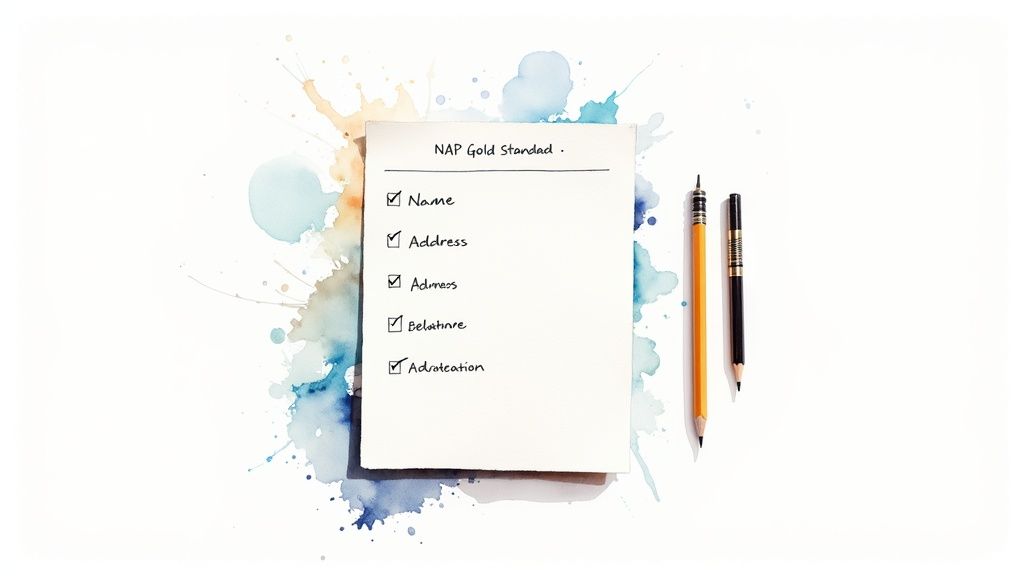
Before you even think about building your first citation, you need a blueprint. A winning citation strategy doesn't start with submissions; it starts with getting your own house in order.
Why? Because even tiny inconsistencies in your business info can confuse the heck out of search engines and water down your local SEO.
Think about the common mistakes we've all seen. A business uses "St." on one directory and "Street" on another. Or they list a suite number as "#200" in one place and "Ste 200" somewhere else. These little slip-ups create conflicting signals for Google. The goal is to get rid of every last bit of that confusion by creating one master file for all your business information.
This document becomes your "gold standard," the single reference point for every submission you or your team ever makes. It’s a simple step, but it ensures everyone is singing from the same hymn sheet, every single time.
What to Include in Your Master NAP Document
Your master file should be more than just the basics. A truly comprehensive source of truth saves you from future headaches and makes the whole citation building process smoother. Get the exact formatting locked down for these key details:
- Business Name: Is it "Smith & Co. LLC" or just "Smith & Co."? Pick one and commit to it.
- Physical Address: Decide on the exact format. This includes nailing down abbreviations for street types (e.g., Ave vs. Avenue) and suite numbers.
- Primary Phone Number: Always use your main, local business line. Avoid tracking numbers here.
- Website URL: Stick with your canonical homepage URL. Don't forget that consistency is just as important across your own digital properties, like your landing pages, to present a unified brand front.
Crucial Takeaway: The name of the game is pixel-perfect consistency. Fire up a simple spreadsheet or document and create a finalized, copy-and-paste-ready version of your NAP and other key business details. Trust me, this small bit of prep work prevents countless headaches later on.
With your standardized NAP data ready to go, it’s time to actually start building citations. You’ve really got two ways to tackle this: doing it all by hand or using an automated service. Each has its place, and the right choice really boils down to your business, your budget, and how much time you have.
The Manual vs. Automated Showdown
Going the manual route is exactly what it sounds like. You or someone on your team will sit down, go to each directory one-by-one, create a profile, and carefully plug in all your business info from that master NAP sheet you created. Yes, it’s a grind. But the big payoff is total control. You can make sure every single listing is perfect—uploading the best photos, writing a compelling description, and choosing the most accurate categories. These are the little details that automated tools almost always miss.
That hands-on approach is a game-changer when you're trying to get into those high-value, niche directories. Think about industry-specific associations or your local chamber of commerce; these listings often need a more personal touch that automation just can't replicate.
On the flip side, automated citation services are all about speed and scale. You enter your business details just once, and the service blasts it out to dozens, sometimes hundreds, of directories at the same time. It’s an incredibly efficient way to build a wide footprint fast and lock in consistency across the big-name platforms. The main drawback? You lose that custom touch and often can't get into the hyper-local or super-niche directories that can give you a real edge.
Key Insight: The smartest play isn't picking one or the other. It's using both. Let an automated service knock out the big, foundational directories. Then, use your manual effort to hunt down those high-impact, niche listings your competitors are probably ignoring.
This hybrid strategy gives you the best of both worlds. You get the broad consistency from automation paired with the detailed, quality optimization that only comes from manual work. A balanced approach also sets you up for the future. As your business grows, you can keep refining your process. If you're looking to bring more advanced tactics into the mix, our AI SEO checklist is a great resource for leveling up your marketing tasks.
Ultimately, the decision comes down to your resources. If you have more time than money, the manual path is a solid choice. But if you need to scale quickly and have the budget for it, automation followed by a targeted manual cleanup is almost always the most effective way to go.
Auditing and Repairing Your Digital Footprint
https://www.youtube.com/embed/vjPuuUpNqmk
Even if you’ve nailed down a perfect master list for your business's name, address, and phone number (NAP), you might already have a messy digital footprint. Old addresses, disconnected phone numbers, and variations of your business name can linger online for years, actively hurting your local SEO.
Running a citation audit is your first move to get things back under control.
The easiest way to start is with a few simple, manual searches. Hop on Google and search for your business name paired with old addresses or phone numbers. You'll probably be surprised by what's hiding out there on forgotten directories or old social media profiles. Every one of these incorrect listings sends a conflicting signal to search engines, watering down your authority.
Prioritizing Your Cleanup Efforts
Once you have a list of incorrect citations, you need a game plan. Not all bad listings are created equal, so don't just dive in randomly.
Focus your energy on the heavy hitters first—platforms like Google Business Profile, Yelp, and Apple Maps. A wrong phone number on a major directory is way more damaging than one on some obscure, low-traffic website nobody's ever heard of.
I always recommend creating a simple spreadsheet to track your progress. For each bad listing, note the URL, what’s wrong with it, and the status of your correction request. This keeps everything organized and makes sure no bad data gets left behind.
Fixing inaccurate citations isn't just an SEO task—it's about the customer experience. A potential customer showing up to a vacant storefront because of an old address instantly destroys any trust they had in your brand.
To get the full picture of your online health, it's also a good idea to periodically perform a comprehensive website audit that looks at technical SEO issues. This wider view helps ensure all the pieces of your digital strategy are working together correctly.
The infographic below breaks down the two main approaches for building out your citation strategy, whether you're cleaning up old listings or starting from scratch.
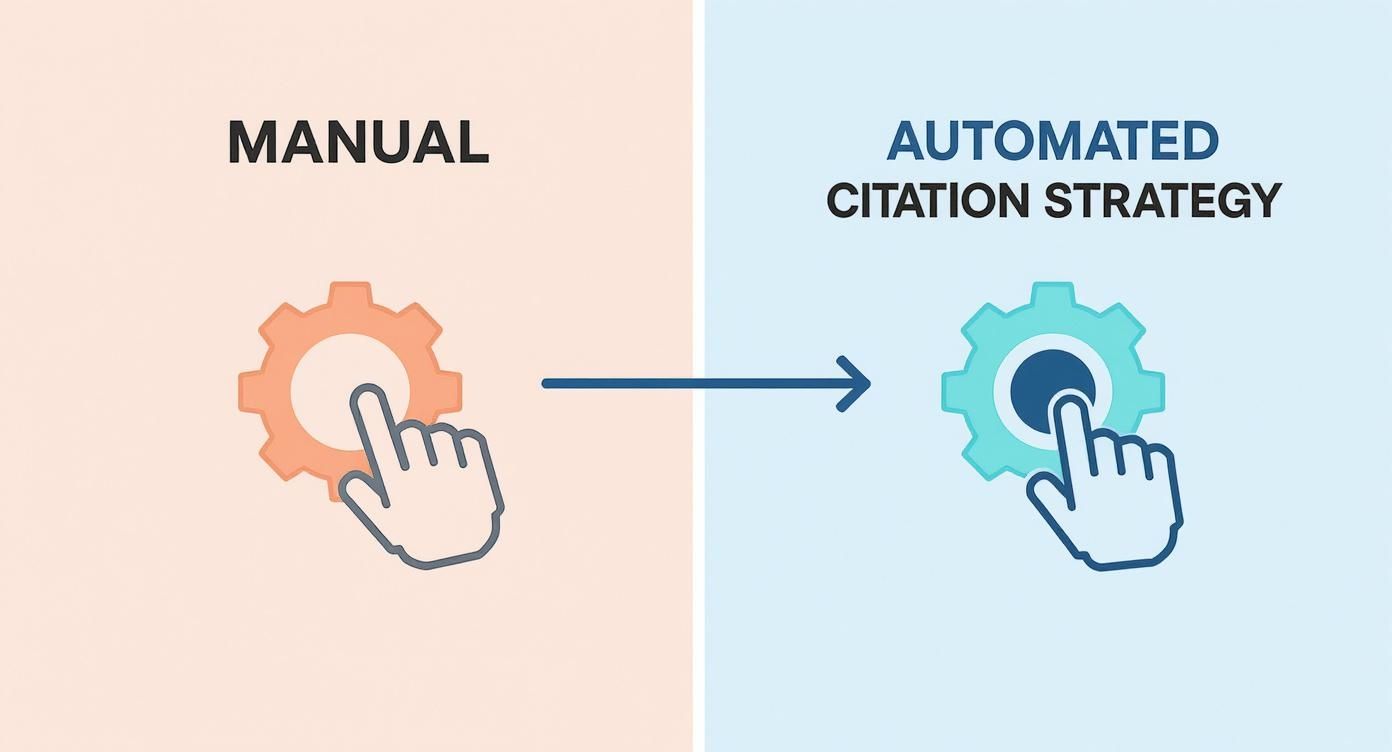
As you can see, manual cleanup gives you total control, while automated tools offer speed and scale. A typical cleanup process involves claiming the listing, verifying that you own the business (usually with a phone call or postcard), and then manually updating the information.
It definitely takes patience, but the payoff is real. These local signals contribute around 7% to local ranking factors, which is a pretty substantial piece of the SEO puzzle.
Common Citation Building Questions Answered
When you're deep in the weeds of local SEO, a few common questions about citation building always seem to pop up. Let's clear the air on some of the biggest ones so you can move forward with confidence.
Probably the number one question I get is, "How long will this take?" It's a fair question, but the answer isn't "overnight." Search engines need time to find, crawl, and then index all these new or updated listings. Realistically, you should start seeing some positive movement in your local rankings within 2-4 months of a consistent citation campaign. Patience is key here.
Another one I hear a lot is, "Do I really need citations if my Google Business Profile is solid?" The answer is a resounding yes.
Think of it this way: Google validates your GBP info by checking it against other reputable sources online. When it sees dozens of consistent citations across the web, each one acts like a vote of confidence, beefing up your GBP's authority and making it a much stronger local ranking signal.
Structured Versus Unstructured Citations
Okay, so what's the deal with "structured" and "unstructured" citations? It's simpler than it sounds.
A structured citation is what you typically think of—a neat, organized listing on a business directory like Yelp or Yellow Pages. Your Name, Address, and Phone number (NAP) are all tucked into specific fields, making it super easy for search engines to read and verify.
An unstructured citation, on the other hand, is more of a casual mention. It could be a local news site writing about your grand opening, a mention in a forum discussion, or even a blogger including your address in a post. To get more advanced strategies like this, the RebelGrowth blog is a great place to dig deeper. Both types are super valuable for painting a complete picture of your business's digital footprint.
Ready to take control of your entire digital marketing strategy? RebelGrowth provides AI-powered tools for content creation, social media management, and backlink networking to help you dominate the search results. Visit us at https://rebelgrowth.com to learn more.