
Guest posting is a classic content marketing play where you write an article for someone else's blog. It's a simple concept, but the goal is powerful: build brand authority, pull in referral traffic, and snag valuable backlinks to boost your site's SEO.
Why Guest Posting Is an SEO Game Changer

This is so much more than a simple link-building chore. Think of it as a core strategy for building credibility with both people and search engines.
When you get a high-quality, relevant piece of content published on a respected site, you're sending a loud and clear signal to Google about your expertise. It helps you build what's known as topical authority.
But it's not just about the links. A single, well-placed guest post can put your brand in front of a fresh, engaged audience. This drives targeted referral traffic back to your site—visitors who are far more likely to be interested in what you have to offer.
Building Authority and Relationships
Every time you land a guest post, you solidify your position as a thought leader in your space. You stop being a faceless brand and become a recognized voice—a trusted source of information.
That kind of credibility is priceless. It often snowballs into other opportunities like podcast interviews, speaking gigs, and future collaborations.
Plus, the relationships you build with editors and site owners are just as crucial as the SEO juice. These connections can turn into long-term partnerships that deliver value way beyond a single backlink.
The Modern Focus: Quality Over Quantity
The spray-and-pray days of churning out low-quality articles for any blog that would take them are long gone. Thank goodness.
Today, successful guest posting is all about strategic, high-quality placements. One article on an industry-leading blog is worth more than a dozen on irrelevant, low-traffic sites.
This is a quick summary of the key advantages of integrating guest posting into your SEO and marketing strategy.
| Core Benefits of Strategic Guest Posting | Primary Impact on Your Business |
|---|---|
| High-Quality Backlinks | Boosts your website's domain authority and search rankings. |
| Increased Brand Authority | Establishes you as a trusted expert in your niche. |
| Targeted Referral Traffic | Drives engaged, relevant visitors directly to your website. |
| Audience Growth | Introduces your brand to new, untapped customer segments. |
| Valuable Networking | Builds lasting relationships with editors and industry influencers. |
Focusing on quality placements ensures your efforts really move the needle on your SEO. Understanding what backlinks are and why they matter is the first step, and guest posting is one of the best ways to earn them. For those looking to really dial in their strategy, our AI SEO checklist can help you find key areas for growth: https://rebelgrowth.com/lp/ai-seo-checklist
The core idea is to shift your mindset from transactional link building to relational authority building. This approach not only aligns with Google's guidelines but also delivers more sustainable, long-term results for your brand.
The numbers back this up, too. Industry data shows that 79% of editors believe guest content is effective for their marketing goals. On top of that, 47% of SEO professionals point to guest posting as their main method for building links, highlighting its vital role in any serious marketing plan.
How to Find A-List Guest Post Opportunities

The entire success of your guest posting campaign boils down to one thing: finding the right places to publish. Seriously. A single guest post on a high-authority blog can drive more results than a dozen articles scattered across low-quality sites.
So, it's time to stop mindlessly Googling "write for us." We need to get strategic. The real goal is to find A-list opportunities—blogs that are respected in your industry and are genuinely looking for expert contributors just like you.
Reverse Engineer Your Competitors' Success
One of the smartest ways to find gold-standard opportunities is to see where your top competitors are getting published. Think about it: if a major blog in your niche has already featured them, they're likely open to similar, high-quality content.
This is where an SEO tool like Ahrefs or Semrush comes in handy. You can plug in a competitor's domain and analyze their backlink profile. This isn't just snooping; it's smart reconnaissance. Filter their links to see which ones come from blog posts, and you’ll quickly build a list of proven, relevant sites that accept guest articles.
Pay close attention to blogs where a competitor has published more than once. That usually signals a strong relationship with the editor—which is exactly the kind of partnership you want to build.
Identify and Follow Influential Guest Bloggers
Every industry has them—the prolific guest bloggers whose names seem to pop up everywhere. These people are basically trail guides, leading you straight to valuable platforms.
Start by identifying a few well-known thought leaders in your space. A quick search for their name plus "guest post" will often turn up a whole portfolio of their work. Follow them on LinkedIn and X (formerly Twitter), where they almost always share their latest articles.
By tracking where they publish, you'll uncover a pre-vetted list of blogs that: * Definitely accept guest posts. No guesswork needed. * Are relevant to your niche. The influencer is in your field, after all. * Have high standards. Reputable experts are picky about where their name appears.
This is way more efficient than starting from scratch because you're piggybacking on the hard work these experts have already done.
By focusing on where the top performers in your niche are publishing, you're essentially getting a pre-qualified list of high-value targets. This saves you countless hours of sifting through irrelevant or low-authority sites.
The online world is incredibly noisy. With around 70 million new posts published on WordPress blogs every month, getting noticed is a real challenge. This flood of content is exactly why finding the right blogs is more important than ever. You can dig into more blogging statistics reports to see just how competitive it is out there.
Vetting Your Guest Posting Opportunities
Once you've got a promising list of sites, the final step is to vet each one. Not every opportunity is a good one, and a single bad placement can be a huge waste of time or even hurt your SEO.
Here’s a quick checklist for qualifying your prospects: * Domain Authority (DA) or Domain Rating (DR): Aim for sites with a DA/DR of 40 or higher. This metric gives you a rough idea of the site's backlink strength and overall authority. * Niche Relevance: This is non-negotiable. The blog's content has to align with your expertise. A link from an irrelevant site just doesn't carry much weight with search engines. * Audience Engagement: Take a look at recent posts. Are people commenting? Are articles getting shared on social media? An engaged audience means your post is more likely to be seen. * Content Quality: Read a few articles. Are they well-written, in-depth, and actually helpful? High-quality content is a great sign of a reputable publication that Google trusts.
This vetting process ensures your hard work pays off, contributing directly to your brand's authority and your SEO goals.
Crafting a Pitch Editors Can't Ignore
You’ve found the perfect blog. Now for the hard part. Busy editors are the gatekeepers here, and they can spot a generic, copy-pasted pitch from a mile away. Trust me, most of those emails go straight to trash without a second thought.
To get a 'yes,' your outreach needs to feel less like a transaction and more like the start of a genuine partnership. This means rolling up your sleeves, doing your homework, and creating a personalized pitch that proves you're a valuable contributor—not just another person asking for a backlink.
The Anatomy of a Winning Pitch
A pitch that actually gets a response has a few key ingredients working together. It starts with a subject line that gets an editor to actually open the email and moves into a body that quickly shows you understand their audience and can provide real value.
Your very first sentence should prove you’re a real reader. Mention a recent article you loved, a specific point an author made, or something you genuinely learned from their content. This one simple act of personalization immediately sets you apart from 90% of the pitches flooding their inbox.
A personalized pitch isn't just about dropping the editor's first name in the greeting. It's about proving you've invested time in understanding their content, their audience, and their goals. This is how you go from being a stranger to a potential collaborator.
This visual shows the whole process, from finding sites to sending the outreach we're focused on right now.
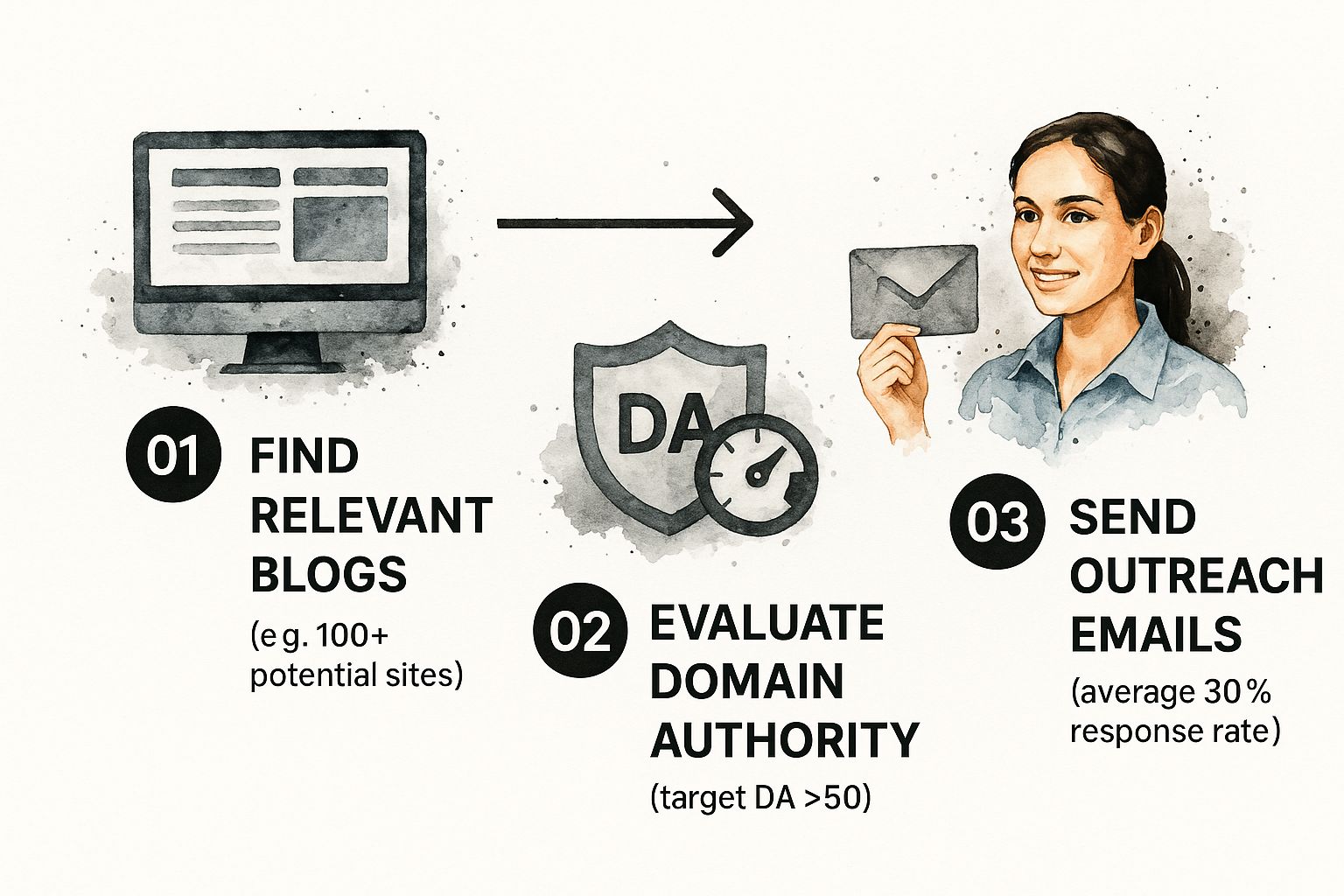 The infographic makes it clear: after all the research, outreach is the final, make-or-break step.
If you want to see what great communication looks like in the wild, studying some solid influencer outreach email templates can give you some killer ideas on what works.
To help you nail this part, use this quick checklist before you click send. It’s a simple way to double-check that you’ve covered all your bases and made your email feel like it was written just for them.
| Pitch Personalization Checklist | ||
|---|---|---|
| Use this checklist to ensure your outreach email is personalized and effective before you hit send. | ||
| Checklist Item | Why It Matters | Example Implementation |
| Personalized Opening Line | Shows you're a genuine reader, not a bot. It builds immediate rapport. | "I really enjoyed your recent article on Core Web Vitals—the section on LCP was a game-changer for me." |
| Relevant Topic Suggestions | Proves you understand their content strategy and audience needs. | "I noticed you haven't covered [Specific Topic] yet, which seems like a natural follow-up to your post on [Topic]." |
| Demonstrated Credibility | Reduces the editor's risk by showing you can deliver high-quality content. | "Here are a couple of pieces I've written on similar topics for [Reputable Site 1] and [Reputable Site 2]." |
| Clear Value Proposition | Answers the editor's "What's in it for me?" question upfront. | "This post would give your readers actionable steps to solve [Problem X], which I see them asking about in comments." |
| Correct Editor's Name & Blog Name | It's a basic sign of respect and attention to detail. Getting this wrong is an instant red flag. | "Hi [Editor's Name], I'm a big fan of the work you're doing over at [Blog Name]." |
Checking these five things can dramatically increase your chances of getting a positive response. It shows you’ve put in the effort, which editors always appreciate.
Proposing Topics That Solve Problems
The real meat of your pitch is the topic ideas. Vague suggestions like "An Article About Marketing" are a complete waste of time. You need to come to the table with specific, well-researched headlines that fit their blog perfectly while filling a gap they haven't addressed.
Look through their recent posts. What are they covering? More importantly, what questions are their readers asking in the comments section? Your goal is to pitch something that feels like it was already on their content calendar.
Here are a few angles I've used to generate topic ideas that get accepted:
- The Keyword Gap: Use an SEO tool to find keywords their competitors rank for but they don’t. Pitch an article built around one of those high-value terms.
- The Update Angle: Find one of their popular posts that’s a bit outdated. Offer to write a completely refreshed version with new stats, insights, and examples.
- The Next-Level Post: Pinpoint a topic they've covered for beginners. Propose a more advanced, deep-dive follow-up for readers who are hungry for more.
When you lay out your ideas, frame each one as a direct solution for their audience. Briefly explain why it would be valuable and what readers will walk away with. This shows you're focused on their success, not just your own.
Proving Your Credibility
Okay, so you’ve hooked them with a personal touch and killer topic ideas. The final piece is proving you're the right person for the job. Editors take a risk every time they publish an outside contributor. Your job is to make them feel 100% confident in saying yes to you.
Don't just say you're an expert—show it.
Drop in two or three links to your best published articles on other reputable sites. This is your portfolio. It instantly shows your writing style, your quality, and your expertise in the subject.
If you don't have a ton of published clips yet, that's okay. Link to the best, most relevant posts on your own blog. The goal is simply to provide clear proof that you can deliver a high-quality article their audience will actually love. This little bit of social proof is often what seals the deal and gets your blog guest posting pitch accepted.
Writing a Guest Post That Gets Published

Getting your pitch accepted is a huge win, but now the real work begins. Your goal isn't just to check a box and submit an article. It's to deliver something so good the editor is thrilled they worked with you. That's how you turn a one-off guest post into a long-term relationship.
Here’s the secret: the best guest posts aren't written for your brand or even for the backlink. They're written for the host blog’s audience. When you put their readers first, everything else—including the SEO benefits—just falls into place.
Match the Host Blog's Style and Voice
Before you type a single word, you need to become a student of the host blog. Every publication has its own unique personality, and your ability to match it is make-or-break for a successful blog guest posting submission.
Spend some time reading at least three to five of their most popular articles. As you read, pay close attention to:
- Tone: Is it formal and academic, or super casual and conversational? Do they lean into humor and personal stories, or is it strictly data-driven?
- Formatting: How do they use headings, subheadings, and bold text? Are the paragraphs short and punchy, or do they go into more detail?
- Visuals: What kind of images pop up? Are they using custom graphics, detailed screenshots, or polished stock photos?
When you adapt your writing style, you're sending a clear signal to the editor: "I've done my homework and I respect your platform." It makes their job way easier and massively increases the chance your post gets published with minimal edits. Think of it like being a guest in someone's home—you want to fit in.
The most successful guest bloggers are chameleons. They can adapt their voice and style to fit any publication, making their content feel native to the site. This simple act of alignment is what separates amateurs from professionals.
Weaving Your Link in Naturally
Let’s be real: a big reason you're doing this is for the backlink. But the way you place that link is the difference between a valuable contribution and a piece of spam. An editor will spot a forced, self-promotional link from a mile away and either delete it or reject your post entirely.
Your link has to add genuine value. It should feel like a helpful, logical next step for the reader, not a clunky advertisement. It all comes down to context.
To make your backlink feel completely natural, stick to these rules:
- Link to a relevant, in-depth resource. Your link should point to a piece of content that actually expands on the point you’re making, not just your homepage or a sales page.
- Use descriptive anchor text. Ditch generic phrases like "click here." Instead, use anchor text that tells the reader exactly what they'll find, like "a detailed guide on email outreach."
- Place it where it makes sense. Don't try to cram your link into the introduction. Find a spot in the body of the article where it supports a specific claim or offers more information.
For instance, if you're writing about content strategy, you could naturally link to a resource by saying something like, "Building an effective content calendar is a foundational step, and you can explore more advanced content planning strategies on our blog." See how that’s helpful, not disruptive?
Crafting a Powerful Author Bio
Your author bio is your final—and most direct—chance to drive some traffic back to your own site. The body of the post was all about serving their audience; the bio is your little corner to shine a spotlight on yourself.
Don't waste it. A weak bio like "John Doe is a writer" does absolutely nothing for you. You need to craft a compelling, two-to-three-sentence bio that hits three key points:
- Establishes Credibility: Briefly state who you are and what you do. For example, "Jane Smith is the founder of XYZ Marketing, where she helps SaaS companies double their organic traffic."
- Offers Value: Give the reader a compelling reason to click. This is the perfect place to offer a freebie, like an ebook, a checklist, or a link to your best content.
- Includes a Clear Call-to-Action (CTA): Tell people exactly what to do next. Use action-oriented language like "Download your free SEO checklist here" or "Read more of her marketing insights on the https://rebelgrowth.com/blog."
This tiny piece of real estate at the bottom of your post can become a surprisingly powerful source of high-quality referral traffic. A well-optimized bio turns passive readers into active visitors on your own website, making it a critical part of your whole strategy.
Navigating the New Rules of Guest Blogging
Let's get one thing straight: the world of guest blogging has changed. A lot.
The old spray-and-pray tactics of blasting out low-effort articles to any site with a pulse are dead. In fact, doing that today can get you in hot water with Google and actively hurt your site's reputation. To succeed now, you need a completely different playbook.
It’s all about understanding the fine line between a genuine content partnership and a sketchy link scheme that Google can sniff out from a mile away. The game isn’t about collecting links anymore; it’s about earning them by providing real value and establishing your authority.
Differentiating Good from Bad Guest Posting
The biggest shift is the move away from seeing guest posts as simple transactions. Modern, effective guest posting is about sharing your unique expertise with a new audience on a platform that's a natural fit for your brand.
Spammy guest posting, on the other hand, is purely transactional. You'll recognize it by a few key red flags:
- Paid Placements: This is when you're paying a fee just to get a link, and nobody seems to care about the quality of the content or if it's even a good fit for the audience.
- Irrelevant Content: Publishing an article about digital marketing on a blog dedicated to pet grooming? That’s a classic sign of a low-quality, spammy arrangement.
- Keyword-Stuffed Articles: The content is thin, barely readable, and jam-packed with exact-match anchor text. It's written for search engine bots, not actual humans.
Sticking to ethical practices isn't just about getting results—it's about protecting your brand. These outdated methods are huge red flags for search engines. For a look at how we approach data and partnerships, you can review our RebelGrowth privacy policy.
Here's a simple gut check for modern guest posting: if you wouldn't be proud to share the article with your own audience, it's probably not a good placement. Your goal should always be to educate and inform, not just to snag a backlink.
Why Quality and Relevance Are Everything
Back in the day, a link was a link. Not anymore. Now, the context and quality of that link matter more than anything. A single backlink from a highly respected, relevant industry blog is worth way more than a hundred links from random, low-quality sites.
Why? Because search engines have gotten incredibly smart about understanding topical authority. When you consistently publish insightful content on reputable sites within your niche, you're sending a powerful signal to Google that you're a legitimate expert. This builds your credibility and gives your own site's authority a serious boost.
The sheer volume of junk content out there has made high-quality blogs much more selective. Many have shut down guest submissions altogether. At the same time, search engines are actively devaluing links from mass guest posting schemes, making high-quality, deeply researched content the only real path forward. You can find more on this from the definitive guide to guest blogging on Backlinko.
From Transactions to Relationships
The most successful guest bloggers today aren't just firing off one-time posts. They're focused on building genuine, long-term relationships with editors and site owners.
A one-off guest post is good. Becoming a trusted, regular contributor is a game-changer.
Think of it as a mindset shift from "link building" to "authority building." When an editor knows you're going to deliver an amazing piece of content that their audience will love, every single time, you become a go-to resource for them. These relationships often blossom into other opportunities, like podcast appearances, co-hosted webinars, or other joint projects.
This approach pays dividends for years. You're not just getting a link; you're building a network of allies who are happy to promote your content and support your brand. This turns your blog guest posting efforts into a powerful, sustainable engine for growth.
Common Blog Guest Posting Questions
As you start getting into strategic guest posting, a few questions are bound to pop up. It's a field with a lot of moving parts, and it’s totally normal to feel unsure about certain details.
Let’s clear the air and tackle some of the most common questions people have. Getting these answers straight will help you move forward with more confidence.
How Many Guest Posts Should I Aim for Each Month?
This is a classic, and the honest answer is: it all comes down to your resources and goals. Quality will always, always trump quantity. A single guest post on a high-authority site like HubSpot or Search Engine Journal will do more for your SEO than ten posts on unknown blogs.
That said, consistency is key.
A good starting point for a small team or a solo operator is to aim for 2-4 high-quality placements per month. This is a manageable goal that lets you focus on creating genuinely great content without burning out.
- For aggressive growth: Larger teams might target 8-10+ posts per month, but this requires serious resources for outreach, writing, and relationship management.
- For steady progress: Sticking to a few well-chosen posts each month builds momentum over time without ever sacrificing quality.
Remember, the goal here is to build relationships and authority, not just hit a quota. Don't chase numbers at the expense of relevance and quality.
Do I Have to Pay for Guest Posts?
This is a tricky one. You should never pay a fee simply for a link placement. That falls squarely into the category of a paid link scheme, which is a direct violation of Google's guidelines and can get you penalized.
However, some legitimate, high-traffic blogs do charge an editorial or review fee. This isn't for the backlink itself; it's to cover the time their team spends reviewing, editing, and publishing your content. You're paying for their labor.
The key distinction is whether you're paying for content services or just buying a link. If the fee covers a real editorial process on a site with high standards, it can be a worthwhile investment. If it feels like a simple transaction to get a dofollow link on a low-quality site, walk away.
What’s the Difference Between Dofollow and Nofollow Links?
Understanding this is fundamental to guest posting for SEO.
In simple terms, a dofollow link passes "link equity" or "link juice" from the host site to yours. It's basically a vote of confidence that tells search engines, "This site is a valuable resource, and we vouch for it." These are the links that directly help boost your domain authority.
A nofollow link, on the other hand, has a small piece of code (rel="nofollow") that tells search engines not to pass along that link equity. Editors often use these for user-generated content or links in author bios.
So, are nofollow links useless? Absolutely not. While they don't provide that direct SEO boost, they can still: * Drive significant referral traffic * Increase brand awareness and visibility * Lead to new opportunities and partnerships
Plenty of top-tier publications use nofollow links for all external contributors as a standard policy. Don't dismiss a great opportunity just because the link is nofollow; the brand association and traffic can be incredibly valuable on their own.
How Long Should My Guest Post Be?
Forget the old advice of "always write 500 words." The ideal length is determined by the host blog's guidelines and its audience's expectations, not a magic number. Today, comprehensive, in-depth content performs best.
As a general rule, aim for a minimum of 1,200 words. Most high-quality blogs are looking for substantial, well-researched articles that thoroughly cover a topic. I've found that posts in the 1,500-2,500 word range often perform exceptionally well, as they provide enough depth to be truly valuable to the reader.
Before you even start writing, analyze the top-ranking posts on the target blog. How long are they? What level of detail do they provide? Use that as your benchmark and aim to create something that's even more comprehensive and helpful. This commitment to quality is what will make your blog guest posting efforts truly pay off.
Ready to stop guessing and start growing? rebelgrowth gives you the AI-powered tools and network to scale your guest posting and SEO without the manual grind. Start ranking higher and building authority today.