
B2B SEO marketing is all about optimizing your website to get in front of high-value decision-makers using search engines. We're not chasing massive traffic numbers here. The real goal is to connect with specific companies that are actively looking for complex, high-ticket solutions. This makes it a totally different beast from marketing to the general public.
Why B2B SEO Marketing Is a Different Ball Game
Let's try an analogy. Think of B2C (Business-to-Consumer) SEO as a busy high-street shop. It’s designed to pull in lots of individual shoppers, often relying on emotional triggers to make a quick sale.
B2B SEO, on the other hand, is more like a specialized engineering library. It exists to attract a very specific crowd—engineers, procurement managers, and C-suite executives—who are deep in the research phase for a major business problem.
The objective isn't a fast transaction. It’s to establish your company as a trusted, authoritative voice that can guide a whole committee of decision-makers through a long and detail-oriented buying process. This core difference in audience and intent shapes every single part of the strategy.
Let’s lay out exactly what separates these two approaches, because understanding this is crucial before you spend a single dollar.
B2B SEO vs B2C SEO Key Differences
While both B2B and B2C SEO use the same search engines, the way they approach them couldn't be more different. The B2B buyer operates on logic, ROI, and efficiency. In contrast, a B2C customer is often swayed by emotion, social trends, and the need for a quick solution. This table breaks down the key strategic divides:
| Characteristic | B2B SEO (Business-to-Business) | B2C SEO (Business-to-Consumer) |
|---|---|---|
| Audience | Niche, expert-level professionals, buying committees | Broad, individual consumers |
| Sales Cycle | Long (months or even years) | Short (minutes to days) |
| Keyword Intent | Informational, problem/solution-focused (e.g., "supply chain optimization software") | Navigational, transactional (e.g., "best running shoes") |
| Content Strategy | In-depth guides, whitepapers, case studies, webinars | Blog posts, product reviews, how-to videos |
| Decision Driver | Logic, ROI, efficiency, long-term value | Emotion, price, trends, immediate need |
| Primary Goal | Generate qualified leads, build authority | Drive direct sales, increase brand awareness |
As you can see, the path to success in B2B requires a fundamentally different mindset. It's a marathon of building trust, not a sprint for a quick conversion.
- Longer Sales Cycles: B2B purchases aren't impulse buys. They involve multiple stakeholders, detailed research, and serious budget approvals. This can stretch the sales cycle out over months, not days.
- Complex Keyword Intent: People aren't searching for "cheap running shoes." They're using highly specific, technical queries like "enterprise-grade cloud data warehousing solutions" or "ISO 27001 compliance software for healthcare."
- Focus on Authority over Volume: A handful of qualified leads from the right companies is infinitely more valuable than thousands of random website visitors. Your content has to be deeply informative, backed by data, and absolutely trustworthy.
This infographic really drives home the statistical differences, especially when it comes to the extended sales cycles and the critical need for trust.
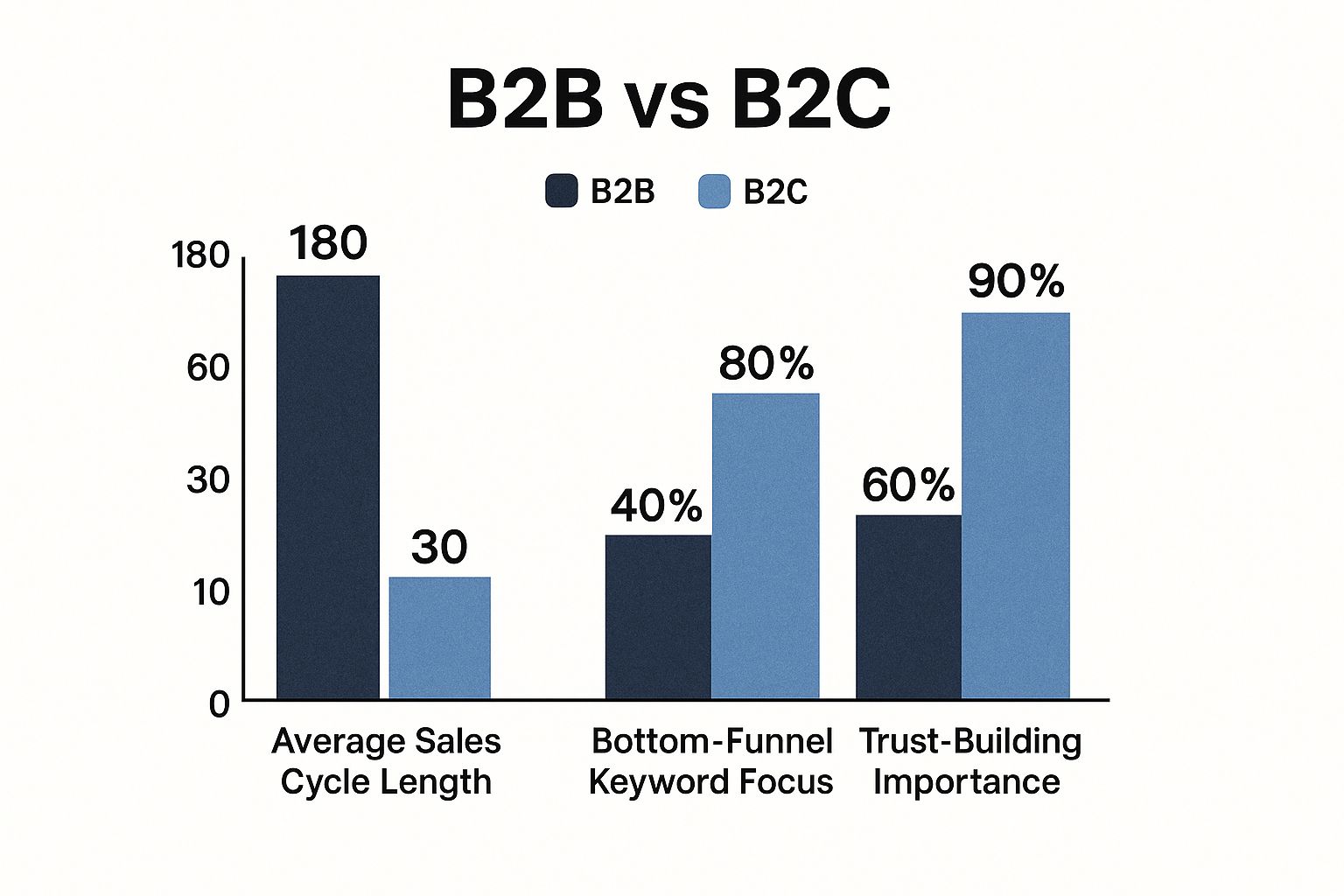
The data makes it crystal clear: the B2B game demands a sustained investment in building credibility over a much longer timeframe. For a deeper dive into how specialized B2B marketing agencies tackle these challenges in specific markets, check out firms like Vertically Media.
Proving Value Through Strategic Investment
Because of all this complexity, smart B2B companies don't see SEO as just another marketing expense—it's a critical long-term investment. And their budgets reflect that. B2B firms typically dedicate about 11% of their total marketing budgets to SEO, putting it on par with major channels like email marketing.
This spending pays off. For every $1 invested in SEO, businesses can see an average return of over $22. With nearly 93% of companies reporting a positive impact from their SEO efforts, its role as a primary engine for revenue growth is impossible to ignore.
In B2B, SEO isn’t just about being found. It’s about being found by the right people, at the right stage of a complex decision-making process, with content that proves you are the right solution.
Building Your Foundational B2B SEO Strategy

A winning b2b seo marketing program isn't just a collection of tactics; it's a carefully engineered system. You wouldn't build a skyscraper on a patch of sand, and you can't expect to land high-value clients without a solid blueprint. That blueprint starts with one thing: knowing exactly who you're trying to reach.
Forget about generic demographics. In B2B, everything hinges on developing detailed buyer personas. These aren't just job titles; they are composite sketches of your ideal customers, digging into their specific pain points, professional goals, and day-to-day headaches.
What keeps the Director of Operations up at night? What software integrations is the Head of IT losing sleep over? Answering questions like these lets you step into their shoes and understand the exact problem they’re trying to solve with a Google search.
Uncovering B2B-Specific Keyword Intent
Once you're inside your audience's head, the next step is to figure out the exact language they use. B2B keyword research is a different beast entirely. It’s less about chasing massive search volume and more about zeroing in on high-intent, problem-aware search queries. These are the terms that signal a searcher is past the window-shopping phase and is actively looking for a solution.
Think about the chasm between a broad search like "what is cloud computing" and a laser-focused query like "enterprise-grade HIPAA compliant cloud storage." The first is purely informational, top-of-funnel stuff. The second screams "I have a specific, urgent business need." You want to capture that second user.
The most valuable B2B keywords often have lower search volumes but carry immense commercial intent. A single click from a keyword like "industrial automation software for manufacturing" could be worth thousands of times more than a click from a generic term.
These money-making keywords tend to fall into a few key categories that mirror the B2B buyer's journey:
- Problem/Solution Keywords: "how to reduce supply chain logistics costs"
- Comparison Keywords: "salesforce vs hubspot for enterprise"
- Branded Alternative Keywords: "Marketo alternatives"
- Integration Keywords: "project management software that integrates with slack"
Here’s a great visual that shows the difference in intent and value between typical B2C and B2B keywords.
The screenshot makes it crystal clear: B2C keywords often have huge volume but low click value. B2B keywords are the complete opposite, with much lower search volume but a significantly higher business value behind every single click.
Mapping Keywords to the Buyer Journey
With a solid list of intent-driven keywords in hand, the final piece of the foundation is mapping them to your content and, most importantly, the buyer's journey. Not all keywords serve the same purpose. Your strategy needs to be a guided tour, leading prospects from their first inkling of a problem all the way to signing on the dotted line.
This strategic mapping ensures you have the perfect asset ready for the right person at exactly the right time.
- Awareness Stage (Top of Funnel): At this point, your audience is just starting to put a name to their problem. You should be targeting broad, informational keywords with in-depth blog posts and ultimate guides. A perfect example is creating a resource like "The Complete Guide to Warehouse Automation" to attract people searching for high-level solutions.
- Consideration Stage (Middle of Funnel): Now, prospects are actively weighing their options. This is where you target comparison and solution-focused keywords with assets like case studies, white papers, and webinars. Your goal here is to prove your expertise and build unshakable trust.
- Decision Stage (Bottom of Funnel): The buyer is ready to make a choice. Here, you focus on branded keywords, pricing pages, and demo requests. These pages need to be obsessively optimized for one thing: conversion. For a masterclass on this final step, check out this excellent guide to creating high-converting landing pages.
By building this framework, your b2b seo marketing efforts transform from random acts of content into a cohesive, lead-nurturing machine. You're no longer just publishing articles; you're building a strategic pathway that turns curious searchers into loyal customers.
Creating Authoritative Content for B2B Audiences

Let's get one thing straight about B2B SEO: content isn't just about filling up pages with keywords. It's the currency of trust.
Your audience—the VPs of Operations, the IT Directors, the CFOs—isn't looking for a flashy sales pitch. They’re searching for expert-level solutions to complex, high-stakes problems. This is where authoritative content becomes your single most powerful asset. It acts as your digital subject matter expert, working 24/7 to prove you know your stuff long before a sales call is ever on the table. In short, it’s a non-negotiable part of any serious b2b seo marketing strategy.
Moving Beyond Standard Blog Posts
A regular blog is a fantastic starting point, perfect for casting a wide net and building top-of-funnel awareness. But the savvy B2B buyer is looking for more. They need content that mirrors the seriousness of their potential investment. This means you have to go deeper, prioritizing formats that deliver real substance and prove your expertise.
For B2B audiences, these high-impact formats are king:
- Ultimate Guides: Think of these as the definitive online textbook on a critical topic. They are massive, multi-chapter resources that cover an industry problem from every conceivable angle.
- Original Research & Data Studies: Nothing screams "authority" like publishing your own data. A survey on industry trends or an analysis of proprietary info positions you as a primary source. Decision-makers will cite your findings, and other websites will link back to you.
- In-Depth White Papers & Ebooks: Perfect for capturing leads in the consideration stage, these gated assets offer a deep dive into a niche subject. You're providing actionable insights in exchange for a prospect's contact info—a fair trade.
- Comprehensive Case Studies: A good story of success builds trust like nothing else. Go beyond a simple quote and show the problem, your solution, and the measurable, ROI-driven results.
These content types aren't just one-offs; they’re designed to nurture leads through a long and often complex sales journey, building confidence at every single touchpoint.
Structuring Content with Topic Clusters
Creating amazing individual pieces of content is only half the battle. If you want to establish true domain authority in the eyes of search engines and your audience, you need a smart structure. The best way to achieve this is with the topic cluster model.
Imagine your website's content not as a random pile of articles, but as a meticulously organized library.
A topic cluster model organizes your content into a hub-and-spoke system. You have a central "pillar page" covering a broad topic, which then links out to more specific "cluster pages" that explore related subtopics in greater detail.
Let's say you sell warehouse automation software. Your topic cluster might look like this:
- Pillar Page: A massive ultimate guide titled "The Complete Guide to Warehouse Automation."
- Cluster Pages: More focused articles like "Calculating ROI on Automated Picking Systems," "Integrating WMS Software with Robotics," and "Top 5 AGV (Automated Guided Vehicle) Safety Protocols."
This structure does two things beautifully. It signals to Google that you have deep expertise on the entire topic, not just a few isolated keywords. And for your visitors, it creates a seamless experience, letting them drill down from broad concepts to the specific answers they need. If you want to see how other B2B leaders tackle this, check out the RebelGrowth blog for some practical examples of growth-focused content strategies.
Translating Features into Business Value
This is probably the most common mistake I see in B2B content: focusing on what the product does instead of why it matters. Your audience of business leaders doesn't really care about the nitty-gritty technical specs. They care about outcomes. They think in terms of ROI, efficiency gains, risk reduction, and competitive advantage.
Your content absolutely must translate every feature into a tangible business benefit.
| Instead of This (Feature-Focused) | Try This (Benefit-Focused) |
|---|---|
| "Our software uses an advanced AI algorithm." | "Reduce forecasting errors by 40% with our predictive AI, saving your team hours of manual work." |
| "We offer 24/7 customer support." | "Maintain 99.9% uptime and protect your revenue with expert support that resolves critical issues in minutes." |
| "This platform has a fully integrated dashboard." | "Get a single source of truth for your entire operation, cutting down on reporting time and enabling faster, data-driven decisions." |
This shift in language is fundamental to effective b2b seo marketing. You aren't just selling software or a service; you're selling a business outcome. To make sure your B2B content strategy is both effective and scalable, frameworks like a content marketing operations maturity model can provide a clear path forward. When you consistently speak the language of business value, you create content that not only ranks but also resonates, persuades, and converts.
Earning High-Impact B2B Backlinks
In B2B SEO, backlinks are the currency of authority. You should think of them less like simple links and more like professional endorsements. When a respected industry journal links to your content, it’s like getting a glowing recommendation from a top CEO—it carries serious weight with search engines and potential clients alike.
The game here is all about quality, not quantity. A single link from a highly trusted source can be worth more than a hundred from low-quality, irrelevant sites. This part of your b2b seo marketing strategy is about building genuine credibility, not just ticking a box.
So, forget about those old-school link-begging tactics. Modern B2B link building is about creating assets so valuable that other industry players actually want to reference them.
Become a Citable Source with Data
The surest way to earn powerful backlinks is to become the source of truth for your industry. B2B decision-makers are hungry for data to justify their choices, and journalists and bloggers need solid statistics to back up their arguments. When you create and publish original research, you position your company as a primary source.
And no, this doesn't mean you need to commission a multi-million dollar study. You can generate incredibly valuable data with simpler approaches:
- Customer Surveys: Poll your customer base on a pressing industry challenge. Then, package the results into a report with clear charts and key takeaways.
- Internal Data Analysis: Dig into anonymized data from your own platform to uncover interesting trends. For instance, a project management tool could publish a report on the most productive days of the week for remote teams.
- Expert Roundups: Interview a dozen industry experts on a hot topic and compile their insights into a single, powerhouse article.
When you publish unique data, you create a linkable asset. It's something others will naturally cite when they need to make a point, forming the foundation of a sustainable B2B link-building program.
A single, well-executed data report can generate dozens of high-authority backlinks over its lifetime. It becomes a perennial resource that builds your site's authority on autopilot.
Master Strategic Guest Posting
Guest posting is far from dead; it has just grown up. The old strategy of blasting generic articles to any site that would take them is now worthless. Today, strategic guest posting is about securing a byline on a highly respected, niche publication that your ideal customers already read and trust.
Think of it as getting invited to speak at an exclusive industry conference. The goal isn't just the link—it's the direct exposure to a perfectly targeted audience.
Follow these rules for high-impact guest posting:
- Identify Niche Publications: Look for trade journals, specialized industry blogs, and partner company blogs. A post on a site with 5,000 highly relevant readers is way better than one on a generic site with 100,000.
- Provide Your Best Content: Never treat a guest post like it's second-tier. Offer up unique insights, actionable advice, and original data that you'd be proud to feature on your own blog.
- Focus on the Relationship: Connect with the editor or content manager first. Build a genuine rapport before you pitch your idea. The real goal is to become a trusted contributor, not just a one-time author.
This method builds both your topical authority and brings in valuable referral traffic from an audience that's already warmed up to what you offer.
Leverage Digital PR for High-Tier Mentions
Digital Public Relations (PR) is the art of getting your company mentioned in the news and major industry publications. It’s basically link building on an enterprise scale. Instead of pitching a guest post, your PR team or agency pitches a compelling story that features your company's expertise or data.
A successful digital PR campaign could look like a few different things:
- Expert Commentary: Offering your company's experts to comment on breaking news within your industry.
- Story-Driven Data: Pitching the compelling narrative you found in your original research to journalists.
- Newsworthy Announcements: Promoting a significant product launch, a new partnership, or a major company milestone.
A single mention in a top-tier publication like Forbes, TechCrunch, or a leading trade journal can send powerful authority signals to search engines. It validates your brand's credibility in a way few other tactics can, making it a cornerstone of any advanced b2b seo marketing plan.
Weaving AI and Tech into Your B2B SEO Strategy

The future of b2b seo marketing isn't about replacing human experts with robots. It's about giving your experts superpowers. Think of AI as less of a replacement and more of a hyper-intelligent research assistant—one that can sift through mountains of data in seconds to find opportunities you'd otherwise miss.
This isn't just a futuristic concept anymore. It's a practical toolkit for sharpening your competitive edge. The goal is simple: fold these tools into your daily workflow to make your entire SEO program smarter, faster, and more effective.
Using AI for Scalable Content Ideation
Let's be real—one of the biggest headaches in B2B content is the constant need for fresh, expert-level topics. This is where AI really shines. These tools can analyze competitor content, dig through forum discussions, and spot search trends at a massive scale, spitting out hundreds of topic ideas that speak directly to your audience's problems.
But this goes way beyond basic keyword research. AI helps you:
- Find Semantic Gaps: Pinpoint related topics and questions your competitors aren't even touching. This is your chance to own the conversation.
- Create Topic Clusters: Automatically group related keywords into logical clusters, which is perfect for building out a hub-and-spoke content model.
- Predict Search Trends: Analyze data to forecast what topics are about to pop off before they become hyper-competitive.
When you let AI handle the heavy lifting of ideation, your human experts can focus on what they do best: adding deep, nuanced insights that create truly authoritative content. For a step-by-step guide on this, check out our AI SEO checklist.
Optimizing Content with NLP Analysis
Natural Language Processing (NLP) is just a fancy term for AI that understands human language. For SEO, this is a game-changer. NLP tools can analyze the top-ranking content for any keyword and deconstruct why it's successful. They spot key entities, common questions, and even the underlying sentiment of the articles that are already winning.
By looking at content through the same lens as a search engine, you can dial in your own articles for user intent with surgical precision. This isn't about stuffing keywords; it’s about covering a topic so thoroughly that Google has no choice but to see you as the definitive answer.
This isn't a "nice to have" anymore; it's becoming essential. AI is reshaping how B2B companies work, from refining content to predicting search behavior. In fact, a whopping 83% of companies now see AI as a major plus for their SEO efforts.
Personalizing the User Experience
Finally, tech and AI are key to creating a more personal on-site experience, which is a huge engagement signal for search engines. By tracking how users move through your site, AI-driven tools can dynamically suggest the most relevant content, case study, or white paper for that specific visitor.
This does more than just boost metrics like time on page. It actively guides prospects through their unique buyer's journey, serving up the right information at the right time. This turns your website from a static brochure into an intelligent resource that nurtures leads and builds trust, making your entire b2b seo marketing engine run that much smoother.
Measuring B2B SEO Success That Matters
In B2B SEO, celebrating a number one ranking for a keyword that doesn't drive pipeline is like winning a race with no finish line. Sure, it feels good, but it doesn't actually get you anywhere. The real measure of a successful b2b seo marketing program isn't just visibility; it's tangible business impact.
We have to shift the conversation away from these vanity metrics and toward what actually moves the needle—qualified leads, demo requests, and ultimately, revenue. Success isn't about being found. It's about being found by the right companies and turning that discovery into a real sales opportunity. This all comes down to a disciplined approach to tracking that connects your SEO data directly to your bottom line.
Moving Beyond Rankings and Traffic
Let's be clear: organic traffic and keyword rankings are useful diagnostic metrics, but they are not the end goal. A huge surge in traffic from an irrelevant audience does nothing for your sales team. To prove real value, you have to focus on Key Performance Indicators (KPIs) that directly track progress through the long, winding B2B buyer's journey.
These are the metrics that truly matter:
- Marketing Qualified Leads (MQLs): This tells you how many leads from organic search meet a predefined set of criteria, showing they're a great fit for your business.
- Sales Qualified Leads (SQLs): This takes it a step further, measuring how many of those MQLs the sales team has accepted as legitimate opportunities worth their time.
- Demo or Consultation Requests: This is a powerful, bottom-of-funnel metric. It signals strong buying intent from your organic visitors.
- Content Downloads: Tracking downloads of gated assets like white papers or case studies helps you measure middle-of-funnel engagement and see what content is effectively generating leads.
Focusing on these KPIs helps you build a rock-solid business case for continued SEO investment because you're finally speaking the language of the C-suite.
The most powerful statement you can make isn't "We rank #1 for this keyword." It's "Our SEO efforts generated $500,000 in sales pipeline last quarter."
Connecting SEO Data with Your CRM
The real magic happens when you tear down the wall between your website analytics and your Customer Relationship Management (CRM) system. By integrating platforms like Google Analytics with your CRM (think Salesforce or HubSpot), you can trace a customer's entire journey—from their first Google search to the final signed contract.
This kind of integration lets you answer the most critical questions:
- Which specific blog posts or landing pages are bringing in the most valuable leads?
- What's the average contract value of customers who found us through organic search?
- How does the sales cycle length for SEO-generated leads compare to other channels?
This closed-loop reporting gives you undeniable proof of ROI. You're no longer just showing traffic growth; you're demonstrating SEO-influenced customer wins and proving that your content strategy is a direct contributor to the company's revenue goals.
The Key B2B SEO Metrics and Their Business Impact
To make this crystal clear, let's map these SEO metrics to their direct business outcomes. Having this connection straight helps everyone from the marketing team to the board of directors understand the true value of your efforts.
Connecting SEO activities to business goals is the difference between being seen as a cost center and a revenue driver. The table below breaks down exactly how to frame your performance metrics in a way that resonates with leadership.
| SEO Metric | What It Measures | Direct Business Impact |
|---|---|---|
| Organic Lead Volume | Total number of leads from search | Fills the top of the sales funnel |
| Lead-to-MQL Rate | Percentage of leads meeting quality criteria | Measures the quality and relevance of your traffic |
| SEO-Influenced Pipeline | Total dollar value of sales opportunities from organic | Directly quantifies SEO's contribution to sales goals |
| Customer Acquisition Cost (CAC) | The cost to acquire a new customer via SEO | Proves the cost-effectiveness and efficiency of SEO |
This framework shifts the focus from inputs to outcomes. It’s not just about what you did, but what that work accomplished for the business.
Ultimately, a mature b2b seo marketing strategy is one that is measured not by its search rankings, but by its ability to generate predictable, scalable, and profitable growth for the business.
Got Questions About B2B SEO? We've Got Answers.
Even with a solid plan, a few practical questions always pop up when you're in the trenches with B2B SEO marketing. This is where we tackle the common hang-ups, giving you straight answers to help you navigate the reality of getting a campaign off the ground and keeping it running.
We'll get into realistic timelines, how to think about your budget, and the classic mistakes that can completely derail your progress. Think of this as your quick-reference guide for the nuts and bolts of B2B SEO.
How Long Does B2B SEO Take to Show Results?
Ah, the million-dollar question. The honest answer? It depends, but you absolutely need to be in it for the long haul. B2B SEO is a marathon, not a sprint. Unlike paid ads that give you an instant (and temporary) boost, organic growth is all about methodically building authority and earning trust with search engines.
Generally, you can expect to see some early signs of life—like improved keyword rankings and a small bump in organic traffic—within 3-6 months. But the real prize, a substantial impact on qualified leads and pipeline, usually takes 6-12 months, sometimes even longer if you're in a cutthroat industry.
The key here is patience and consistency. Your first few months are all about laying the groundwork with technical fixes and foundational content. The real, compounding returns on that effort start to snowball after the first year.
How Should We Budget for B2B SEO?
B2B SEO budgets can be all over the map, depending on how competitive your market is, what your goals are, and whether you're building a team in-house or bringing on an agency. The biggest mistake we see? Treating SEO like a small, one-and-done project. It's an ongoing investment in content, technical upkeep, and earning links.
For a small-to-medium-sized business, a few thousand dollars a month is a reasonable starting point. Enterprise programs? They can easily climb into five figures.
- Content & Strategy: This is usually the biggest slice of the pie, covering research, writing, and optimization.
- Technical SEO: You'll need to keep funding ongoing site audits, speed improvements, and schema markup.
- Link Building/Digital PR: Earning high-quality backlinks from relevant sites takes dedicated outreach and resources.
Instead of asking, "What's the cheapest we can get away with?" the better question is, "What level of investment do we need to actually compete in our space?"
What Are the Biggest B2B SEO Mistakes to Avoid?
It's funny, but most companies don't stumble because of some arcane technical issue. They trip over the fundamentals. The single most damaging mistake is targeting the wrong keywords. Specifically, chasing high-volume, B2C-style terms instead of the low-volume, high-intent queries that scream "I have a business problem and need a solution."
Another huge pitfall is creating content that just lists your product's features instead of actually solving your customer's problems. Your audience doesn't care about your algorithm; they care about their ROI. Nail these basics, and you're already ahead of the game.
Ready to stop guessing and start growing? rebelgrowth provides the AI-powered tools and strategic insights you need to dominate search results and drive real business growth. Learn how we can transform your B2B SEO strategy at https://rebelgrowth.com.