
So, what are AI powered SEO tools?Think of them as advanced software that uses artificial intelligence—specifically things like machine learning and natural language processing—to automate and seriously upgrade common SEO tasks. They go way beyond the old-school, manual way of doing things by giving you predictive insights, helping with content, and chewing through massive amounts of data in real-time.
The New Era of SEO and How AI Is Leading the Way

If you've ever found yourself staring at endless spreadsheets, trying to manually track keyword rankings, you know it feels like trying to navigate a new city with a folded paper map. Sure, you might get to your destination, but it’s slow, clunky, and you're completely blind to what's happening on the ground right now. Before we jump into AI solutions, it's good to have a solid handle on what is SEO and its classic challenges. The biggest headache has always been dealing with a mountain of data and trying to keep up with Google's constant algorithm changes.
This is where AI powered SEO tools step in and act like your strategic GPS. They don't just point you down the best road; they predict traffic jams ahead of time and suggest shortcuts you didn't even know existed. This tech is quickly turning SEO from a reactive chore into a predictive, automated strategy.
From Manual Labor to Predictive Strategy
The market for these tools has exploded, hitting a valuation of around $67 billion in 2025. This massive growth is fueled by a 22% annual increase in people actually using them. Today, something like 86% of SEO professionals have brought AI into their workflow, with 75% using it specifically to get rid of those soul-crushing manual tasks.
This huge shift is happening because these tools solve the core problems of data overload and constantly moving goalposts from search engines. They give marketers the ability to:
- Automate Tedious Tasks: Instantly run technical site audits, track thousands of keywords, and dissect competitor backlink profiles without lifting a finger.
- Generate Data-Driven Insights: Stop looking backward at historical data and start getting predictive analytics on new keyword trends and content gaps.
- Scale Content Creation: Draft everything from meta descriptions to full blog posts that are perfectly tuned to what people are actually searching for.
- Enhance Decision-Making: Get clear, prioritized recommendations based on complex data, turning raw information into an actual game plan.
By taking over the heavy lifting of data analysis and repetitive work, AI frees you up to focus on the high-impact stuff. Instead of being buried in spreadsheets, you can pour your expertise into creativity, building your brand, and truly understanding your audience.
This isn't about replacing marketers. It's about giving them superpowers. AI becomes a co-pilot, handling the complex flight systems so you can focus on where you're headed.
Understanding the Technology Behind AI SEO Tools
To really get the most out of AI powered SEO tools, it helps to peek under the hood. You don’t need to be a data scientist, but knowing the core technologies will demystify how these platforms come up with such powerful insights.
Think of it like a car. You have an engine that provides the power, a steering wheel that gives you direction, and a GPS that tells you the best route. They all work together to get you where you're going. The tech in AI SEO tools works in a similar way.
Machine Learning The Predictive Brain
At its heart, Machine Learning (ML) is the brain of any AI SEO tool. It's a type of AI that teaches software how to learn from massive amounts of data and get smarter over time—all without a developer hard-coding every single rule.
Let's say you're trying to figure out which keywords will start trending next month. An ML model can sift through billions of data points that a human could never process. It looks at historical search volumes, competitor rankings, news cycles, and even social media chatter. By spotting tiny, almost invisible patterns, it learns what signals a coming spike in search interest.
This predictive power is a complete game-changer. Instead of just reacting to what’s already popular, ML lets SEO tools forecast emerging opportunities. That gives you a huge head start on your competition.
Natural Language Processing The Expert Communicator
If Machine Learning is the brain, then Natural Language Processing (NLP) is the mouth and ears. This is the technology that gives a tool the ability to understand, interpret, and generate human language in a way that actually makes sense.
NLP is what allows an AI tool to read a top-ranking blog post and see beyond just the keywords. It understands the sentiment, the structure, and the real reason a user is searching for something. It can tell the difference between a search for "apple" the fruit and "Apple" the tech giant based on the words around it. This is absolutely critical for creating content that genuinely solves a user's problem.
For example, NLP is the magic behind:
- Semantic Keyword Analysis: Finding related concepts and topics that help you build authority.
- Search Intent Recognition: Figuring out if a user wants to buy something, learn something, or find a specific site.
- Content Quality Scoring: Judging how your content's readability, tone, and relevance stack up against the top players.
This deep understanding of language ensures the recommendations you get are nuanced and effective, moving way past simple keyword stuffing.
Generative AI The Creative Engine
Finally, Generative AI is the creative force that pulls it all together. This is the tech that powers tools like ChatGPT, which can create brand-new, original content from all the information and patterns it has learned.
In the world of SEO, Generative AI takes the opportunities found by ML and the contextual understanding from NLP to produce tangible assets. It’s the part of the tool that can draft a compelling meta description, write a detailed blog post outline, or even generate an entire article that’s already optimized for a specific keyword cluster. It's not just copying and pasting information; it's synthesizing it into something new and useful.
These three technologies aren't working in silos. ML finds the opportunity, NLP understands the language around it, and Generative AI creates the solution. It’s this powerful combination that makes modern AI SEO tools so much more than data dashboards—they're active partners in building your strategy.
The Core Benefits of Using AI in Your SEO Strategy

It’s one thing to understand the tech, but what really matters is seeing how it changes the game. Bringing AI-powered SEO tools into your workflow isn’t just about adding another subscription to the stack. It’s a fundamental upgrade to how you do SEO, day in and day out.
The most immediate win? A massive boost in automation and raw efficiency.
Think about all the hours your team sinks into manual SEO chores. Running a deep technical audit, tracking thousands of keyword positions, or reverse-engineering a competitor’s backlink profile are traditionally huge time sucks. They’re necessary, but they’re a grind.
AI tools take these multi-day projects and crush them down into minutes. This isn't just a time-saver; it’s a mind-saver. It frees up your team from the drudgery of data entry and spreadsheet hell, letting them focus their brainpower on big-picture strategy, creative content, and actually connecting with your audience.
Before AI, most of our work was done in the rearview mirror. Now, we have a clear view of the road ahead. To see just how much things have changed, take a look at this side-by-side comparison.
Comparing Traditional SEO vs AI-Powered SEO
This table highlights the fundamental shift in capabilities when moving from manual SEO practices to an AI-augmented approach across key marketing tasks.
| SEO Task | Traditional Approach (Manual) | AI-Powered Approach (Automated & Predictive) |
|---|---|---|
| Keyword Research | Brainstorming, analyzing SERPs one by one, using static keyword lists. | Identifying emerging trends, predicting keyword value, and uncovering hidden content gaps. |
| Content Creation | Writing based on experience and keyword density guidelines. | Generating data-driven outlines, optimizing for semantic relevance, and tailoring tone to audience segments. |
| Technical Audits | Manually checking sitemaps, robots.txt, and running slow, periodic crawls. | Performing continuous site monitoring, identifying complex issues, and predicting potential crawl problems. |
| Competitor Analysis | Periodically tracking a few known competitors' rankings and backlinks. | Analyzing the entire competitive landscape in real-time and forecasting their next strategic moves. |
| Performance Reporting | Compiling historical data from various sources into monthly reports. | Creating dynamic dashboards with predictive forecasting and real-time performance alerts. |
The difference is stark. One approach is reactive and labor-intensive, while the other is proactive, strategic, and gives you an almost unfair advantage.
Unlocking Predictive Insights
Beyond just doing things faster, AI adds a predictive layer that older tools just can't touch. Your standard analytics dashboard is retrospective—it tells you what already happened. AI, on the other hand, crunches immense datasets to forecast what’s likely to happen next.
It's like having a sophisticated weather forecasting system instead of just a rearview mirror. One shows you where you've been, while the other helps you pack for the storm ahead.
With these predictive capabilities, you can:
- Spot Emerging Trends: AI can pick up on subtle shifts in search behavior and topic interest long before they hit the mainstream, giving you a serious head start.
- Find Untapped Opportunities: By analyzing competitor blind spots and content gaps, AI points you toward high-potential keywords and topics your rivals have completely missed.
- Anticipate Algorithm Shifts: Machine learning models can spot patterns that often signal an upcoming search engine algorithm update, helping you adjust your strategy before your rankings take a hit.
This kind of forward-looking intelligence shifts your team from a reactive SEO posture to a proactive one. Instead of constantly playing catch-up, you start setting the pace.
Achieving Personalization at Scale
The final knockout benefit is the ability to personalize your content at a scale that would be impossible for a human team to manage. Modern SEO isn't just about ranking for broad keywords; it's about meeting the specific needs of different audience segments with content that feels like it was written just for them.
AI is brilliant at this. It analyzes user data, search intent, and on-site behavior to figure out what different groups of users are actually looking for. From there, it helps you create content that speaks directly to their unique questions and pain points.
This creates a much more powerful and resonant content strategy. For example, an e-commerce site can use AI to generate product descriptions that hit home with different buyer personas. A B2B company can create blog posts that tackle the specific challenges of various industries they serve.
The impact here is massive. We're seeing AI-powered content strategies lead to an up to 45% rise in organic traffic and a 38% boost in conversion rates. This approach has also driven huge performance gains, with some companies reporting a 30% increase in search engine rankings within six months. You can dig into more of these numbers in this breakdown of AI SEO statistics and their impact on saffronedge.com.
When you deliver the right message to the right person at the right time, you build stronger connections and, ultimately, get better results.
Exploring the Main Categories of AI SEO Tools
The world of AI SEO tools is blowing up, and trying to pick one can feel like standing in a food court with a thousand options. It's overwhelming.
To make sense of it all, it helps to break these tools down into four main groups based on what they actually do. This way, you can figure out which type of tool solves the specific SEO headache you're dealing with right now.
Each category tackles a different piece of the SEO puzzle, from the initial brainstorming all the way to measuring your results. Getting a handle on these groups lets you build a set of tools that covers all your bases without paying for stuff you don't need.
This infographic gives you a quick visual on why so many people are jumping on board, from saving a ton of research time to getting more accurate with their ranking efforts.
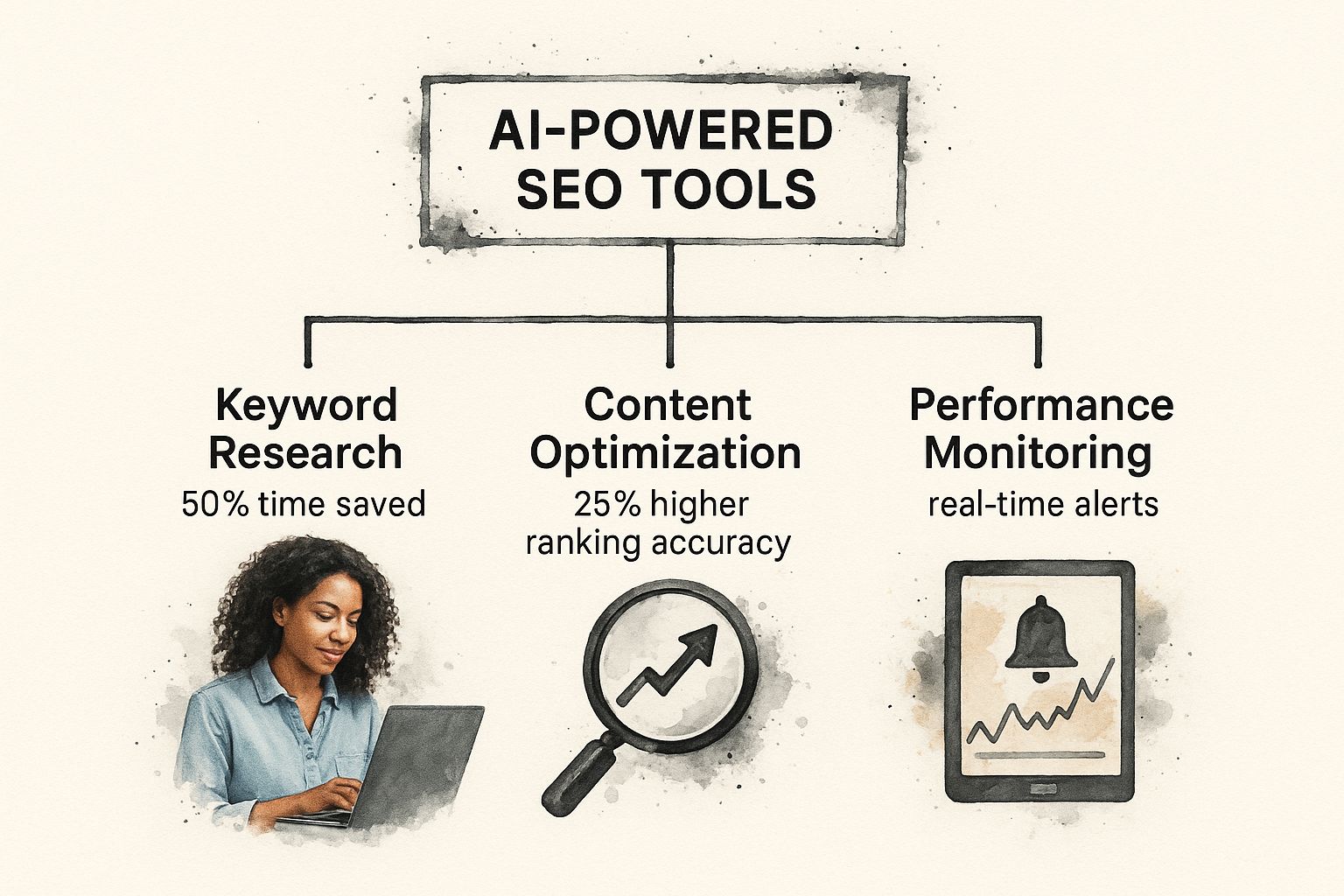
As you can see, the real win isn't in just one spot. It's about making the entire SEO process smarter and faster.
Keyword Research and Content Strategy
This first group is all about getting your foundation right. Before you write a single word, you have to know what your audience is actually looking for and which topics will get their attention. AI tools here are way more advanced than your classic keyword list generator.
They dig into search trends, see what your competitors are doing, and analyze user behavior to uncover entire topic clusters. Instead of just spitting out a list of keywords, they map out the whole conversation your audience is having online, showing you exactly where you fit in.
- Spotting Opportunities: These tools can predict keyword trends before they get crowded, giving you a chance to get in early.
- Semantic Search: They help you see how different topics are related, so you can cover a subject from all angles and build up your site's authority.
- Competitor Gap Analysis: AI can instantly see what your rivals are ranking for and, more importantly, what they're missing. This gives you a clear roadmap for what to create next.
This level of strategic insight is a game-changer. It's why nearly half (47%) of marketers are already using AI SEO tools to work more efficiently. Better yet, around 84% are planning to use them to find and jump on new search trends by 2025. You can dig into more stats about the future of AI in SEO on livepositively.com.
Content Creation and Optimization
Once you have a solid plan, it's time to actually create the content. This is where generative AI really starts to flex its muscles, acting like a super-smart assistant for your content team.
These tools can help draft everything from blog posts to the copy for your most critical pages. They'll generate data-driven outlines to make sure your content is structured for success from the get-go. Then, as you write, they'll check your draft against the top-ranking pages and give you real-time tips for making it better.
Think of it this way: AI isn't here to replace writers. It's here to supercharge them. It handles the tedious research and data crunching, which frees up your creative team to focus on great storytelling, unique insights, and nailing your brand's voice. For instance, our guide on building high-converting landing pages stresses the need for killer copy—a task AI can help you scale without sacrificing quality.
Technical SEO and Auditing
The third category is all about the stuff happening behind the scenes—the technical health of your website. Technical SEO can be a beast, with hundreds of little issues that can secretly torpedo your rankings.
AI-powered audit tools put this whole process on autopilot. They constantly crawl your site, sniffing out problems like broken links, slow pages, and indexing errors as they happen. Forget doing a manual audit once a quarter; with these tools, you get a steady stream of alerts, already prioritized for you.
They can often even predict problems before they start hurting your traffic. This flips technical SEO from a reactive scramble to a proactive, easy-to-manage routine.
Link Building and Outreach
Finally, let's talk backlinks. Building high-quality links is still a massive piece of any good SEO strategy, but it's always been a manual grind. Not anymore.
AI is now making this process way more efficient. These tools help by: 1. Finding Prospects: They scan the web for relevant, authoritative sites that would be a perfect fit to link back to your content. 2. Personalizing Outreach: AI can help you draft personalized emails that actually get a response, saving you from the "copy-paste" approach that rarely works. 3. Tracking Mentions: Some tools will even find places where your brand was mentioned but not linked to, handing you a golden opportunity to ask for a backlink.
By taking over the most repetitive parts of the job, these tools let SEOs spend less time prospecting and more time building real relationships—which is what truly great link building has always been about.
How to Choose the Right AI SEO Tool
Picking the right AI powered SEO tool isn't about grabbing the one with the longest feature list. Think of it as a real investment in your team's day-to-day workflow and your company’s growth. If you don't approach it thoughtfully, you can end up with a complicated tool that creates more problems than it solves.
The very first step? Get brutally honest about your single biggest goal right now. Are you in a constant battle to produce enough quality content to keep up with competitors? Or is your main headache trying to wrestle with technical site health and confusing algorithm updates?
Your answer cuts through the noise and instantly narrows down your options. A team that needs to pump out more content will lean toward tools with strong AI writing and optimization features. But a team drowning in technical debt needs a platform built for automated site audits and monitoring.
Define Your Primary Use Case
Before you even glance at a single product page, figure out what a "win" actually looks like for you. When you know your core need, you won't get distracted by shiny features you’ll probably never touch.
- Content Scaling: If the mission is to publish more blog posts, landing pages, and product descriptions, look for tools that excel at content generation, outlining, and on-page optimization.
- Technical Mastery: Need to boost site speed, squash crawl errors, and get a handle on indexing? A tool with powerful technical SEO auditing and real-time alerts is your best bet.
- Keyword Strategy: If you’re trying to find new topic clusters and get ahead of emerging trends, you'll want a platform with top-notch keyword research and competitive analysis.
This first bit of self-assessment is easily the most important part of the whole process. It’s your north star. For a more structured way to figure this out, our AI SEO checklist can help you nail down exactly what you need.
Evaluate Integration and Usability
Here’s the thing: the most powerful tool on the market is completely useless if it doesn't play nice with your current workflow or if your team finds it impossible to use.
Seamless integration is a must-have. Make sure any tool you consider can connect smoothly with your key platforms, like your CMS (WordPress, for example) and analytics tools like Google Search Console. This prevents data from being trapped in different places and makes the tool feel like a natural part of your process.
User-friendliness is just as vital. When you’re in a free trial, really pay attention to the user interface (UI). Is it intuitive? Can your team members find what they need without a week of training? A clean, logical dashboard means people will actually use it, which is how you get your money's worth.
"A tool’s value isn’t in its features, but in its adoption. If your team doesn't use it, the features don’t matter. Prioritize a simple, intuitive user experience over a complex tool with a steep learning curve."
Consider Cost and Team Empowerment
Finally, look closely at the pricing and pick a tool that truly empowers your people. Hunt for flexible plans that can grow with you. Some tools charge per user, while others are based on usage—like how many articles you generate or keywords you track. Find a model that fits your budget and where you see your business going.
Picking a tool has a sense of urgency to it; a whopping 82% of enterprise experts are planning to increase their AI spending just to stay in the game. You can dig deeper into investment trends in AI-powered optimization on livepositively.com.
Here's a handy checklist to walk you through the evaluation process, ensuring you cover all your bases before making a final decision.
AI SEO Tool Evaluation Checklist
This checklist is designed to give you a structured way to compare different AI SEO tools. Use it to make sure you're asking the right questions based on what your business actually needs.
| Evaluation Criteria | Key Questions to Ask | Importance (High/Medium/Low) |
|---|---|---|
| Core Functionality | Does this tool directly address our primary goal (e.g., content scaling, technical SEO)? | High |
| Accuracy & Reliability | How accurate is the data and AI output? Can we trust its recommendations? | High |
| Integration Capabilities | Does it connect with our CMS, Google Analytics, Search Console, and other key software? | High |
| User Experience (UX) | Is the interface intuitive? How steep is the learning curve for the team? | Medium |
| Scalability & Pricing | Does the pricing model align with our budget and growth plans? Are there usage limits? | Medium |
| Support & Training | What kind of customer support is available (live chat, email)? Are there training resources? | Medium |
| Unique Features | Does it offer any unique features that give us a competitive edge? | Low |
By systematically going through these points, you can move past the marketing hype and focus on the practical value each tool offers.
Most importantly, choose AI powered SEO tools that make your team smarter, not ones that try to replace them. The goal is to automate the repetitive grunt work and uncover deep insights. This frees up your human experts to focus on what they do best: strategy, creativity, and building relationships. The right tool is a partner, not an automated replacement.
The Future of Search Is a Human and AI Partnership
The explosion of AI powered SEO tools doesn’t mean the SEO professional is heading for the exit. Far from it. This is the start of a powerful—and necessary—partnership. The real magic of this tech isn’t about replacing human expertise, but supercharging it. It creates a dynamic where each side does what it does best.
Think of AI as the ultimate data cruncher and operations manager rolled into one. It can tirelessly chew through the massive, repetitive tasks that used to eat up our days—sifting through mountains of keyword data, running technical audits, and keeping a close eye on what competitors are up to. This frees us up from the tactical grunt work, letting us focus on high-level strategy.
Shifting Focus to Human Strengths
When AI handles the data, we can pour our energy into the things algorithms just can't do. This is where real growth and connection happen, tapping into uniquely human skills.
- Strategic Oversight: AI can spit out data all day long, but it takes a human to interpret that data in the context of business goals, brand identity, and the competitive landscape.
- Deep Creativity: Sure, AI can generate content. But it can’t replicate that spark of human creativity, the art of storytelling, or the emotional connection that builds a truly loyal audience.
- Authentic Relationships: Building quality backlinks and brand authority isn't just a numbers game. It's about genuine networking, building trust, and fostering real relationships—stuff that requires a human touch.
This human-AI collaboration is only getting more important as search itself changes. AI-generated content is already a significant player. It makes up roughly 13% of top-performing Google search results, and AI Overviews are now showing up in about 15% of searches.
Embracing the AI Co-Pilot
The big takeaway here is to see these tools not as a threat, but as an indispensable co-pilot. They give us the speed, scale, and analytical horsepower to compete, while we bring the wisdom, strategy, and creativity needed to win.
The most successful SEO strategies of tomorrow will not be "AI vs. human" but "AI and human." Success will be defined by how well we integrate these powerful tools to augment our own intelligence and strategic capabilities.
To really get a handle on the long-term picture, it’s worth digging into the future of SEO in the time of generative AI. Adapting to this new reality—where technology amplifies human ingenuity—is the only way to build lasting success in an increasingly complex digital world.
Frequently Asked Questions About AI SEO Tools
As you start exploring the world of AI powered SEO tools, it's totally normal for questions to pop up. This tech is moving fast, and getting a handle on its real-world impact is the key to using it well. Let's dig into some of the most common questions marketers have.
This final section will give you clear, straightforward answers to help you move forward with confidence and figure out your next steps.
Will AI SEO Tools Replace SEO Professionals?
This is probably the biggest question on everyone's mind, and the answer is a firm no. Think of an AI tool as a super-efficient research assistant, not a replacement for the strategist leading the charge. These tools are built to support and amplify human expertise, not make it obsolete.
AI is fantastic at chewing through repetitive, data-heavy tasks. It can sift through thousands of keywords, run complex technical audits in minutes, and spit out content drafts based on hard data. This frees up SEO specialists from the grunt work, letting them focus on what humans do best.
The winning SEO strategies of the future will be a true human-AI partnership. AI will handle the data and scale, while humans provide the strategy, creativity, and the nuanced thinking required to turn insights into action. It's all about collaboration, not replacement.
At the end of the day, AI tools handle the "what" and the "how," but a human professional determines the "why." They’re a powerful force multiplier, giving smaller teams the ability to get results that once required a massive staff.
Can Google Detect and Penalize AI Content?
The whole conversation around AI content and Google penalties tends to miss the point. Google’s main goal has always been the same: reward content that is high-quality and genuinely helpful, no matter how it was made. There isn't some special penalty just for using AI in your writing process.
Low-quality, spammy content that adds zero value will get dinged, whether it was written by a person or an algorithm. On the flip side, well-researched, insightful content gets rewarded, even if AI helped draft or outline it.
The secret is to use AI as a tool to create better content, not just churn it out faster. A human expert should always be in the driver's seat to:
- Fact-check every claim and data point.
- Add unique insights, personal stories, and original perspectives.
- Refine the tone and style to sound like your brand.
- Ensure the final piece completely nails what the user was searching for.
Stick to these rules, and you can confidently use AI to scale your content production without worrying about penalties. For more tips on building a solid content strategy, feel free to check out the different topics on the RebelGrown blog.
How Can I Start with AI on a Small Budget?
Jumping into AI-powered SEO doesn't mean you have to break the bank. Most of the top platforms know that businesses of all sizes want in on the action, so they’ve structured their plans accordingly. The trick is to start small and be strategic.
First, figure out your single biggest SEO headache. Is it the mind-numbing hours spent on keyword research? The constant struggle to publish new articles? Nailing this down helps you find a tool that solves a specific problem, instead of paying for a massive platform with a dozen features you’ll never touch.
Here are a few practical ways to get started:
- Take Advantage of Free Trials: Almost every major AI SEO tool offers a free trial or a limited free plan. This is your best bet for test-driving the interface and seeing if the output is up to snuff before you pull out your credit card.
- Focus on Specialized Tools: Instead of an all-in-one suite, look for a tool that excels at the one thing you need most, whether that’s content optimization, technical audits, or something else.
- Use General AI with SEO Prompts: You can get a lot of mileage out of widely available tools like ChatGPT by feeding them very specific, SEO-focused prompts. This is a great way to handle tasks like writing meta descriptions or brainstorming article outlines before you commit to a dedicated platform.
By starting with a focused, needs-based approach, you can start getting the benefits of AI without blowing your budget.
Ready to supercharge your SEO and marketing efforts with the power of AI? RebelGrown provides an all-in-one solution to help you create AI-generated content, build backlinks, and automate your social media, all driven by a powerful AI marketing agent. Start ranking higher and growing faster by visiting https://rebelgrowth.com.