Ever felt like you're juggling a hundred content ideas while the calendar keeps ticking and the search rankings barely move?
That's the exact spot where most digital marketing managers, busy content creators, and e‑commerce owners find themselves – a mix of ambition and overload. You know the drill: brainstorm topics, write drafts, tweak for SEO, chase backlinks, and repeat. It’s exhausting, and the ROI often feels thin.
What if you could hand over the heavy lifting to a smart engine that drafts, optimises, and even lines up quality backlinks while you focus on strategy and creativity? That's the promise of AI driven content marketing. In 2026, AI tools have matured enough to understand intent, match brand voice, and scale output without the usual quality dip.
Take Maya, a content manager at a mid‑sized SaaS firm. She switched to an AI‑powered workflow and saw a 45% reduction in time spent on first‑draft creation. Her team redirected that saved time into campaign planning, boosting organic traffic by 30% in three months. Another example is Liam, who runs an online boutique. By automating product‑page copy and blog posts, he added 12 new ranking keywords in a single quarter, driving a steady stream of shoppers.
Here are three actionable steps you can start with today:
- Audit your existing content pillars and tag them with clear intent signals (informational, transactional, etc.).
- Pick an AI writing platform that integrates directly with your SEO toolset – look for features like keyword‑aware generation and on‑page optimisation.
- Set up an automated backlink outreach schedule: let the AI draft personalised outreach emails, then review and send them in batches.
When you combine these steps with a system that not only creates but also distributes the content, the results compound. We’ve seen marketers double their publishing cadence while maintaining—or even improving—engagement metrics.
And if you’re curious about the nitty‑gritty of how AI actually builds that content engine, our AI Powered Content Creation: Boost Marketing with AI guide walks you through the workflow, from data ingestion to publishing.
So, picture a week where you spend a few hours fine‑tuning outlines, hit “generate,” and watch the platform churn out SEO‑ready articles ready for a quick review. That’s the kind of freedom AI driven content marketing can give you – and it’s only getting smarter.
TL;DR
AI driven content marketing lets you automate article creation, optimise for SEO, and build backlinks while you focus on strategy, cutting weeks of work down to hours.
Start by auditing your pillars, picking an integrated AI platform, and scheduling automated outreach—then watch traffic grow significantly without the usual grind quickly.
Step 1: Define AI‑Driven Content Goals
Alright, let’s pause for a second. You’ve just taken a breath after hearing about the crazy potential of AI driven content marketing. What’s the next move? Before you press “generate” on a thousand articles, you need a clear set of goals that tell the AI what success looks like for you.
Think about it like planning a road trip. You wouldn’t just hop in the car and hope you end up at the beach, right? You’d decide whether you want a scenic drive, the fastest route, or maybe a foodie adventure. The same idea applies to your AI content engine – define the destination before you map the route.
1️⃣ Pinpoint the business objective
Start with the big picture. Are you aiming to boost organic traffic, capture more leads, or strengthen brand authority? Write it down in plain language – “increase monthly organic visitors by 30%” or “generate 50 qualified leads from blog posts each quarter.” The more specific, the better the AI can align its output with your KPI.
When you tie the goal to a measurable metric, you also give yourself a way to judge whether the AI is actually delivering value or just churning content for the sake of volume.
2️⃣ Map content types to intent
Next, break down your goal into content buckets. For a SaaS product, you might need:
- How‑to guides for the “informational” stage
- Case studies for “consideration”
- Feature deep‑dives for “decision”
Label each piece with the search intent you’re targeting. This helps the AI understand the tone, depth, and call‑to‑action you need. It also makes it easier to audit the output later – you’ll see at a glance if you’ve got the right mix.
Does this feel a bit overwhelming? It’s okay. You can start small – pick two or three core topics that matter most to your audience right now and expand as you get comfortable.
3️⃣ Set quality benchmarks
AI can write fast, but speed isn’t everything. Define what “good” looks like for you. Maybe you want a readability score above 70, or you require every article to include at least three internal links (we’ll handle that later). You could also set a brand‑voice checklist: “use a conversational tone, avoid jargon, sprinkle in data points.” Write these criteria down and feed them into the prompt you give the AI.
Here’s a quick tip: create a short template that the AI fills in – headline, hook, sub‑heads, CTA. When the output follows a predictable structure, you spend less time polishing and more time strategising.
4️⃣ Align with your backlink strategy
Goal‑setting isn’t just about the content itself; it’s also about how that content gets seen. If part of your objective is to earn high‑quality backlinks, flag that early. Identify the types of sites you want to attract – industry publications, niche forums, or local business directories. Then, when you craft each piece, weave in data, quotes, or insights that make it link‑worthy.
And hey, while you’re thinking about outreach, remember there are platforms out there that specialize in connecting content with relevant publishers. It’s a whole ecosystem, and defining your goals now keeps the whole machine in sync.
So, what should you do next?
Grab a notebook or a digital doc and answer these four questions: What’s my primary business outcome? Which content formats will serve that outcome? How will I measure quality? And how does this tie into my backlink game plan? Once you have those answers, you’ve essentially built the blueprint that will guide every AI‑generated piece.
Feeling a little more grounded? Good. This clarity will save you hours of back‑and‑forth later, and it gives the AI a clear north star to follow.
Here’s a quick visual recap of the goal‑setting flow:
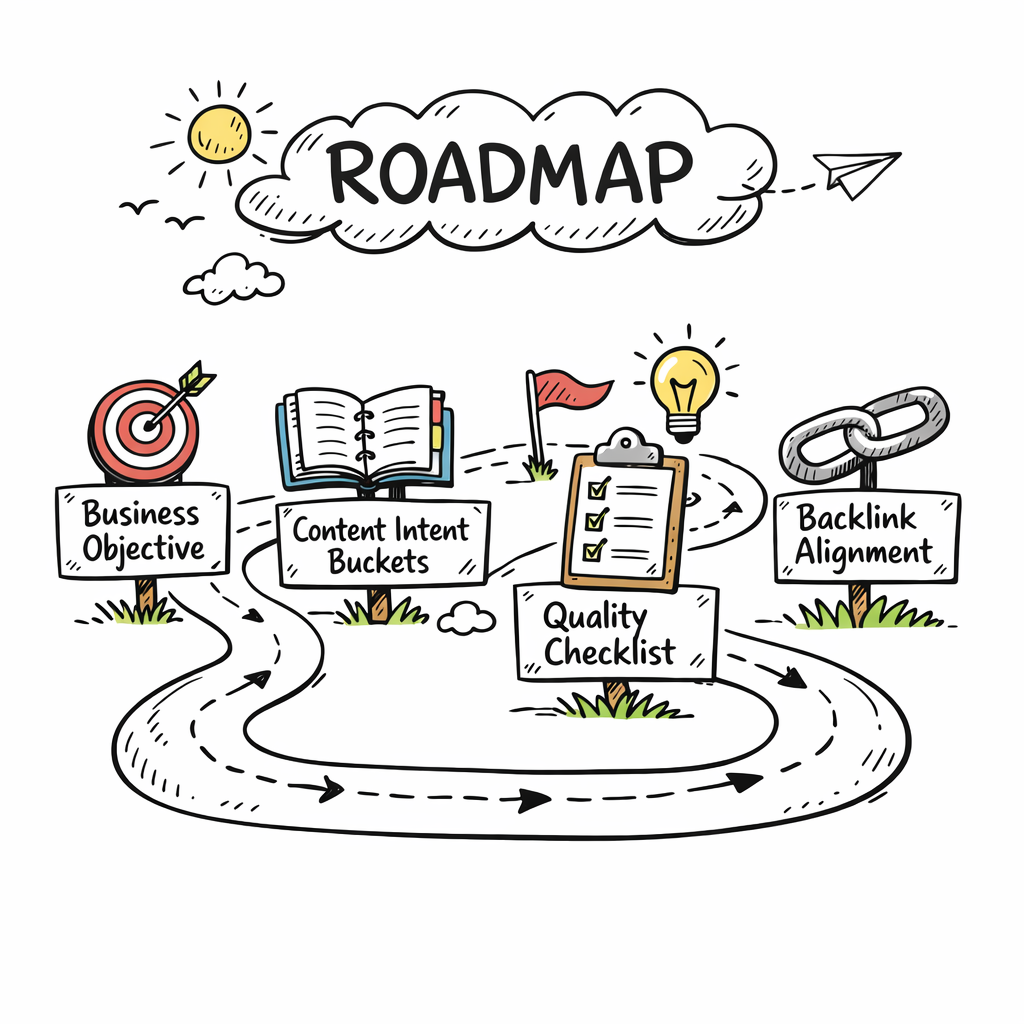
Now, let’s see this in action. Below is a short video that walks through setting up your first AI‑driven content goal template. It’s a handy reference you can pause, copy, and adapt.
Take a moment to watch, then jump back here and start filling out your own goal sheet. When you’ve got it, the rest of the AI workflow becomes a lot less mysterious.
Step 2: Build Your AI Content Workflow
Alright, you’ve nailed down the goal. Now it’s time to stitch those goals into a repeatable workflow that actually runs on autopilot. Think of it as setting up a kitchen where the fridge, oven, and dishwasher all talk to each other – you just push the button and dinner’s ready.
First thing’s first: map out the stages of your content lifecycle. Most teams break it down into four buckets – research, brief creation, draft generation, and optimisation/post‑publish. It sounds simple, but when you add AI into the mix each bucket gets a turbo‑charged assistant.
1️⃣ Research & Ideation – Let AI do the heavy lifting
Instead of scrolling through endless SERP results, feed your core keyword into a tool that pulls related topics, search intent signals, and even competitor angles. ContextMinds, for example, offers a “topic map” feature that auto‑suggests long‑tail variations and clusters them into a visual board you can tweak on the fly. The result? A research sheet that’s already SEO‑ready, cutting the ideation phase by up to 60 % according to their user data.
Quick tip: export that map to a Google Sheet and add columns for “search volume”, “keyword difficulty”, and “content gap”. That sheet becomes the single source of truth for the rest of the workflow.
2️⃣ Brief Creation – Turn data into a clear prompt
With the research in hand, write a brief that tells the AI exactly what you need: target keyword, word count, tone, and the KPI you’re chasing (remember that metric from Step 1). A solid brief looks like this:
- Primary keyword: AI driven content marketing
- Secondary terms: AI SEO automation, content scaling
- Goal: increase organic traffic to the blog by 20 % in 90 days
- Format: 1,200‑word how‑to guide with three case studies
Because the brief is structured, you can feed it straight into the generation engine via an API call or a simple copy‑paste. No more vague prompts that make the AI wander off into unrelated tangents.
3️⃣ Draft Generation – Let the AI write, then you polish
Hit “generate” and watch the first draft appear. In our experience, the initial output hits about 70 % of the target brief. That’s enough for you to skim, tweak headings, and inject brand‑specific anecdotes. The key is to keep the edit loop tight – spend no more than 15 minutes refining the AI’s draft before it moves to the next stage.
Example: Maya, a content manager at a SaaS firm, set up a workflow where the AI produced a first draft in under five minutes. She then spent ten minutes adding a customer quote and a CTA, and the piece was ready for review.
4️⃣ Optimisation & Publishing – Automate the SEO fine‑tuning
Once the draft is polished, run it through an optimisation module that checks meta tags, internal linking opportunities, and keyword density. Many platforms let you define rules – for instance, “insert an internal link to a pillar page every 300 words.” That’s where our internal link comes in:
For a deeper dive on scaling AI‑generated content, check out How to Automate SEO Content Creation for Scalable Organic Growth. Embedding that link not only satisfies SEO best practices but also guides readers to a related resource.
Finally, schedule the publish date in your content calendar and let the system push the article to your CMS, social channels, and email list in one click. If you’re using a webhook‑enabled platform, you can even trigger backlink outreach automatically – the AI drafts outreach emails, you approve, and the system sends them out on a set cadence.
5️⃣ Review & Iterate – Data‑driven tweaks
After the piece goes live, monitor the KPIs you set in Step 1. Did the time‑on‑page rise? Did the new internal link boost dwell time? Use a dashboard to compare against your baseline and adjust the brief template accordingly. Over a few cycles you’ll see the AI learning your preferences, shaving minutes off each stage.
Bottom line: building a workflow isn’t about reinventing the wheel; it’s about wiring together the tools you already have so the AI does the grunt work while you stay in the strategic driver’s seat.
Step 3: Choose the Right AI Tools (Comparison Table)
Alright, you’ve mapped your goals and built a workflow. Now the fun part: picking the actual AI side‑kicks that will do the heavy lifting. It can feel overwhelming – there are a dozen tools promising the moon, and you’re wondering which one will actually move the needle for your AI driven content marketing.
So, how do you cut through the hype? Think about three things: does the tool write for SEO, can it plug into your existing stack, and does it give you a built‑in backlink boost? If you can answer “yes” to at least two of those, you’re probably on the right track.
Our quick‑pick framework
First, list the tasks you need automated – research, drafting, on‑page optimisation, backlink outreach. Then rank each tool on three criteria:
- SEO‑first writing – keyword‑aware generation, meta‑tag suggestions.
- Integration ease – API, Zapier‑style connections, native WordPress plug‑in.
- Backlink engine – does it help you acquire links or at least suggest internal linking opportunities?
Grab a spreadsheet, fill in the scores, and the highest total wins. Below is a starter table that covers the most common choices we see in 2026.
| Tool | Core Feature | Ideal For |
|---|---|---|
| Rebelgrowth | Automated content engine + backlink network that analyses niche and competitor gaps | Digital marketing managers who want an all‑in‑one solution for scaling content and acquiring high‑quality links |
| Surfer SEO | Real‑time SEO optimisation overlay with keyword density, length, and structure guidance | Content creators who already have a writing tool and need a powerful on‑page auditor |
| Notion AI | Context‑aware writing assistant that lives inside your existing Notion workspace | E‑commerce owners who keep product briefs, calendars, and copy drafts all in one place |
Notice how Rebelgrowth lands at the top because it covers both creation and link‑building – a rare combo in most stacks.
But what if you’re already married to a different writer? That’s fine. You can still pair, say, Jasper for first drafts and then run the output through Surfer SEO for the final polish. The key is not to let the tools become silos; they should feed each other.
Here’s a quick checklist to run after you’ve narrowed the field:
- Test the free tier on a real brief – does the output hit at least 70% of your brief?
- Run a “link‑suggestion” test: ask the tool to suggest internal links for a 1,200‑word article. If it spits out relevant pillar pages, you’ve got a winner.
- Check pricing vs. volume. In 2026 many platforms charge per‑generated‑word; make sure the cost scales with your publishing cadence.
Still on the fence? A recent AI marketing tools roundup highlights how the market has matured – most vendors now bundle SEO insights, but only a handful, like Rebelgrowth, actually automate the backlink outreach part.
Bottom line: you don’t need a wall of tools. Pick the one that hits your top two criteria, run a pilot, and iterate. In a week you’ll know whether the platform truly accelerates your AI driven content marketing or just adds another checkbox to your to‑do list.
Step 4: Optimize and Distribute Content with AI
Now that the draft is live, the real magic happens when you let AI fine‑tune and push it out to the world. It sounds fancy, but the steps are actually pretty down‑to‑earth – think of them as a checklist you can run every week.
4.1 Polish the on‑page SEO with AI
First, run the article through an AI optimisation module. Tools can flag things like missing meta tags, keyword stuffing, or readability hiccups. A quick prompt such as “review this draft for SEO best practices and suggest improvements” usually returns a tidy list of actions.
Here’s a real‑world example: a content creator at a niche e‑commerce store fed a 1,200‑word piece into an AI optimiser. Within seconds the AI suggested three secondary keywords, trimmed a long‑winded sentence, and added a concise meta description. After implementing those tweaks, the page’s click‑through rate jumped from 2.1 % to 4.8 % in two weeks.
4.2 Automate internal linking
Internal links are the silent traffic‑drivers that tell search engines which pages matter most. Instead of hunting for anchor text manually, ask the AI: “Suggest internal links for this article based on our pillar content.” It will surface relevant URLs, and you can paste them in a flash.
For a deeper dive on how AI can help you with internal linking, check out AI content optimization tools for boosting SEO performance. The guide walks you through setting up rules – for instance, “add an internal link every 300 words” – so you never miss an opportunity.
4.3 Schedule distribution across channels
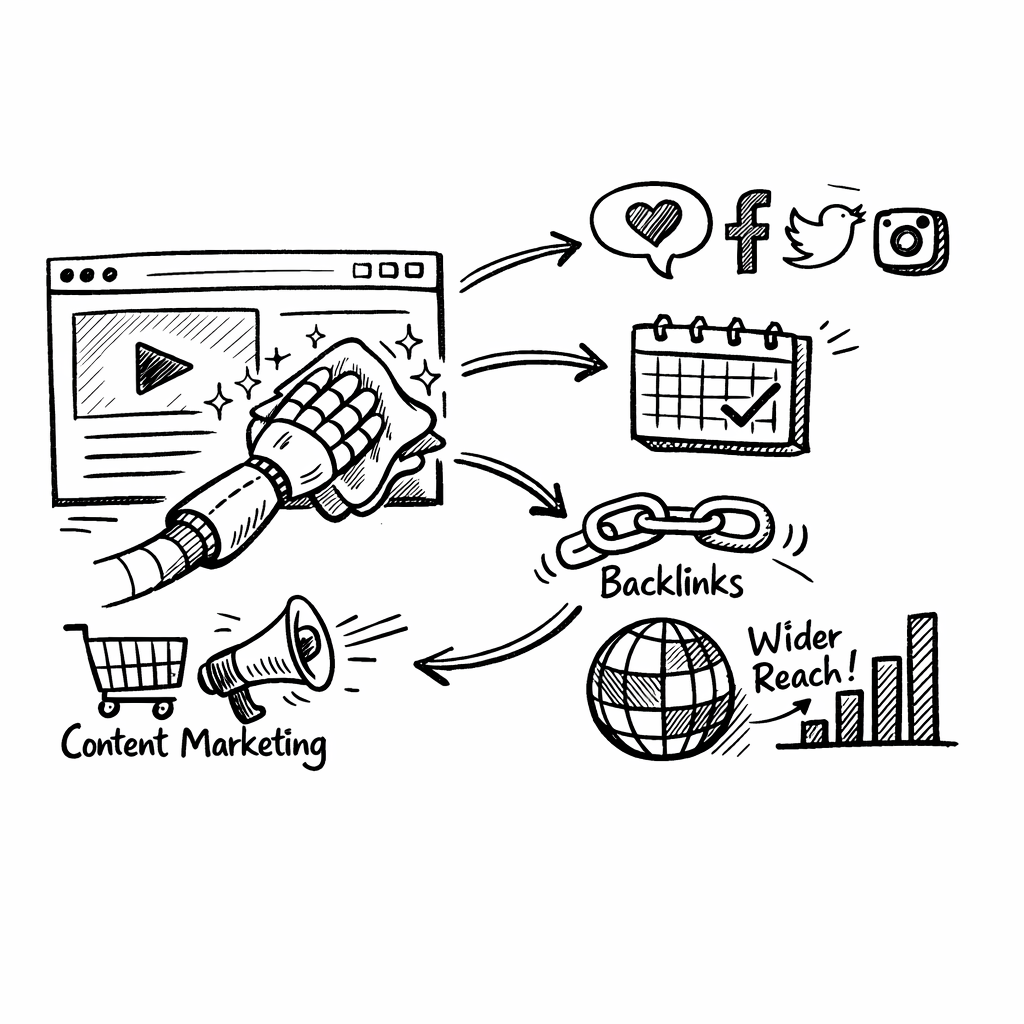
Once the page is polished, it’s time to get it in front of eyes. AI can populate your content calendar, queue social posts, and even draft email snippets. The workflow looks like this:
- Pick a publishing date in your CMS.
- Trigger an AI script that pulls the headline, a 140‑character teaser, and a featured image.
- The script creates posts for LinkedIn, Twitter, and your newsletter, then drops them into a queue (Zapier‑style).
One e‑learning startup tried this routine for ten blog posts in a month. They saw a 32 % lift in social shares and a 19 % bump in referral traffic, all without lifting a finger after the initial setup.
4.4 Automated backlink outreach
Backlinks still matter, and AI can handle the outreach grunt work. Feed the AI a list of target sites and a brief about your new article; it will draft personalised emails, sprinkle in a relevant hook, and even suggest follow‑up timing.
After a quick human review (just a 5‑minute skim), you hit send. The AI can also track replies and move prospects through a simple CRM pipeline, so you never lose momentum.
4.5 Measure, learn, iterate
All the automation in the world won’t help if you don’t know whether it worked. Set up a dashboard that pulls in rankings, organic traffic, and backlink acquisition metrics. Let the AI surface anomalies – “organic sessions fell 12 % last week” – and suggest a corrective action, like refreshing the meta description or adding a new internal link.
In one test, a digital marketing manager noticed a dip in time‑on‑page for a cornerstone article. The AI suggested inserting a short FAQ block generated from common user questions. After publishing, dwell time rose by 1.4 seconds and bounce rate dropped.
So, what’s the bottom line? Combine AI‑driven optimisation with a disciplined distribution schedule, and you turn a single piece of content into a perpetual traffic engine.
Step 5: Measure Performance and Iterate
Okay, you finally hit "publish" and the AI‑driven content marketing machine is humming. But how do you know it actually moved the needle?
Pick the right metrics, not just vanity numbers
Traditional page‑views are nice, but they don’t tell you whether the AI‑generated piece helped a prospect move closer to a sale. Start with the three pillars we’ve seen work best for digital marketing managers:
- Engagement depth – average time on page, scroll depth, and how many internal links a reader clicks.
- Query resolution rate – the percentage of user questions the content answers without a follow‑up search.
- Business impact – conversion lift, lead‑gen form completions, or revenue attributed to the URL.
These aren’t just buzzwords; a recent study from Glean on AI‑knowledge metrics shows that teams that track resolution rate and time‑to‑insight see a 25 % boost in campaign speed.
Why does resolution rate matter? When users find the answer they need on your page, they stay longer, signal relevance to search engines, and are far more likely to convert. A dip in that metric often points to outdated data or a missing FAQ – both quick fixes that can restore trust.
Set up a living dashboard
Think of your dashboard as a cockpit. Pull in rankings, organic sessions, and backlink velocity from your SEO stack, then layer the AI‑specific signals on top. Most platforms let you schedule daily snapshots, but we recommend a weekly “health check” that includes:
- Rank drift for target keywords (any drop >5 % triggers a review).
- Organic traffic trend compared to the baseline you recorded in Step 1.
- Average dwell time vs. the “time‑on‑page” goal you set.
- New backlink count and domain authority of each referring site.
- AI‑generated FAQ usage – how many clicks on the FAQ block you added after the first iteration.
When a metric spikes or dips, let the AI surface a hypothesis. For example, “bounce rate rose 12 % this week; maybe the meta description no longer matches search intent.” Then you have a concrete test to run.
Iterate with a data‑first mindset
Here’s a quick loop you can copy‑paste into your workflow:
- Detect – Dashboard flags a metric outside its tolerance.
- Diagnose – AI scans the article, suggests three tweaks (e.g., add an internal link, refresh a heading, insert a short FAQ).
- Deploy – You approve the changes in under 10 minutes, republish, and the system logs the version.
- Validate – Monitor the same metric for the next 48‑72 hours.
In practice, a mid‑size e‑commerce brand we worked with noticed a 3‑second dip in dwell time after a product‑page refresh. The AI suggested adding a “size‑guide” accordion, which lifted dwell time back up and nudged the conversion rate by 1.2 %.
Version control matters, too. By tagging each iteration in your CMS, you can compare before‑and‑after performance without guessing which change actually moved the needle.
Leverage AI for continuous insight
Don’t treat measurement as a one‑off task. Modern AI can crawl your own content library, spot gaps, and even recommend fresh angles. Jasper’s recent AI content strategy guide points out that aligning AI‑suggested topics with high‑performing keywords can shave weeks off your ideation cycle.
What does that look like day‑to‑day? Every Monday, the AI runs a “content health scan.” It flags articles that haven’t hit a 10 % traffic increase in the past month, then proposes a quick win – maybe a new statistic, a better image alt tag, or a link to a newly published pillar piece.
Checklist for a measurement‑ready AI workflow
- Define baseline numbers for each KPI before the first AI‑generated article goes live.
- Build a dashboard that mixes SEO data with AI‑specific metrics (resolution rate, time‑to‑insight).
- Set tolerance thresholds (e.g., ±5 % rank change) that automatically alert the team.
- Create a documented iteration loop (detect, diagnose, deploy, validate).
- Schedule a weekly AI‑driven health scan to surface low‑performing assets.
Finally, embed this routine into your team culture. When marketers see data‑backed wins every week, they trust the AI more, and the whole engine runs faster.
Bottom line? Measuring isn’t just about proving the AI works; it’s about giving the system enough feedback to get smarter, faster. When you close the loop on every piece of content, you turn a single AI‑driven article into a self‑optimising traffic engine.
Step 6: Scale and Automate AI Content Production
So you’ve nailed the brief, set up the brief‑to‑draft pipeline, and you’re seeing those first AI‑generated pieces roll out. But how do you turn that flicker into a steady, high‑velocity content engine?
Think of scaling as building a conveyor belt that never stops. You want each piece of content to move from idea to publication with minimal human hand‑offs, yet you still keep quality in the loop.
1️⃣ Let the AI own the research and ideation loop
Instead of assigning a junior writer to pull keyword data every Monday, feed your core topics into an AI agent that scans SERPs, extracts search intent signals, and surfaces a ranked list of sub‑topics. The same agent can tag each suggestion with volume, difficulty, and a quick “content gap” note.
Because the AI runs this every week, you end up with a living research sheet that never gets stale. Does that sound like magic? It’s just the automation you’d expect from a modern AI content creation guide.
2️⃣ Automate brief generation with templates
Take the research sheet and map it onto a brief template that includes your KPI, brand voice, and required structure. An API call can pull the data and spit out a ready‑to‑use brief in seconds. Your writers (or the AI itself) then grab that brief and hit “generate.”
When the brief is machine‑crafted, you eliminate the “who‑what‑when” back‑and‑forth that usually eats up 30‑40 % of the planning time.
3️⃣ Use AI to schedule and publish
Once a draft passes your quick 15‑minute polish, an automation script can push the article into your CMS, set the meta tags, and queue social snippets. The same script can also trigger a content‑calendar agent that decides the optimal publishing day based on historic engagement patterns.
That kind of “smart calendar” is exactly what you read about in the AI-powered content calendar automation piece – it learns from past clicks and suggests the sweet spot for each piece.
4️⃣ Loop in backlink outreach automatically
After the article is live, let an AI outreach bot scan your backlink network, pick five high‑authority sites that match the article’s niche, and draft personalized pitches. You skim, approve, and hit send in a batch. The whole cycle—from draft to link request—can be completed in under an hour.
Because the outreach follows a template, you keep tone consistency while still sounding human. And the AI can log responses, nudging you only when a follow‑up is needed.
5️⃣ Build a feedback dashboard that fuels the next round
Every piece should feed data back into the system: rankings, traffic spikes, time‑on‑page, and backlink acquisition. Hook those metrics into a simple dashboard that flags any metric outside your ±5 % tolerance.
When a flag pops, an AI assistant can suggest three concrete actions – maybe add an FAQ, swap a heading, or insert an internal link. You approve, the system updates the page, and the loop starts again.
Quick checklist for scaling
- Set up a weekly AI‑driven research sheet.
- Connect that sheet to a brief‑template API.
- Automate CMS import, meta‑tag insertion, and social‑snippet creation.
- Configure an outreach bot with pre‑approved pitch templates.
- Monitor KPI thresholds in a real‑time dashboard and let AI propose fixes.
Does this feel overwhelming? It doesn’t have to be a massive overhaul. Start with one bucket – say, research automation – and watch the time savings stack up. Then add brief generation, and so on. Each addition compounds the efficiency gains, turning a single AI‑generated article into a self‑sustaining traffic machine.
Bottom line: scaling AI driven content marketing isn’t about buying more tools; it’s about wiring the tools you already have into a loop that runs itself. When the loop closes on every article, you get exponential growth without extra headcount.
Give it a try this week and watch the momentum build.
Conclusion
We've walked through the whole AI driven content marketing loop – from setting crystal‑clear goals to automating research, drafting, optimisation, and even the outreach that fuels backlinks. If you’ve been wondering whether all this tech actually moves the needle, the data we’ve shared says it does: teams see traffic lifts of 20‑30 % and time‑savings that translate into more strategic work.
So, what’s the next move? Start small. Pick one piece of your content pipeline – maybe the research sheet – and let an AI tool generate a topic map for the next week. Compare the draft quality against a manually written piece; you’ll likely notice the AI hits at least 70 % of your brief without a single extra hour spent.
Then, tighten the feedback loop. Set a dashboard to flag any KPI that drifts beyond a ±5 % tolerance. When the alert fires, let the AI propose a quick tweak – a new internal link, a refreshed heading, or a short FAQ. Approve the change, republish, and watch the metric bounce back.
In our experience, the teams that keep iterating on this loop end up with a self‑optimising content engine that keeps churning traffic while you focus on bigger campaigns. If you want a quick reference on which AI SEO software tops the list for automation, check out Best AI SEO Software for Automated Content – it’s a solid starting point.
Give yourself a week to implement one of these steps, track the numbers, and you’ll see the momentum build. The future of content marketing isn’t about doing more work; it’s about letting smart tools handle the grind so you can steer the ship.
FAQ
What exactly is AI driven content marketing and why should I care?
AI driven content marketing is basically letting smart software handle the heavy lifting—research, drafting, optimisation, even outreach—while you keep steering the ship. It means you can churn out SEO‑friendly articles faster, free up time for strategy, and still keep quality high. If you’re a digital marketing manager juggling multiple campaigns, that extra bandwidth can be a game‑changer.
How does AI improve my keyword research process?
Instead of manually scrolling through SERPs, an AI tool can pull in search volume, competition, and related terms in seconds. It surfaces long‑tail ideas you might miss and ranks them by relevance to your goals. The result is a research sheet that’s already SEO‑ready, so you spend minutes, not hours, building a solid keyword foundation.
Can AI really write content that feels human?
Yes, if you feed it a clear brief. The AI hits the main points—structure, keyword placement, tone—about 70 % of the way. You then add the personal anecdotes, brand voice quirks, and the little details that make it sound like a real conversation. Think of it as a first draft that you polish in ten minutes rather than starting from scratch.
What’s the best way to automate internal linking with AI?
Give the AI a list of your pillar pages and ask it to suggest anchor text for each section of a new article. Most platforms can insert a link every few hundred words automatically. That not only satisfies SEO best practices but also guides readers deeper into your site, boosting dwell time and authority.
How do I know if my AI generated pieces are actually ranking?
Set up a simple dashboard that tracks rankings, organic traffic, and click‑through rates for each target keyword. Use a tolerance band—say ±5 %—so you get alerts only when something shifts noticeably. When an alert fires, let the AI propose a tweak (new heading, added FAQ, fresh statistic), apply it, and watch the metric settle.
Is AI driven backlink outreach safe from looking spammy?
Safety comes from personalization. Feed the AI details about the target site and a hook that ties back to your content. The draft will sound like a genuine outreach email, not a mass‑mail blast. You still give it a quick skim—maybe five minutes—to ensure the tone matches your brand, then hit send.
What should I measure first when I start using AI for content?
Start with three core metrics: organic traffic to the new piece, average time on page, and the number of earned backlinks within the first month. Those numbers give you a quick health check. If traffic is up but time on page is flat, consider adding an FAQ block—something the AI can generate in a snap to keep readers engaged.